
Why join a mastermind group to grow your business
TL;DR:
- Mastermind groups provide accountability, strategic clarity, and diverse input for faster business growth.
- Participants experience higher decision speed, goal achievement, emotional resilience, and reduced isolation.
- Engaged entrepreneurs committed to sharing and feedback benefit most from the collective intelligence.
Entrepreneurship carries a stubborn mythology: the visionary founder, alone in a garage, willing success into existence through sheer determination. That image is compelling, but it is also largely fiction. The reality is that groups provide external structure and faster, better strategic decisions than isolated founders working on their own. Mastermind groups sit at the intersection of accountability, community, and practical strategy, offering early-stage entrepreneurs a structured environment where real momentum is built. This guide breaks down what mastermind groups are, why they work, and how you can use one to accelerate your own entrepreneurial journey with confidence and clarity.
Table of Contents
- What is an entrepreneurial mastermind group?
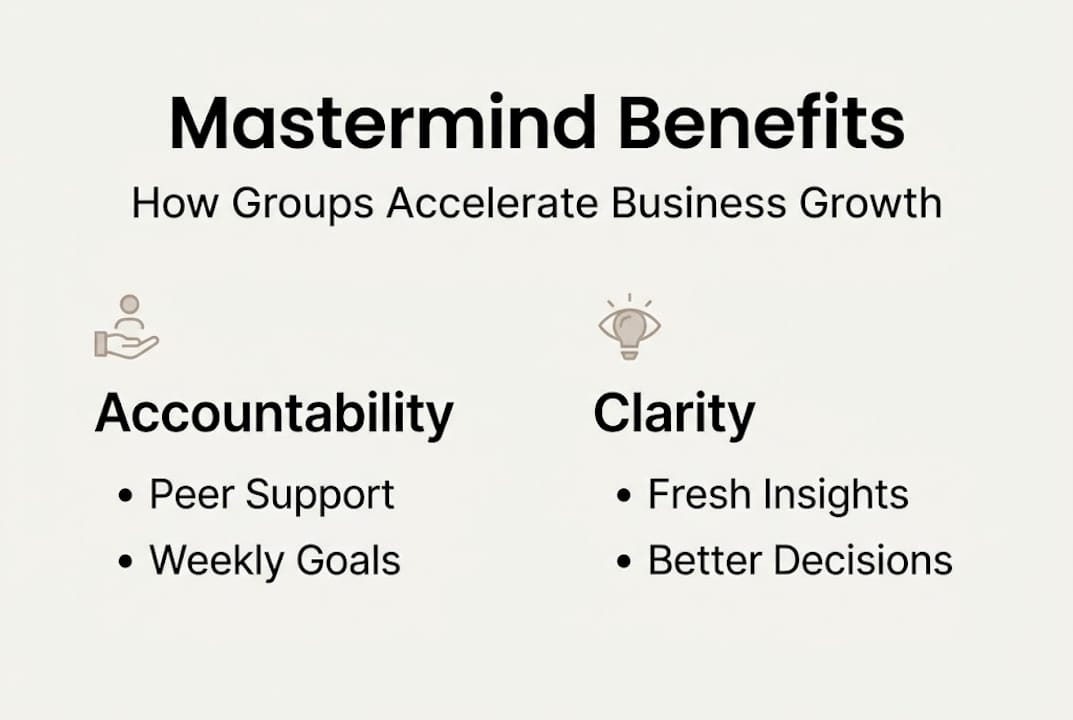
- Core benefits: Accountability, clarity, and better decisions
- Mastermind vs solo entrepreneurship: What the evidence shows
- Who thrives in mastermind groups (and how to get the most out of one)
- Our take: Why mastermind groups are a growth multiplier
- Ready to level up? Find your mastermind or guided community
- Frequently asked questions
Key Takeaways
| Point | Details |
|---|---|
| Structured accountability | Mastermind groups help you stay on track and follow through with business goals more effectively. |
| Better decisions | Regular feedback from peers leads to smarter and faster strategic choices for your business. |
| Faster business growth | Entrepreneurs in masterminds reach profitability sooner than those who go it alone. |
| Supportive community | Joining a mastermind connects you with founders who understand your journey and challenges. |
What is an entrepreneurial mastermind group?
A mastermind group is a peer-to-peer support and accountability structure where a small group of entrepreneurs meet regularly to share challenges, exchange ideas, and hold each other to their commitments. The concept dates back to Napoleon Hill’s 1937 book Think and Grow Rich, where he described the “master mind” as a coordination of knowledge and effort between two or more people working toward a definite purpose. Nearly a century later, the format has evolved, but the core principle remains unchanged: collective intelligence outperforms individual thinking almost every time.
At its core, a mastermind group typically consists of four to ten members who share a similar stage of business development or ambition level. Smaller groups tend to create deeper trust and faster dialogue, while slightly larger groups bring more diverse perspectives to the table. Understanding how mastermind groups work in practice helps founders set realistic expectations before they join one.
Here is what a well-structured mastermind typically includes:
- Regular meetings: Weekly or biweekly sessions, either in person or virtual, lasting 60 to 120 minutes
- Hot seat format: One member presents a current challenge and receives focused, structured feedback from the group
- Goal setting and check-ins: Members declare commitments at the end of each session and report back on progress at the next
- Shared norms: Confidentiality agreements, participation standards, and agreed communication styles that build trust over time
- Facilitator or rotating chair: Someone who keeps meetings on track and ensures every member gets equal floor time
What separates a mastermind from a standard networking group is the depth of engagement. Networking events encourage broad, surface-level connection. A mastermind goes deeper, building over weeks and months into genuine mutual investment in each other’s success. Unlike a mentorship program, where one experienced person guides someone less experienced, mastermind groups operate on horizontal trust. Every member is both teacher and student simultaneously.
The table below illustrates how masterminds compare with other common support formats:
| Format | Structure | Direction | Depth | Commitment level |
|---|---|---|---|---|
| Mastermind group | High | Peer-to-peer | Deep | High |
| Networking event | Low | Broad | Surface | Low |
| Mentorship program | Medium | Top-down | Medium | Medium |
| Online community | Variable | Many-to-many | Variable | Low to medium |
Research confirms that external accountability improves execution enough that entrepreneurs who use it reach profitability more often within two years compared to those who rely solely on internal motivation. This is not a minor statistical footnote. It is a meaningful signal that the structure a mastermind provides can directly influence how quickly your business becomes financially sustainable.
Core benefits: Accountability, clarity, and better decisions
Once you understand the format, the benefits of mastermind participation become both logical and deeply practical. The three most consistent outcomes reported by mastermind members are stronger accountability, greater strategic clarity, and faster, more confident decision-making. Each of these operates differently, but together they create a growth environment that is very hard to replicate alone.
Accountability works in layers. A regular cadence of daily intentions, weekly check-ins, monthly reviews, and quarterly goal assessments creates a rhythm that keeps you moving even when motivation dips. Accountability is not about guilt or pressure. It is about declaring what matters to you in front of people who care enough to ask about it the next time they see you. That social investment changes behavior in ways that personal discipline alone rarely can.
“The biggest shift for me was realizing that my peers were genuinely invested in my success. Knowing they would ask me about my progress next week made me do the work this week.” This kind of mutual investment is what separates mastermind accountability from simply writing goals in a journal.
Clarity comes from being challenged. One of the most underrated benefits of a mastermind is the way it forces you to articulate your thinking out loud. When you explain your business model or your marketing strategy to a room of sharp, engaged peers, gaps appear that were invisible when the ideas existed only in your own head. This process, sometimes called the “rubber duck effect” in problem-solving circles, is dramatically amplified when the rubber duck pushes back with thoughtful questions.
Decision quality improves with diverse input. Groups provide external structure and faster, better strategic decisions, particularly because peer groups bring varied experiences and backgrounds to every problem. When you are deciding whether to raise prices, pivot your offer, or hire your first team member, having five other founders weigh in from their own hard-won experience is genuinely invaluable.

The table below compares key outcomes between mastermind members and solo founders:
| Outcome area | Solo founder | Mastermind member |
|---|---|---|
| Decision speed | Slower, more hesitant | Faster with peer input |
| Accountability | Self-driven only | External reinforcement |
| Emotional resilience | Often isolated | Supported by community |
| Strategic blind spots | Frequent | Regularly surfaced |
| Goal follow-through | Inconsistent | Measurably higher |
Beyond the tactical benefits, the importance of community for founders cannot be overstated. Entrepreneurship carries a real emotional weight. The fear of failure, imposter syndrome, and the loneliness of making consequential decisions without colleagues are real challenges. A mastermind creates a container where those feelings can be named, normalized, and worked through together, which is something no productivity app or business book can fully replicate.
Pro Tip: Track your three most important weekly commitments in a shared document visible to your mastermind group. Public visibility is one of the most powerful behavioral motivators available to you, and it costs nothing to implement. Pair this with peer collaboration habits and you will see measurable progress within your first month.
Mastermind vs solo entrepreneurship: What the evidence shows
The case for mastermind participation becomes even more compelling when you compare it directly to the solo founder experience. Most early-stage entrepreneurs start out working alone, and for good reason. You are building something personal, you move fast without consensus, and you have full creative control. But those advantages carry hidden costs that compound over time and quietly slow your growth.
Here are the most common pitfalls that solo founders face, in order of how frequently they derail early-stage businesses:
- Decision fatigue: When every choice falls on one person, the sheer volume of daily decisions drains cognitive energy. Research in behavioral economics consistently shows that decision quality deteriorates as the number of decisions increases throughout a day.
- Procrastination on high-stakes tasks: Without external accountability, founders tend to defer the uncomfortable work, the sales conversations, the pricing decisions, the difficult hires, in favor of tasks that feel productive but carry less risk.
- Tunnel vision: Solo founders often become deeply attached to their original idea, making it harder to recognize when a pivot is necessary. A peer group provides the honest, outside perspective needed to surface this problem early.
- Emotional isolation: The highs and lows of building a business are extreme. Without people who understand that specific experience, the lows can feel disproportionately heavy and the wins feel hollow without someone to share them with.
- Skill gaps that go unaddressed: Alone, you may not even know what you do not know. A mastermind group surfaces skill gaps you would never have identified on your own.
The contrast with mastermind participation is significant. Mastermind participants reach profitability more often within two years because improved execution compounds quickly. Small, consistent wins driven by accountability add up to business outcomes that simply do not materialize at the same rate for founders working in isolation.
Statistic worth noting: Entrepreneurs with structured accountability and peer support systems are statistically more likely to still be operating and profitable at the two-year mark, a period during which a significant proportion of new businesses typically struggle or close.
The path to building business community as an entrepreneur is not just a nice-to-have social activity. It is a strategic growth decision with measurable outcomes. And the data on community support for growth consistently points in one direction: founders who invest in peer networks outperform those who do not.
Who thrives in mastermind groups (and how to get the most out of one)
Not every entrepreneur is automatically a great fit for a mastermind group, and not every mastermind group is automatically a great fit for every entrepreneur. Understanding who benefits most, and what habits maximize results, is essential before you commit time and energy to joining one.
Entrepreneurs who thrive in masterminds tend to share these characteristics:
- They are self-aware enough to recognize their own blind spots and genuinely open to feedback
- They bring a growth mindset that treats setbacks as data rather than verdicts
- They are at a stage where they have something concrete to work on, whether that is an idea being validated, a product being launched, or a business being scaled
- They are willing to show up consistently, not just when they feel inspired
- They are as invested in the success of their peers as they are in their own progress
- They can balance vulnerability with professionalism, sharing real challenges without derailing the group’s focus
Founders who approach masterminds primarily as networking opportunities, or who are not ready to be honest about their struggles, tend to get less from the experience. The value is proportional to what you bring into the room.
Practical steps to prepare before joining a mastermind:
- Define your top three business goals for the next 90 days so you arrive with clear priorities
- Identify your two or three biggest current obstacles, being specific rather than vague
- Decide on a communication style and time commitment level that you can realistically sustain
- Research the group’s existing members, format, and norms before committing
- Choose groups where members are at a comparable stage, since the most useful feedback comes from people who understand your specific context
A regular accountability cadence, structured around daily intentions, weekly check-ins, monthly reviews, and longer-term planning cycles, leads to consistent progress and measurable growth over time. Building those rhythms into your mastermind participation is the single most reliable way to convert group energy into business outcomes.
Pro Tip: Before each mastermind meeting, write down the one thing you most want the group’s input on. Showing up with a specific, well-framed challenge gets you far more useful feedback than arriving with a vague sense that something isn’t working. You can learn more about how to structure this effectively by exploring how to create a mastermind group and reviewing startup community examples from founders who have done it well.
Our take: Why mastermind groups are a growth multiplier
Many founders believe that finding a great mentor is the fastest path to growth. Mentorship is genuinely valuable, and we would never argue otherwise. But there is something a mastermind group offers that even the most experienced individual mentor cannot replicate: the compounded effect of diverse peer intelligence applied consistently over time.
A mentor has one perspective, shaped by their own path. A mastermind group of five or eight founders brings five or eight different industries, failure histories, and strategic instincts to your problem. The breadth of that input, applied to your specific challenge in real time, creates insights that no single advisor can generate alone.
What surprises most new mastermind members is how much vulnerability accelerates their growth. When someone is willing to admit they have no idea how to handle a difficult client or that their revenue has stalled for three months, the group responds with focused, practical support instead of judgment. That honesty breaks the isolation that slows so many founders down and creates the conditions for genuine breakthroughs.
We have seen this pattern play out repeatedly: founders who join masterminds with openness and consistency make faster, bolder decisions and experience the kind of mastermind group transformation that reshapes not just their business but their entire approach to building one. The group effect is not a soft benefit. It is a structural growth advantage that compounds with every session.
Ready to level up? Find your mastermind or guided community
If the evidence in this guide resonates with you, the next step is finding the right structured environment to apply it. Nomad Excel’s entrepreneurship bootcamp brings together early-stage founders in immersive, hands-on programs designed to deliver exactly the clarity, accountability, and community that mastermind research points to. If you are weighing your options, exploring the reasons for joining entrepreneurship bootcamps can help you decide whether an intensive program fits your current stage. You can also start by building business community intentionally, using the frameworks in this guide as your foundation. Growth accelerates when you stop going it alone.
Frequently asked questions
What makes mastermind groups effective for entrepreneurs?
Mastermind groups create faster, better strategic decisions by combining peer accountability with diverse input, helping entrepreneurs execute more consistently and reach profitability faster than those working in isolation.
How often should a mastermind group meet?
A practical accountability cadence includes daily intentions, weekly check-ins, monthly reviews, and quarterly planning sessions, with the exact format adjusted to suit the group’s commitments and goals.
Who should join an entrepreneurial mastermind group?
Aspiring and early-stage entrepreneurs who are open to feedback, committed to consistent participation, and focused on measurable growth will benefit most, since external accountability improves execution and profitability odds within two years.
What is the difference between a mastermind group and a mentorship program?
A mastermind group is peer-driven, with every member contributing equally as both advisor and learner, while a mentorship program typically involves a more experienced individual providing guidance to someone at an earlier stage of their journey.
Can joining a mastermind really help me grow my business?
Yes. Research shows that mastermind participants reach profitability more often within two years and experience faster overall business growth compared to founders who rely entirely on their own judgment and motivation.
Comments are closed.