
Entrepreneurial resilience explained: Build strength for growth
TL;DR:
- Entrepreneurial resilience is a learnable, multidimensional process involving psychological, organizational, and financial aspects.
- Building resilience requires deliberate practice, strong networks, and strategic habits, not innate traits.
- Strengthening resilience leads to better business outcomes, faster recovery, and sustained growth during adversity.
Most founders assume resilience is something you either have or you don’t. You’re either the type who bounces back from failure with a smile, or you struggle in silence and wonder if entrepreneurship is really for you. That framing is not only wrong, it’s actually harmful. Entrepreneurial resilience is a learnable, multidimensional process that any founder can build, regardless of their starting point. In this article, you’ll learn exactly what research defines as entrepreneurial resilience, how it breaks down into three practical domains, what the evidence says about its impact on success, and the concrete steps you can take to strengthen it starting today.
Table of Contents
- Defining entrepreneurial resilience: More than bouncing back
- The three domains of resilience: Psychological, organizational, and financial
- Why resilience matters: Success factors, evidence, and edge cases
- Building entrepreneurial resilience: Actionable strategies and resources
- A fresh take: Why resilience is less about traits and more about habits and networks
- Take the next step: Resources and programs to build your resilience
- Frequently asked questions
Key Takeaways
| Point | Details |
|---|---|
| Resilience is multidimensional | Entrepreneurial resilience combines psychological, organizational, and financial adaptability. |
| Process over traits | Resilience is developed through actions, habits, and support—not innate personality. |
| Community matters | Engaging with supportive networks and communities accelerates resilience and business growth. |
| Practical actions work | Applying step-by-step strategies and benchmarking progress fosters real resilience. |
Defining entrepreneurial resilience: More than bouncing back
Most people think of resilience as toughness, the ability to endure hardship without showing cracks. In everyday conversation, it’s often used interchangeably with grit or persistence. But entrepreneurial resilience is something far more specific and, frankly, more interesting than those simple definitions suggest.
Research from the Journal of Entrepreneurship defines it clearly: entrepreneurial resilience is “the process entrepreneurs use to develop and deploy capabilities to adapt and respond to adversity in their ventures, extending beyond individual psychological recovery to include strategic, emotional, and behavioral responses ensuring business survival and growth.”
Notice the word process. Resilience isn’t a fixed personality trait you’re born with. It’s something that develops over time through deliberate action and learning. That distinction matters enormously because it means you can actually build it, strengthen it, and apply it intentionally to your business.
What separates entrepreneurial resilience from general resilience is its scope. Founders don’t just face personal setbacks. They navigate challenges that simultaneously affect their finances, their team, their market position, and their own mental state. That’s why entrepreneurship education increasingly focuses on resilience as a core competency, not an optional personality bonus.
The kinds of adversity entrepreneurs regularly face include:
- Cash flow shortfalls that threaten payroll or operations
- Market pivots forced by competition or economic shifts
- Team breakdowns, co-founder conflicts, or talent losses
- Customer churn or unexpected product-market fit failures
- Regulatory changes, supply chain disruptions, or public crises
- Personal burnout overlapping with business pressure
Each of these challenges hits differently. A cash crisis demands a financial response. A team conflict calls for emotional intelligence. A sudden market shift requires strategic agility. No single trait covers all of that. That’s precisely why researchers have identified three distinct but deeply connected domains that together form the full picture of entrepreneurial resilience.
“Entrepreneurial resilience is a process, not a personality type. It’s developed through deliberate practice, strategic decisions, and the right support structures.”
The three domains of resilience: Psychological, organizational, and financial
Once you accept that resilience is a process rather than a fixed trait, the next question is: what does that process actually look like in practice? Researchers have identified three domains that together form a recursive, multidimensional model, meaning each domain strengthens and reinforces the others.
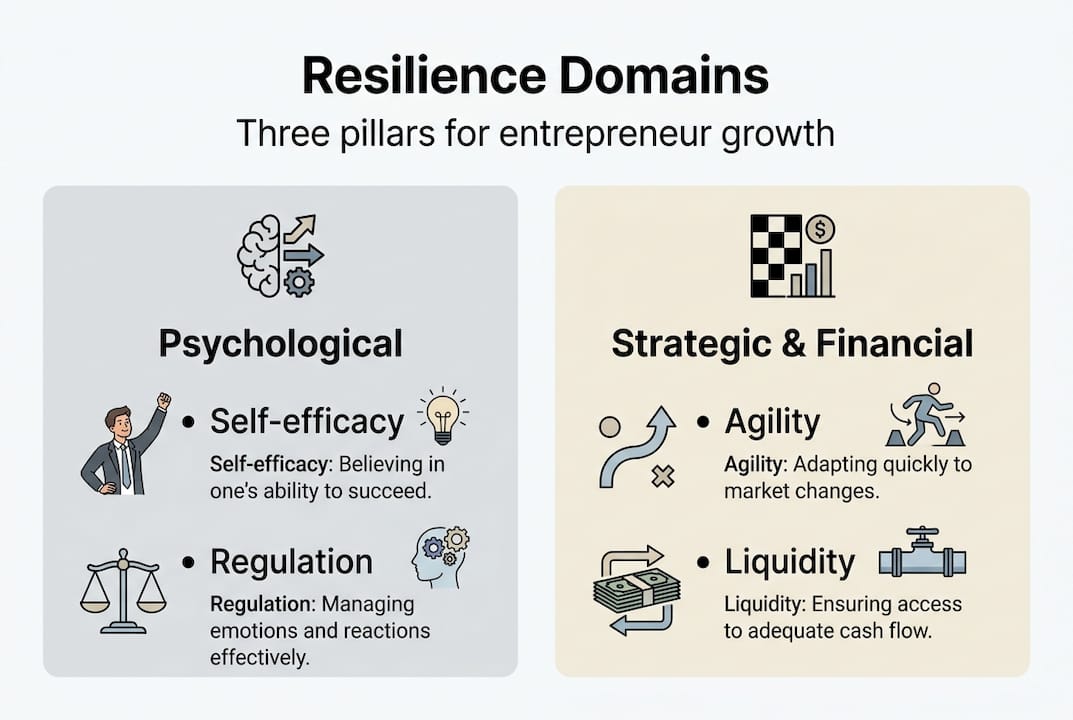
Here’s how each one breaks down:
Psychological resilience covers the inner game. This includes self-efficacy (your belief in your ability to execute), emotional regulation (managing stress and anxiety without shutting down), and cognitive grounding (staying clear-headed under pressure). Founders with strong psychological resilience don’t avoid fear, they act despite it.
Organizational and strategic resilience is about how your business adapts. This includes agile decision-making, willingness to experiment with your business model, and the ability to pivot quickly when data or market signals demand it. It’s the difference between a team that freezes in a crisis and one that reconfigures fast.

Financial and resource resilience focuses on the practical infrastructure of survival. Cash flow tactics, liquidity management, and resource reconfiguration are the core tools here. A founder with strong financial resilience isn’t just cutting costs when things get hard. They’re actively repositioning assets and managing runway with strategic intent.
| Domain | Core skills | Example behaviors |
|---|---|---|
| Psychological | Self-efficacy, emotional regulation | Maintaining focus during setbacks, reframing failures |
| Organizational | Agile decision-making, model adaptation | Rapid pivots, iterative product testing |
| Financial | Cash flow management, liquidity tactics | Building reserves, renegotiating terms, asset reconfiguration |
What makes this model powerful is the recursive quality. Building self-efficacy (psychological) gives you the confidence to experiment (organizational), which produces better financial outcomes (financial), which in turn reinforces your belief in your capabilities (back to psychological). The cycle compounds.
Pro Tip: Start with self-efficacy. Before tackling business model pivots or financial restructuring, invest time in small, winnable challenges that prove to yourself you can execute under pressure. Confidence is infrastructure, not decoration. You can accelerate this process significantly through practical bootcamp skills that put you in real-world problem-solving situations from day one.
Why resilience matters: Success factors, evidence, and edge cases
Building resilience sounds good in theory. But does it actually predict better outcomes in the real world? The evidence says yes, clearly and consistently.
Empirical research across multiple studies shows that entrepreneurial resilience positively correlates with perceived success in a sample of 117 entrepreneurs using OLS regression analysis. In a separate study of 300 UK small and medium enterprises, self-efficacy was confirmed as the key mediator between digitalization capabilities and resilience outcomes. Among 141 Italian startups, emotional stability and conscientiousness predicted resilience, with prior experience acting as a significant moderating factor.
Here’s what that means practically: resilience doesn’t just help you survive hard times. It actively drives growth. The community support benefits that come from being embedded in entrepreneurial networks also play a measurable role in this equation.
Resilience also has macro-level effects. Research shows that regions with higher concentrations of young and small firms experience smaller employment losses during weather-related disruptions and economic shocks, because resilient founders adapt quickly and keep people employed.
Not every entrepreneur benefits equally, though. Several edge cases and moderating factors are worth knowing:
- Digital disruption contexts tend to amplify the role of self-efficacy and passion in determining whether resilience translates to performance
- Prior experience significantly moderates how quickly founders can activate organizational and psychological resilience under pressure
- Gender-based structural barriers mean that trait-focused resilience models can miss real disadvantages faced by women entrepreneurs
- Crisis conditions like COVID-19 exposed that mere recovery isn’t enough. What’s needed is anti-fragility, the ability to grow stronger through disruption, not just return to baseline
Peer collaboration also matters more than most founders realize. Research on peer collaboration consistently shows that founders embedded in strong peer networks adapt faster, problem-solve more effectively, and sustain momentum through longer periods of adversity.
Building entrepreneurial resilience: Actionable strategies and resources
Knowing what resilience is and why it matters is only half the work. The other half is building it. Here’s a practical sequence that addresses all three domains and aligns with what current research recommends for aspiring and early-stage founders.
- Build self-efficacy through small wins. Set short-term, achievable goals that push you slightly outside your comfort zone. Each success, even a minor one, rewires your belief in your ability to execute under pressure.
- Develop your support network deliberately. Don’t wait until you’re in crisis to reach out. Build relationships with other founders, mentors, and operators now, when you can offer value and learn without desperation coloring every conversation.
- Practice agile business model thinking. Run small experiments in your business regularly. Test a new pricing model, try a new channel, interview a different customer segment. Normalize pivoting before you’re forced to.
- Build financial buffers before you need them. Aim for a liquidity cushion that covers at least three months of fixed costs. Proactively renegotiate supplier terms, review subscriptions, and keep a real-time view of your runway.
- Join an entrepreneurial community with accountability structures. The community support you get from peers who are solving similar problems is one of the most underrated levers for resilience. It provides feedback, perspective, and motivation when your own reserves run low.
- Benchmark your resilience and track progress. Use the empirical correlation between resilience and perceived success as a framework. Regularly assess how you respond to setbacks. Are decisions getting faster? Is your emotional recovery time shortening? Are your financial systems getting more robust?
Pro Tip: Take one small experimental risk each week that you wouldn’t normally take. Reach out to a potential partner, test a price increase with a segment, or prototype a feature without full build-out. Small experiments build adaptive capacity faster than big dramatic pivots. You can find structured approaches to this through networking examples that experienced founders actually use.
A fresh take: Why resilience is less about traits and more about habits and networks
Here’s what most resilience content gets wrong: it treats resilience as a solo achievement. The narrative goes something like this: a tough founder endures hardship through sheer willpower, emerges stronger, and earns their success. That story is compelling. It’s also mostly fiction.
Research increasingly supports a process-based view where resilience is developed dynamically across multiple levels, not just within the individual. Trait-based models have real limitations, particularly for women entrepreneurs, where structural inequalities like funding gaps, mentorship access disparities, and visibility barriers mean that individual toughness alone cannot compensate for systemic disadvantage.
The most overlooked lever in building resilience isn’t mindset. It’s community. The founders who adapt fastest and recover most effectively are almost always embedded in strong networks where they can share information, access resources, and find emotional support without judgment. Resilience isn’t built in isolation. It’s cultivated through ongoing practice, strategic relationships, and access to the right structures at the right moments. The shift from trait to habit, and from solo to network, is where real, lasting resilience actually lives.
Take the next step: Resources and programs to build your resilience
Resilience is a skill, and like any skill, it develops fastest when you practice it in the right environment with the right people around you. Nomad Excel’s entrepreneurship bootcamp is built specifically to address all three resilience domains: psychological, organizational, and financial. You’ll work alongside driven founders, get direct access to experienced mentors, and leave with systems and habits that hold up under real-world pressure. If you want structured, expert guidance on accelerating your growth, the mentorship program is a powerful complement. Discover more about joining a bootcamp and what it means for your business trajectory.
Frequently asked questions
Can anyone develop entrepreneurial resilience, or is it innate?
Entrepreneurial resilience is a learnable process involving habits, strategies, and community support. Research confirms that it can be developed dynamically over time, rather than being a fixed personality trait you’re either born with or without.
How do I measure whether I’m becoming more resilient as an entrepreneur?
Track how your response to setbacks changes over time, specifically your decision speed, emotional recovery time, and financial problem-solving effectiveness. Empirical evidence shows entrepreneurial resilience directly correlates with perceived business success, making your own growth trajectory a meaningful benchmark.
What are the best actions to start building resilience today?
Start by joining an entrepreneurial community and practicing small, deliberate pivots in your business. Building psychological resilience through self-efficacy and strong peer networks is the highest-leverage starting point for early-stage founders.
Are there specific challenges women entrepreneurs face in building resilience?
Yes. Trait-based resilience models often overlook structural barriers like unequal access to funding and mentorship. Research critiques highlight the need for community-oriented, process-based frameworks that account for systemic inequalities, not just individual mindset differences.
Comments are closed.