
How to Start a Bootcamp for Entrepreneurial Success
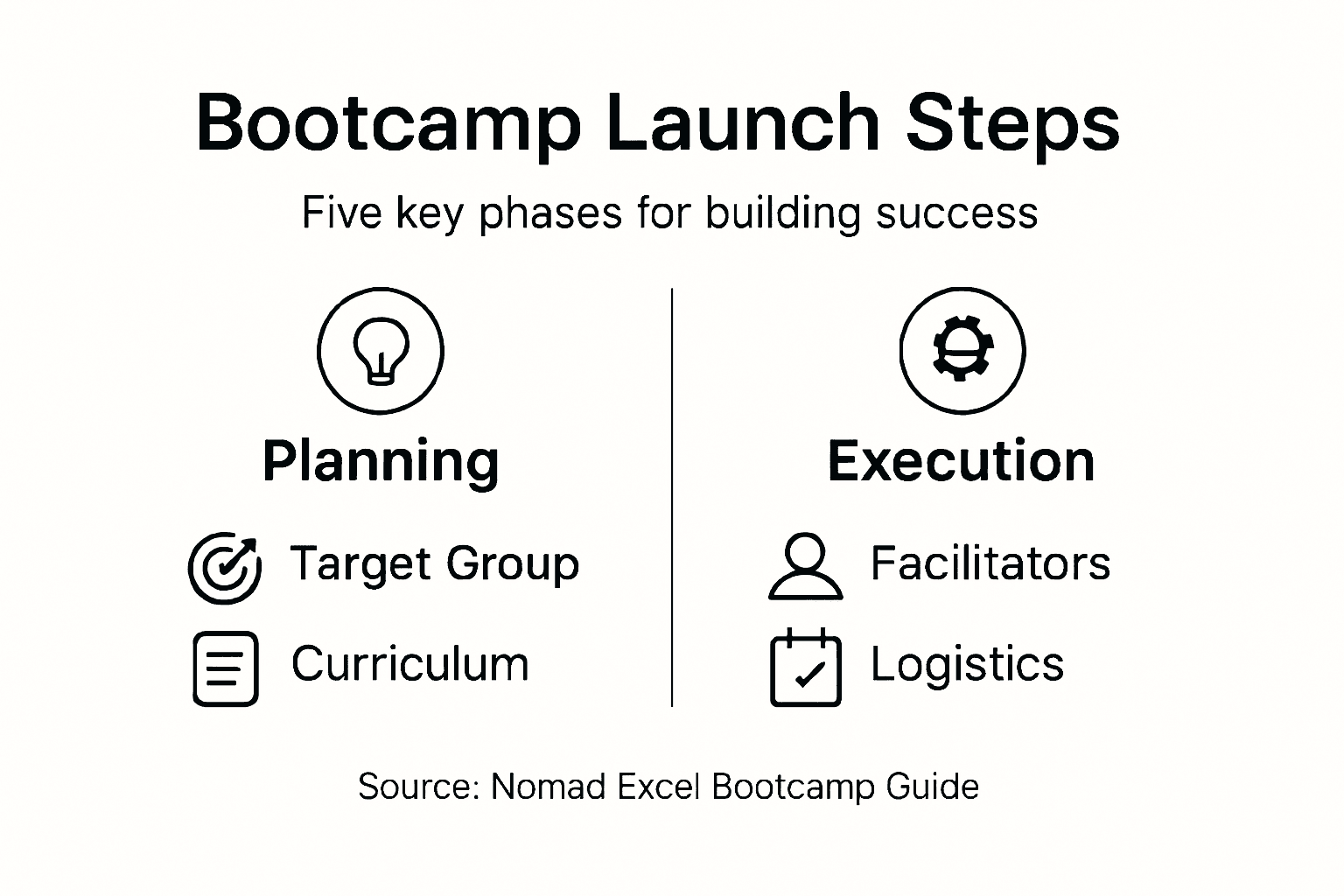
Launching a startup can feel overwhelming when every founder’s journey looks a little different. Tailoring your bootcamp to the unique learning goals and backgrounds of each entrepreneur is proven to deliver significantly better outcomes compared to generic training programs. This guide breaks down the steps for defining clear participant profiles, building immersive curricula, recruiting expert facilitators, and optimizing logistics, all designed to help you create a high-impact bootcamp that supports real entrepreneurial success.
Table of Contents
- Step 1: Define Your Target Bootcamp Model And Participant Profile
- Step 2: Design Immersive Curriculum And Mentorship Frameworks
- Step 3: Secure Expert Facilitators And Build A Collaborative Community
- Step 4: Organize Logistics, Location, And Program Structure
- Step 5: Verify Impact And Optimize For Ongoing Bootcamp Growth
Quick Summary
| Key Point | Explanation |
|---|---|
| 1. Define Participant Profile | Tailor your bootcamp to specific startup stages, experience levels, and industry focuses to enhance participant success. |
| 2. Design Immersive Curriculum | Create a curriculum that combines theoretical knowledge with practical skills, including core modules and mentorship frameworks. |
| 3. Recruit Expert Facilitators | Select facilitators with entrepreneurial experience and strong community-building skills to inspire and connect participants. |
| 4. Organize Effective Logistics | Ensure the location and program structure promote engagement and collaboration, fostering an immersive entrepreneurial environment. |
| 5. Measure and Optimize Impact | Continuously track participant performance and satisfaction to refine your bootcamp and improve long-term outcomes. |
Step 1: Define your target bootcamp model and participant profile
Defining your target bootcamp model requires strategic profiling of potential entrepreneurs and understanding the specific learning needs of your target audience. Entrepreneurial competencies research demonstrates that a tailored approach yields significantly better outcomes compared to generic training programs.
To design an effective bootcamp, you’ll want to develop a clear participant profile by considering several key dimensions:
Startup Stage: Identify whether you’ll target:
- Pre-launch founders with initial business concepts
- Early-stage entrepreneurs with minimal revenue
- Growth-stage founders seeking scaling strategies
Experience Level: Determine the entrepreneurial maturity of your participants
- First-time founders needing comprehensive guidance
- Serial entrepreneurs seeking advanced strategic insights
- Mid-career professionals transitioning into entrepreneurship
Industry Focus: Consider specializing in specific sectors like:
- Technology and software startups
- Social impact ventures
- E-commerce and digital businesses
- Service-based entrepreneurial models
A well-defined participant profile enables more targeted, high-impact training experiences that dramatically increase participant success rates.
The most successful bootcamp models combine rigorous skill development with personalized mentorship and community networking opportunities. Your participant profile should reflect not just demographic characteristics, but also the motivational drivers and learning preferences of your target entrepreneurs.
Here’s a summary of participant profiles and how they influence bootcamp training outcomes:
| Participant Profile Type | Key Characteristics | Bootcamp Impact |
|---|---|---|
| First-Time Founder | Limited business experience | Requires foundational guidance |
| Serial Entrepreneur | Multiple ventures launched | Benefits from advanced insights |
| Mid-Career Professional | Industry expertise, new to startups | Needs transition support |
| Growth-Stage Founder | Scaling an existing business | Seeks scaling strategies |
Pro tip: Conduct preliminary market research by surveying potential participants to validate and refine your bootcamp model and participant profile before full program development.
Step 2: Design immersive curriculum and mentorship frameworks
Creating an effective entrepreneurship bootcamp requires thoughtfully designing a curriculum that combines theoretical knowledge with practical skill development. Entrepreneurship bootcamp design emphasizes developing a growth mindset through hands-on learning experiences that prepare entrepreneurs for real-world challenges.
Your curriculum should incorporate multiple strategic learning components:
Core Skill Modules:
- Business ideation and concept validation
- Product prototyping and development
- Marketing and customer acquisition strategies
- Financial planning and fundraising techniques
- Pitch development and investor communication
Mentorship Framework Components:
- One-on-one expert guidance sessions
- Peer learning and collaboration opportunities
- Industry-specific workshop intensives
- Real-world project implementation
- Ongoing feedback and performance tracking
An immersive curriculum transforms theoretical knowledge into actionable entrepreneurial capabilities through structured, experiential learning approaches.
Successful bootcamp design requires balancing structured learning with flexibility. Your mentorship framework should provide personalized support that adapts to individual participant needs while maintaining consistent high-quality educational standards. This approach ensures participants receive targeted guidance that accelerates their entrepreneurial growth and increases their likelihood of success.

Pro tip: Develop a modular curriculum design that allows customization based on participant skill levels and industry backgrounds, enabling more personalized and impactful learning experiences.
Step 3: Secure expert facilitators and build a collaborative community
Entrepreneurial bootcamp success fundamentally depends on recruiting exceptional facilitators who can transform theoretical knowledge into practical business insights. Building a robust community requires strategic selection of mentors who bring deep entrepreneurial experience and the ability to foster meaningful connections among participants.
When recruiting expert facilitators, focus on key selection criteria:
Professional Qualifications:
- Proven track record of entrepreneurial success
- Demonstrated expertise in specific business domains
- Strong communication and mentorship skills
- Extensive professional network
- Prior experience in educational or training environments
Community Building Capabilities:
- Ability to create inclusive learning environments
- Skills in facilitating peer-to-peer interactions
- Experience in networking and relationship development
- Commitment to participant growth and development
- Emotional intelligence and empathy
A powerful facilitator does more than teach—they inspire, connect, and transform entrepreneurial potential into tangible success.
Successful community development requires intentional design. Your facilitators should not only deliver content but also create opportunities for participants to interact, share experiences, and build lasting professional relationships. This approach transforms a traditional learning environment into a dynamic ecosystem of mutual support and collaborative growth.
Pro tip: Create a structured onboarding process for facilitators that clearly communicates your bootcamp’s mission, values, and expected community-building outcomes.
Step 4: Organize logistics, location, and program structure
Comprehensive bootcamp methodology demands meticulous planning to create an environment that maximizes participant learning and engagement. Successful bootcamp organization requires strategic consideration of multiple logistical elements that collectively create an immersive entrepreneurial experience.
Key logistical considerations include:
Location Requirements:
- Accessible urban or innovation hub setting
- Adequate meeting and workshop spaces
- Strong internet connectivity
- Proximity to relevant business ecosystems
- Comfortable accommodation options
Program Structural Elements:
- Clear daily/weekly schedules
- Balanced mix of instruction and hands-on activities
- Dedicated time for mentorship and networking
- Flexible learning modules
- Integration of collaborative project time
Effective bootcamp design transforms physical space and structured time into powerful learning opportunities that catalyze entrepreneurial growth.
Successful program design requires thinking beyond basic scheduling. You must create a dynamic environment that allows for spontaneous interactions, unexpected learning moments, and genuine community building. This means designing spaces and schedules that feel both structured and organic, giving participants the freedom to explore ideas while maintaining clear learning objectives.
Pro tip: Create contingency plans for potential logistical challenges and build flexibility into your program structure to accommodate unexpected changes or participant needs.
Step 5: Verify impact and optimize for ongoing bootcamp growth
Entrepreneurship bootcamp evaluation requires a comprehensive approach to measuring and enhancing program effectiveness. Systematic impact verification allows you to continuously refine your bootcamp’s value proposition and ensure sustained participant success.
Key metrics and optimization strategies include:
Performance Measurement Dimensions:
- Participant satisfaction ratings
- Learning milestone achievements
- Business launch rates
- Revenue generated by participants
- Long-term venture sustainability
Continuous Improvement Methods:
- Regular participant feedback surveys
- Longitudinal tracking of participant outcomes
- Quarterly curriculum review sessions
- Mentorship effectiveness assessments
- Comparative analysis with industry benchmarks
Impact verification is not a one-time event but an ongoing process of strategic refinement and responsive program design.
Successful bootcamp optimization requires a holistic view that goes beyond immediate program metrics. You must develop a nuanced understanding of how your program transforms entrepreneurial potential, tracking not just short-term achievements but long-term ecosystem impact. This means creating robust feedback mechanisms that capture both quantitative performance indicators and qualitative growth narratives.
The following table compares bootcamp impact evaluation methods:
| Evaluation Method | Data Gathered | Frequency |
|---|---|---|
| Satisfaction Surveys | Participant feedback | After sessions |
| Learning Milestone Tracking | Progress in key skills | Weekly |
| Business Launch Analysis | New ventures started | Program end |
| Revenue Monitoring | Income generated by alumni | Quarterly |
| Alumni Follow-Up | Long-term business outcomes | 18-24 months |
Pro tip: Develop a comprehensive alumni tracking system that allows you to monitor participant progress for at least 18-24 months after program completion.
Accelerate Your Entrepreneurial Bootcamp Journey with Nomad Excel
Starting a bootcamp for entrepreneurial success requires strategic focus on participant profiles, immersive curriculum design, expert mentorship, and measurable impact. If you are facing challenges like defining your target audience, building flexible learning experiences, or fostering a thriving community, you are not alone. Many founders seek the right balance between structured guidance and hands-on execution to maximize results.
At Nomad Excel, we specialize in delivering powerful entrepreneurship bootcamps that transform these challenges into growth opportunities. Our in-person programs combine step-by-step business frameworks, direct mentorship from seasoned entrepreneurs, and a supportive community designed to propel your venture forward. Whether you want to launch or scale your business, our curated experiences help you gain clarity, sharpen skills, and build lasting networks.
Explore more about how our proven methods align with best practices in bootcamp design in our Program Archives, gain inspiration for your entrepreneurial path in our Inspiration Archives, or dive into valuable business insights in our Business Archives. Ready to turn your entrepreneurial vision into reality? Take action today by visiting Nomad Excel and join a bootcamp built to deliver real-world results and lasting impact.
Frequently Asked Questions
What is the first step to start a bootcamp for entrepreneurial success?
Starting a bootcamp requires defining your target bootcamp model and participant profile. Identify the stage of startups you wish to target, such as pre-launch or growth-stage founders, and develop a profile reflecting their experience levels and industry focus.
How can I design a curriculum for my entrepreneurship bootcamp?
Create an effective curriculum by combining core skill modules with hands-on learning experiences. Develop content around business ideation, marketing strategies, and financial planning, then include projects that allow participants to apply their skills immediately.
What qualifications should I look for in facilitators for my bootcamp?
Seek facilitators with proven entrepreneurial success and strong mentorship skills. Ideally, they should have experience in educational settings and the ability to foster community among participants, helping them build valuable connections.
How can I ensure my bootcamp effectively engages participants?
Organize your bootcamp logistics carefully by creating a conducive learning environment. Choose a location that is accessible and equipped with adequate facilities, and design a program structure that balances instruction with hands-on activities and networking opportunities.
What metrics should I use to evaluate the impact of my bootcamp?
Measure your bootcamp’s impact using participant satisfaction ratings, business launch rates, and revenue generated by participants. Collect feedback regularly and track these metrics longitudinally to identify areas for continuous improvement.
How can I gather feedback for ongoing optimization of my bootcamp?
Implement regular feedback surveys to assess participant satisfaction after each session. Collect qualitative and quantitative data to refine your curriculum and mentoring approaches, aiming for a comprehensive evaluation at the end of each program cycle.
Comments are closed.