
Peer Collaboration: Driving Entrepreneur Success Globally
Starting a new venture alongside peers in a bootcamp setting often brings both excitement and uncertainty. The way aspiring entrepreneurs connect and work together can decide how quickly ideas turn into real businesses and how strong those ventures become. Peer collaboration is more than networking—it is a dynamic exchange of learning, support, and innovation that accelerates growth and builds vibrant communities. This guide unpacks actionable strategies for creating effective partnerships and highlights how collaborative approaches can drive entrepreneurial success in immersive environments worldwide.
Table of Contents
- Defining Peer Collaboration In Entrepreneurship
- Types And Formats Of Peer Collaboration
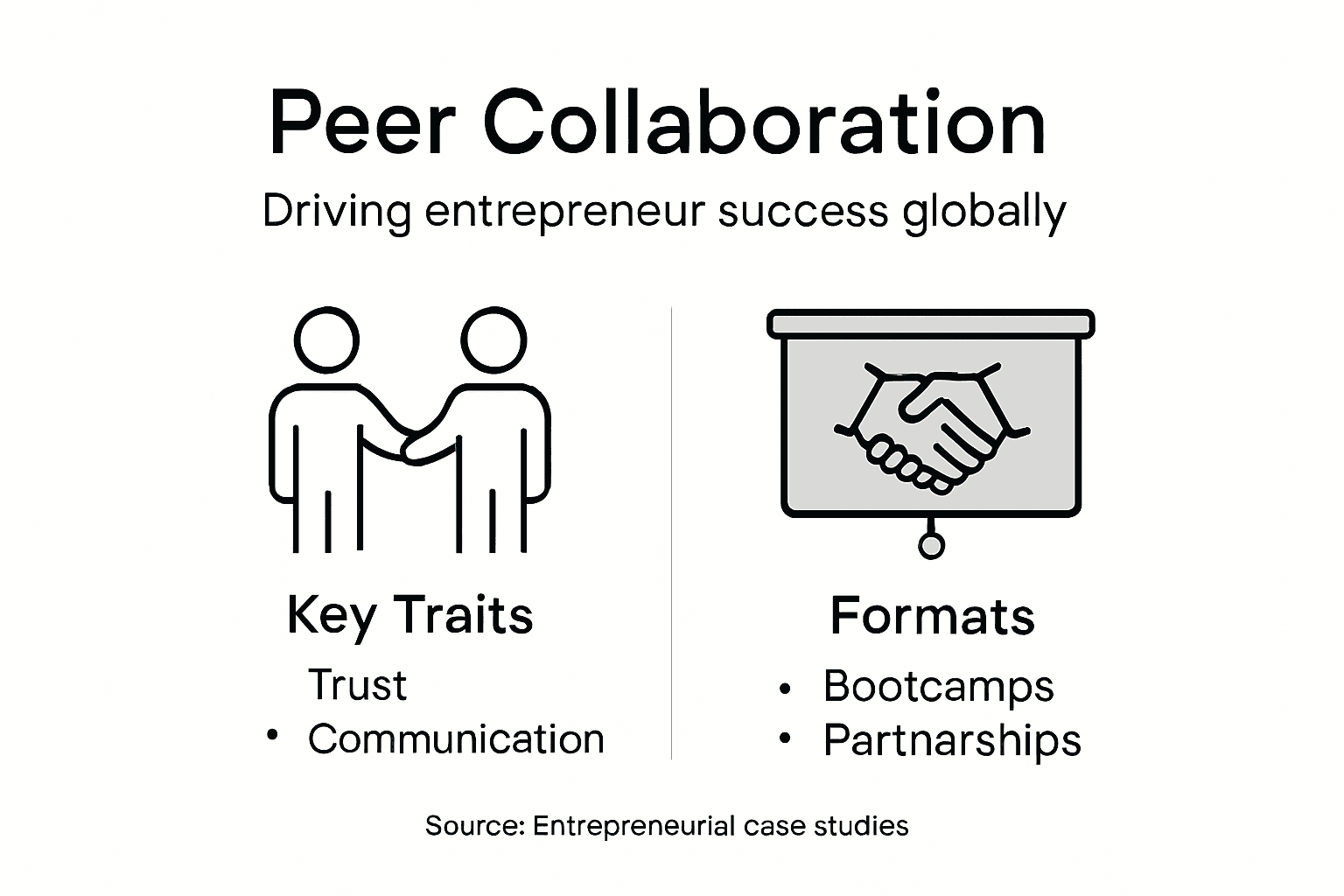
- Key Traits For Effective Collaboration
- Real-World Applications In Bootcamps
- Common Pitfalls And How To Overcome Them
Key Takeaways
| Point | Details |
|---|---|
| Importance of Peer Collaboration | Engaging in structured interactions among entrepreneurs fosters mutual learning and accelerates growth. |
| Types of Collaboration Formats | Various collaboration types, such as Research Partnerships and Joint Ventures, can address specific business goals effectively. |
| Key Traits for Success | Trust, open communication, and mutual respect are essential traits for building effective collaborative relationships. |
| Common Challenges and Solutions | Entrepreneurs should proactively address misaligned goals and communication barriers by establishing clear expectations and protocols. |
Defining Peer Collaboration in Entrepreneurship
Peer collaboration represents a strategic approach where entrepreneurs actively engage with their professional counterparts to accelerate growth, share knowledge, and solve complex business challenges. Systematic research on entrepreneurial interactions reveals that these collaborative networks are far more than simple networking—they are dynamic ecosystems of mutual learning and support.
At its core, peer collaboration involves structured and informal exchanges between entrepreneurs who share similar goals, challenges, or industry backgrounds. These interactions can manifest through various channels:
- Mentorship networks where experienced founders guide emerging entrepreneurs
- Mastermind groups facilitating collective problem-solving
- Online and offline community platforms
- Collaborative project initiatives
- Skill exchange and knowledge sharing programs
The strategic value of peer collaboration extends beyond simple information exchange. Research frameworks highlight that these interactions create profound opportunities for skill development, innovative thinking, and accelerated entrepreneurial growth.
Successful peer collaboration requires intentional relationship building, genuine reciprocity, and a commitment to mutual professional development. Entrepreneurs who master this approach can transform competitive landscapes into cooperative ecosystems where collective intelligence drives individual success.
Pro tip: Schedule regular peer review sessions and create a diverse network of entrepreneurs from different sectors to maximize collaborative learning opportunities.
Types and Formats of Peer Collaboration
Peer collaboration encompasses a diverse range of interaction models that entrepreneurs can leverage to drive business growth and innovation. University-industry collaboration types reveal multiple strategic approaches for connecting with professional peers and creating value.
Entrepreneurs can engage in peer collaboration through several key formats:
- Research Partnerships enabling deep knowledge exchange
- Co-op Programs facilitating hands-on skill development
- Knowledge Transfer Initiatives supporting rapid learning
- Incubation Networks providing structured entrepreneurial support
- Sponsored Project Collaborations generating innovative solutions
- Joint Venture Collaborations creating shared business opportunities
Interorganizational collaboration contexts demonstrate that these formats serve distinct purposes, ranging from resource acquisition to innovation acceleration. Each collaboration type offers unique advantages depending on the entrepreneur’s specific goals and industry landscape.
The effectiveness of peer collaboration depends on selecting the most appropriate format, establishing clear communication protocols, and maintaining a commitment to mutual growth. Successful entrepreneurs understand that collaboration is not a one-size-fits-all strategy but a nuanced approach requiring strategic alignment and genuine commitment.

Pro tip: Evaluate your specific business needs and experiment with multiple collaboration formats to discover the most effective peer engagement strategy for your entrepreneurial journey.
Here is a concise summary highlighting collaboration formats and their core advantages for entrepreneurs:
| Format Type | Primary Goal | Typical Benefit |
|---|---|---|
| Research Partnerships | Deep knowledge exchange | Accelerated innovation |
| Co-op Programs | Skill development | Hands-on experience |
| Incubation Networks | Structured support | Resource access and guidance |
| Joint Ventures | Shared opportunities | New market entry |
Key Traits for Effective Collaboration
Successful entrepreneurial collaboration hinges on a complex set of interpersonal and professional skills that transform potential partnerships into powerful growth engines. Multidisciplinary knowledge integration represents the foundational framework for building robust collaborative relationships among entrepreneurs.
The most critical traits for effective peer collaboration include:
- Trust as the fundamental relationship cornerstone
- Open Communication enabling transparent interactions
- Shared Purpose aligning individual and collective goals
- Complementary Skill Sets creating holistic problem-solving capabilities
- Mutual Respect acknowledging each member’s unique contributions
- Flexibility adapting to changing project dynamics
Interdisciplinary collaboration strategies underscore the importance of leadership in bridging potential gaps and fostering a culture of genuine cooperation. Effective collaboration requires entrepreneurs to move beyond transactional interactions and develop deep, meaningful professional connections that transcend immediate business objectives.
Entrepreneurs who master these collaborative traits can transform potential friction points into opportunities for innovation, creating synergistic relationships that amplify individual and collective potential. The most successful peer collaborations emerge not from perfect alignment, but from a commitment to understanding, growing, and supporting one another’s entrepreneurial journeys.
Pro tip: Conduct regular team communication audits and invest time in building personal relationships that extend beyond purely professional interactions.
Real-World Applications in Bootcamps
Entrepreneurship bootcamps have emerged as powerful platforms for transforming theoretical knowledge into practical, actionable business skills through immersive collaborative experiences. Collaborative pedagogical models provide structured environments where entrepreneurs can develop critical problem-solving and innovation capabilities through hands-on learning approaches.
Bootcamp collaboration typically manifests through several key application strategies:
- Problem-Based Learning challenges that simulate real-world business scenarios
- Peer Assessment mechanisms for constructive feedback and skill refinement
- Digital Technology Integration enabling global team collaborations
- Active Methodology Workshops focusing on practical skill development
- Reflective Learning Tools encouraging deep entrepreneurial insights
- Venture Outcome Simulation testing collaborative strategies
Case studies from entrepreneurial teams demonstrate how structured, intensive programs create powerful learning environments that enhance team cohesion and venture outcomes. Successful bootcamps move beyond traditional lecture formats, creating dynamic spaces where entrepreneurs actively engage, challenge, and support each other’s growth.
The most effective bootcamp experiences transform individual participants into interconnected networks of innovators, where learning becomes a collaborative journey of mutual discovery and professional development. By emphasizing real-world application and peer interaction, these programs create lasting professional connections that extend far beyond the initial program duration.
Pro tip: Actively seek diverse team assignments during bootcamps to maximize exposure to different entrepreneurial perspectives and problem-solving approaches.
Common Pitfalls and How to Overcome Them
Entrepreneurial peer collaboration is a nuanced journey fraught with potential challenges that can derail even the most promising partnerships. Common collaboration pitfalls reveal complex dynamics that entrepreneurs must strategically navigate to maintain productive relationships.
The most significant collaboration challenges include:
- Misaligned Goals creating fundamental partnership tensions
- Communication Breakdowns undermining team effectiveness
- Trust Erosion weakening collaborative potential
- Resource Allocation Conflicts generating interpersonal friction
- Cultural Differences complicating team dynamics
- Unequal Contribution Perceptions breeding resentment
Strategic solutions for collaboration challenges emphasize the importance of establishing clear expectations, developing robust communication protocols, and creating flexible frameworks that accommodate diverse entrepreneurial perspectives. Successful collaboration requires a proactive approach that anticipates potential friction points and develops adaptive strategies to address them.
Entrepreneurs who master the art of navigating collaborative challenges transform potential obstacles into opportunities for growth, learning, and mutual success. By cultivating emotional intelligence, maintaining transparency, and approaching conflicts with a solution-oriented mindset, peer collaborations can become powerful engines of innovation and collective achievement.
Pro tip: Develop a formal collaboration agreement that outlines expectations, roles, and conflict resolution mechanisms before launching any joint venture.
The table below outlines common peer collaboration pitfalls and proactive strategies to overcome each:
| Pitfall | Impact on Collaboration | Solution Strategy |
|---|---|---|
| Misaligned Goals | Causes partnership tension | Set shared objectives upfront |
| Communication Breakdowns | Hampers team effectiveness | Establish clear protocols |
| Trust Erosion | Weakens partnership bonds | Foster transparency and feedback |
| Resource Allocation Conflicts | Triggers interpersonal friction | Use fair workload distribution |
Unlock the Power of Peer Collaboration with Nomad Excel
The article highlights common challenges entrepreneurs face like misaligned goals, trust erosion, and communication breakdowns in peer collaboration. It also reveals how intentional relationship building, structured feedback, and diverse entrepreneurial networks foster success. If you want to move beyond trial and error and build strong, productive connections that drive business growth and innovation, Nomad Excel’s immersive entrepreneurship bootcamps offer the perfect solution.
At Nomad Excel, you will join a curated community of driven founders who learn together through hands-on mentorship, peer collaboration, and daily accountability. These bootcamps bring to life concepts like mastermind groups and skill exchange programs discussed in the article. If your goal is to accelerate growth with trusted peers and expert guidance, our programs create that environment. Ready to transform challenges into opportunities with proven frameworks and a vibrant community? Visit Nomad Excel today to explore how you can get started and build lasting alliances that multiply your entrepreneurial success.
Frequently Asked Questions
What is peer collaboration in entrepreneurship?
Peer collaboration in entrepreneurship refers to a strategic approach where entrepreneurs engage with their peers to share knowledge, accelerate growth, and solve complex business challenges. It goes beyond networking, creating dynamic ecosystems of mutual learning and support.
What are the different formats of peer collaboration?
The formats of peer collaboration include research partnerships, co-op programs, knowledge transfer initiatives, incubation networks, sponsored project collaborations, and joint venture collaborations. Each format serves distinct purposes and offers unique advantages tailored to entrepreneurs’ specific goals.
What key traits are important for successful peer collaboration?
Critical traits for effective peer collaboration include trust, open communication, shared purpose, complementary skill sets, mutual respect, and flexibility. These traits facilitate deeper and more productive professional relationships among entrepreneurs.
How can entrepreneurs overcome common pitfalls in peer collaboration?
Entrepreneurs can overcome common pitfalls by establishing clear expectations, developing robust communication protocols, fostering transparency, and creating flexible frameworks. Proactively addressing potential challenges ensures that collaboration remains productive and beneficial for all parties involved.
Comments are closed.