
What Is Business Model Canvas and Why It Matters
Facing uncertainty about your business strategy can feel overwhelming when launching a new venture abroad. For entrepreneurs at Nomad Excel bootcamps, finding a clear way to visualize ideas is a real challenge. The Business Model Canvas stands out as a powerful framework, breaking down complicated concepts into nine actionable building blocks. This introduction reveals how mapping your strategy visually makes decisions faster and helps turn your startup vision into a concrete plan.
Table of Contents
- Defining Business Model Canvas Concepts
- Nine Essential Building Blocks Explained
- Types and Variations of Business Models
- Real-World Applications for Entrepreneurs
- Common Pitfalls and How to Avoid Them
Key Takeaways
| Point | Details |
|---|---|
| Clear Framework | The Business Model Canvas provides a visual blueprint for entrepreneurs to map out their strategies effectively. |
| Dynamic Tool | Treat the canvas as a living document, regularly revisiting and updating it to adapt to market changes. |
| Interconnected Components | Each of the nine components works synergistically to create a holistic business strategy. |
| Avoiding Pitfalls | Entrepreneurs should continuously validate assumptions and engage stakeholders to ensure alignment and clarity. |
Defining Business Model Canvas Concepts
The Business Model Canvas represents a powerful strategic management tool designed to help entrepreneurs and business leaders visualize their core business strategy through nine critical components. Developed by strategic innovators, this framework transforms complex business planning into a clear, visual blueprint.
At its core, the Business Model Canvas enables organizations to map out how they create, deliver, and capture value. Unlike traditional business plans that can become lengthy and rigid, this canvas provides a dynamic, human-centered approach to business design. Collaborative frameworks help teams align their strategic vision more effectively than traditional documentation methods.
The nine key components of the Business Model Canvas include:
- Customer Segments: Identifying specific groups your business serves
- Value Propositions: Defining unique solutions your business offers
- Channels: Determining how you reach and communicate with customers
- Customer Relationships: Establishing interaction strategies
- Revenue Streams: Mapping out income generation methods
- Key Resources: Identifying critical assets required
- Key Activities: Outlining essential business processes
- Key Partnerships: Recognizing strategic collaborations
- Cost Structure: Understanding expense categories and financial model
This framework transforms abstract business concepts into concrete, actionable strategies. By presenting complex ideas visually, entrepreneurs can quickly prototype and iterate their business models, making strategic planning more accessible and dynamic.
Pro tip: Practice sketching your initial Business Model Canvas draft in pencil, allowing yourself flexibility to experiment and rapidly adjust your strategic thinking without commitment.
Nine Essential Building Blocks Explained
The Business Model Canvas breaks down complex business strategies into nine foundational building blocks that collectively provide a comprehensive view of how an organization creates, delivers, and captures value. These interconnected components serve as a strategic blueprint for entrepreneurs and business leaders to understand and design their business model.

Understanding each building block is crucial for developing a robust and adaptable business strategy. Structured frameworks help companies analyze their core operations by addressing critical questions about their business ecosystem. Let’s explore these nine essential components in depth:
Key Building Blocks of the Business Model Canvas:
- Customer Segments
- Identifying specific target markets
- Defining unique customer groups
- Understanding customer needs and preferences
- Value Propositions
- Creating unique solutions
- Addressing specific customer pain points
- Differentiating from competitors
- Channels
- Determining communication methods
- Selecting distribution strategies
- Optimizing customer engagement
- Customer Relationships
- Establishing interaction models
- Building long-term customer connections
- Designing retention strategies
- Revenue Streams
- Mapping income generation methods
- Identifying pricing strategies
- Exploring diverse monetization approaches
- Key Resources
- Identifying critical business assets
- Understanding required infrastructure
- Evaluating physical, intellectual, and human resources
- Key Activities
- Defining core business processes
- Mapping essential operational functions
- Aligning activities with value proposition
- Key Partnerships
- Recognizing strategic collaborations
- Developing supplier and network relationships
- Creating ecosystem advantages
- Cost Structure
- Understanding expense categories
- Analyzing fixed and variable costs
- Optimizing financial efficiency
These nine building blocks are not isolated elements but interconnected components that work together to create a holistic business strategy. By carefully analyzing and designing each block, entrepreneurs can develop more resilient and adaptable business models.
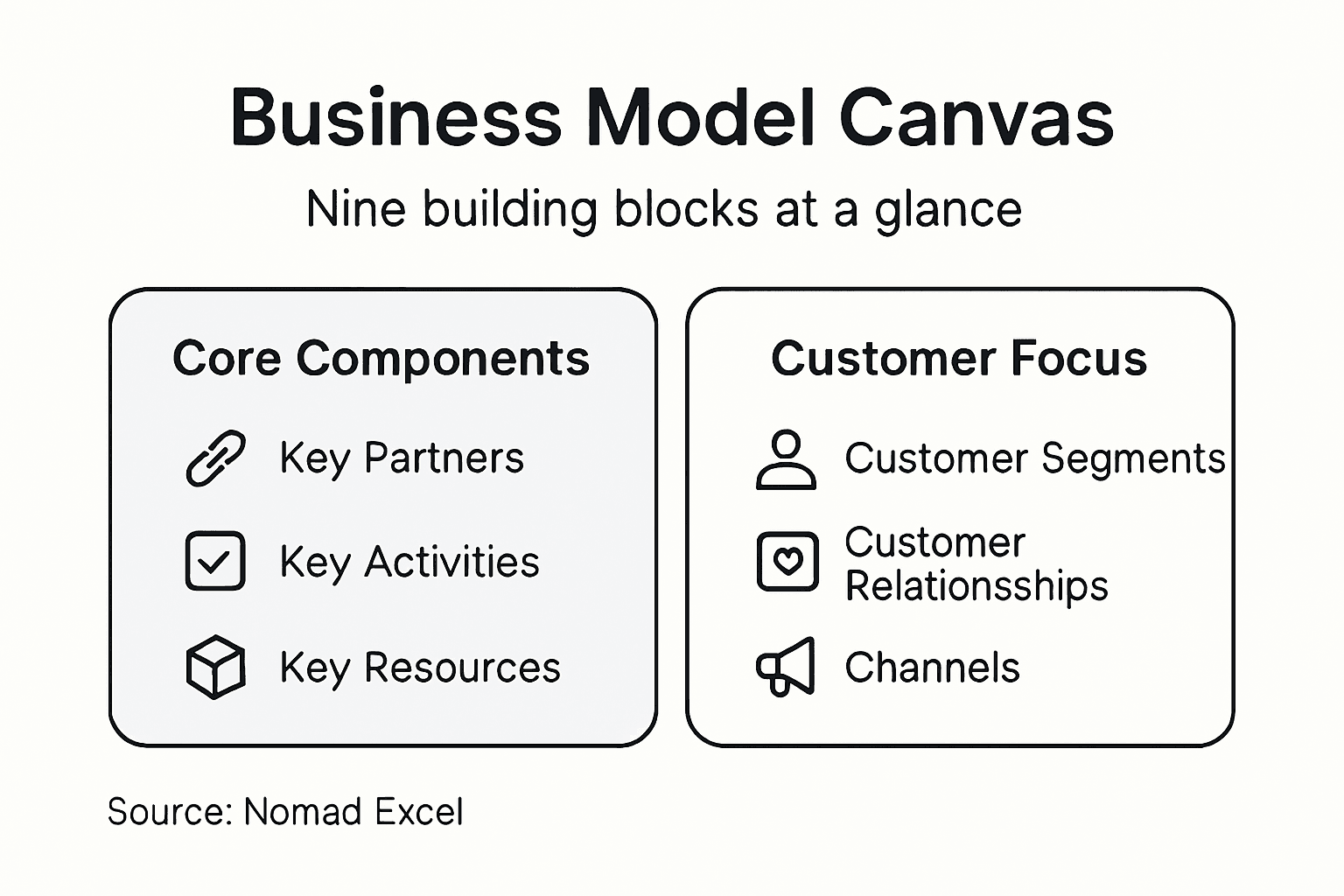
Here’s how the nine Business Model Canvas components impact business strategy:
| Component | Strategic Role | Example Impact |
|---|---|---|
| Customer Segments | Targets unique market groups | Enables focused marketing |
| Value Propositions | Differentiates offerings | Enhances customer retention |
| Channels | Connects with customers | Improves distribution efficiency |
| Customer Relationships | Builds engagement | Increases lifetime value |
| Revenue Streams | Generates income | Supports sustainable growth |
| Key Resources | Powers operations | Secures competitive advantage |
| Key Activities | Drives value delivery | Streamlines business processes |
| Key Partnerships | Expands capabilities | Reduces risk and costs |
| Cost Structure | Manages financial health | Optimizes spending and returns |
Pro tip: Regularly revisit and update your Business Model Canvas as your business evolves, treating it as a dynamic tool for continuous strategic refinement.
Types and Variations of Business Models
Businesses today have numerous strategic approaches to creating and capturing value, with diverse business model variations emerging to address complex market dynamics. Understanding these different models allows entrepreneurs to select the most appropriate strategy for their specific context and goals.
Modern business models extend far beyond traditional sales approaches, incorporating innovative frameworks that challenge conventional thinking. Circular business models represent a transformative approach that prioritizes sustainability, resource efficiency, and long-term ecological impact alongside financial performance.
Key Business Model Types:
Subscription Model
Recurring revenue generation
Predictable customer relationships
Lower customer acquisition costs
Freemium Model
Basic services offered free
Premium features require payment
Low-risk customer acquisition strategy
Marketplace Model
Platform connecting buyers and sellers
Revenue through transaction fees
Network effect potential
Direct Sales Model
Selling directly to consumers
High control over customer experience
Potential for higher profit margins
Circular Economy Model
Emphasizing resource regeneration
Minimizing waste
Creating closed-loop product lifecycles
Each business model type presents unique advantages and challenges. Successful entrepreneurs carefully analyze their target market, value proposition, and operational capabilities to select the most appropriate model. Flexibility and willingness to adapt remain crucial in today’s rapidly evolving business landscape.
Compare popular business model types and their main strengths:
| Model Type | Key Benefit | Major Challenge |
|---|---|---|
| Subscription | Predictable recurring revenue | High retention requirement |
| Freemium | Broad initial reach | Monetizing free users |
| Marketplace | Scales with network effects | Balancing supply and demand |
| Direct Sales | Control customer experience | Intensive sales effort |
| Circular Economy | Promotes sustainability | Complex process redesign |
Pro tip: Treat your chosen business model as a living strategy, consistently reassessing and iterating based on market feedback and emerging opportunities.
Real-World Applications for Entrepreneurs
Entrepreneurs leverage the Business Model Canvas as a strategic tool to translate complex business ideas into actionable, executable plans. This powerful framework enables founders to break down their business vision into systematic, measurable components that can be analyzed, tested, and refined with precision.
Collaborative innovation approaches transform the way entrepreneurs develop and validate their business strategies. By providing a comprehensive visual map, the Business Model Canvas helps founders examine every critical aspect of their venture, from customer relationships to financial streams, reducing risk and enhancing strategic decision-making.
Practical Applications for Different Entrepreneurial Scenarios:
Startup Validation
Quickly test business hypotheses
Identify potential market gaps
Minimize initial investment risks
Product Development
Align product features with customer needs
Map resource requirements
Design targeted value propositions
Investor Presentations
Create clear, concise business overviews
Demonstrate strategic thinking
Communicate business potential effectively
Pivot and Adaptation
Rapidly assess business model weaknesses
Explore alternative revenue streams
Facilitate agile strategic adjustments
Team Alignment
Provide a shared strategic language
Encourage cross-functional collaboration
Create unified understanding of business goals
Successful entrepreneurs recognize that the Business Model Canvas is not a static document but a dynamic tool for continuous business exploration and refinement. Regular review and iteration are key to maintaining relevance in rapidly changing market environments.
The Business Model Canvas transforms complex strategic thinking into a clear, actionable roadmap for entrepreneurial success.
Pro tip: Schedule quarterly Business Model Canvas review sessions with your team, treating it as a living document that evolves with your business insights and market dynamics.
Common Pitfalls and How to Avoid Them
Entrepreneurs often encounter significant challenges when implementing the Business Model Canvas, with common mistakes derailing strategic planning early in their business development process. Understanding these potential pitfalls can help founders navigate complex strategic landscapes more effectively and prevent costly missteps.
Treating the Business Model Canvas as a static document represents one of the most critical errors entrepreneurs can make. Successful business leaders view this framework as a dynamic, evolving tool that requires continuous refinement and stakeholder engagement.
Key Pitfalls to Watch Out For:
Overcomplicating the Canvas
Adding unnecessary complexity
Including excessive, irrelevant details
Losing clarity in intricate designs
Unvalidated Assumptions
Failing to test customer hypotheses
Ignoring market feedback
Relying on theoretical models
Neglecting Cost Structures
Underestimating operational expenses
Overlooking resource allocation
Miscalculating financial requirements
Weak Competitor Analysis
Ignoring market competition
Failing to differentiate value propositions
Underestimating competitive dynamics
Poor Stakeholder Alignment
Misaligning team perspectives
Creating communication gaps
Lacking unified strategic vision
Successful entrepreneurs approach the Business Model Canvas with flexibility, constantly challenging their initial assumptions and remaining open to strategic pivots. The most effective business models emerge from rigorous testing, honest reflection, and a willingness to adapt.
Strategic flexibility is the cornerstone of sustainable business design.
Pro tip: Schedule monthly validation sessions where you critically review each component of your Business Model Canvas, inviting diverse perspectives to challenge your current thinking.
Turn Your Business Model Canvas Insights Into Real-World Success
If you found yourself challenged by how to visualize your business strategy or struggled with translating the nine building blocks of the Business Model Canvas into actionable steps, you are not alone. Many entrepreneurs face roadblocks when trying to clearly define their Customer Segments, Value Propositions, or Revenue Streams. Without the right guidance, these critical components can remain abstract ideas rather than powerful drivers of growth.
At Nomad Excel, we specialize in turning these complex concepts into hands-on learning experiences. Our immersive Entrepreneurship Bootcamps are designed to help you validate your business hypotheses, refine your value proposition, and build scalable strategies with expert mentorship and peer support. Whether you are launching your startup or looking to pivot with a fresh strategy, our programs provide structured sprints and daily accountability to accelerate your progress.
Don’t let your Business Model Canvas stay on paper. Take action now to transform your vision into results. Discover how our bootcamps and retreats can equip you with the clarity and execution plan you need to thrive by visiting Nomad Excel today.
Frequently Asked Questions
What is the Business Model Canvas?
The Business Model Canvas is a strategic management tool that visually outlines a business’s core strategy through nine key components, helping entrepreneurs and business leaders to map how they create, deliver, and capture value.
Why is the Business Model Canvas important for startups?
The Business Model Canvas is important for startups because it simplifies the complex process of business planning, enabling entrepreneurs to test hypotheses, identify market gaps, and adapt their strategies quickly without heavy initial investment.
How can I effectively use the Business Model Canvas in my business?
To effectively use the Business Model Canvas, regularly sketch and update your canvas to reflect changes in your business model, involve team members for collaborative insights, and treat it as a living document that evolves with market dynamics and your business requirements.
What are the key components of the Business Model Canvas?
The key components of the Business Model Canvas include Customer Segments, Value Propositions, Channels, Customer Relationships, Revenue Streams, Key Resources, Key Activities, Key Partnerships, and Cost Structure, all of which work together to create a comprehensive view of the business strategy.
Recommended
- Business Model Innovation: Fueling Entrepreneurial Growth
- The Essential Guide to Frameworks for Business Building
- Business Scalability: Why It Matters for Entrepreneurs
- What Is Business Ideation? Complete Expert Guide – Nomad Excel – Your Entrepreneurial Adventure Starts Here
- How to Prepare for Case Study Interviews | Expert Tips to Succeed
Comments are closed.