
Why Pursue Flexible Entrepreneurship for Life Design
More than 59 million Americans are redefining how and where work happens, fueling a surge in location-independent entrepreneurship. Many aspiring founders feel stuck choosing between traditional business demands and a life of freedom, yet flexible entrepreneurship breaks this mold. In the following guide, you will discover how American and global digital nomads use mobility, adaptability, and scalable systems to design businesses that empower travel, autonomy, and meaningful work.
Table of Contents
- Flexible Entrepreneurship Defined and Debunked
- Types and Models for Modern Nomads
- Core Traits: Mobility, Adaptability, and Scale
- Real-World Benefits and Use Cases Worldwide
- Risks, Financials, and Regulatory Challenges
- Community, Execution, and Avoiding Isolation
Key Takeaways
| Point | Details |
|---|---|
| Flexible Entrepreneurship Prioritizes Lifestyle | This approach emphasizes personal autonomy, adaptability, and remote operations over conventional work structures. |
| Core Traits for Success | Key characteristics such as mobility, adaptability, and scalability are essential for thriving in nontraditional business landscapes. |
| Technological Infrastructure is Essential | A robust technological ecosystem enables flexible entrepreneurs to manage operations smoothly across geographic boundaries. |
| Community and Networking Are Crucial | Building a supportive professional network helps combat isolation and enhances opportunities for collaboration and knowledge exchange. |
Flexible Entrepreneurship Defined and Debunked
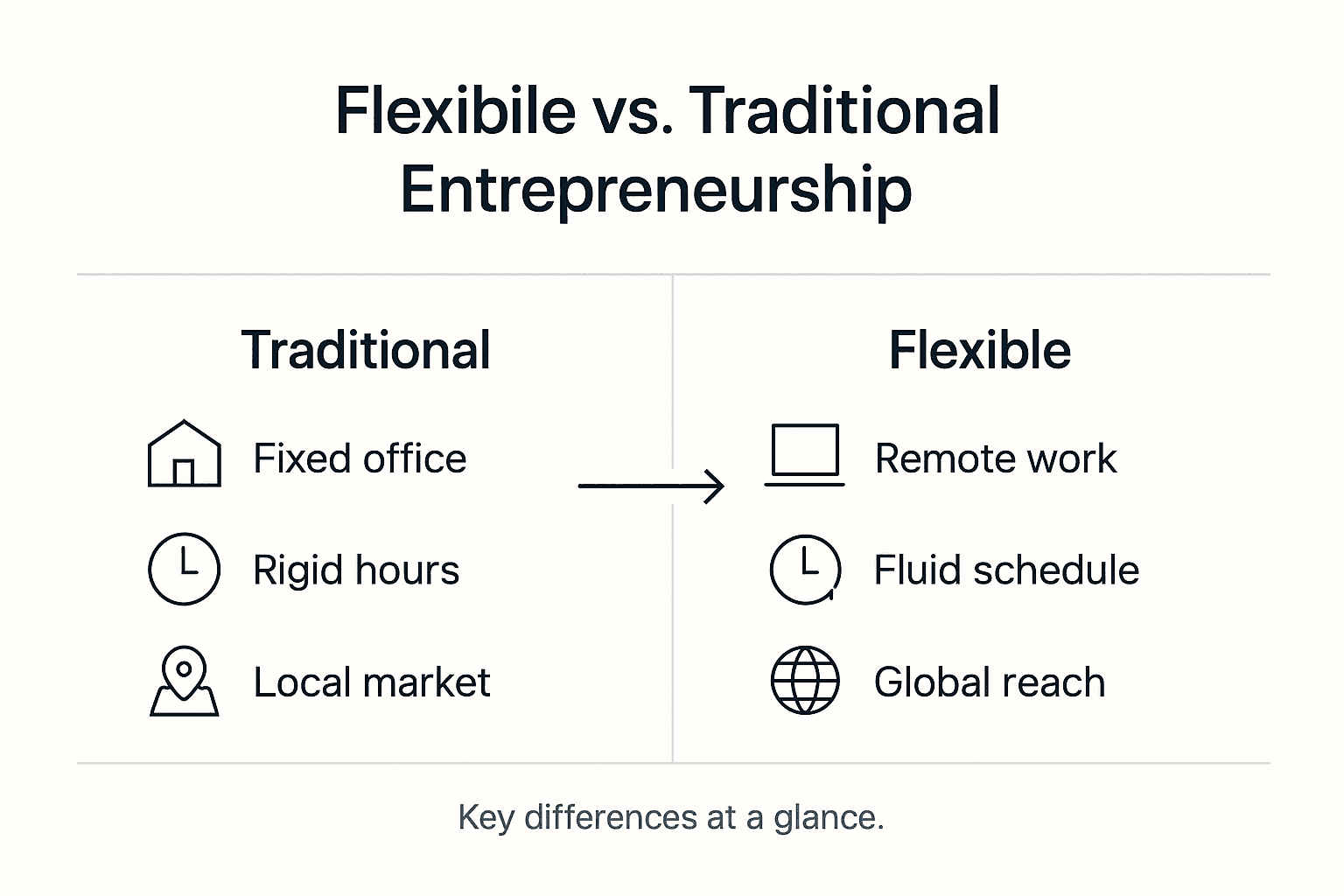
Flexible entrepreneurship represents a strategic approach to business that prioritizes personal lifestyle design over traditional corporate constraints. Unlike conventional entrepreneurial models that demand rigid structures and predictable schedules, this approach embraces adaptability, location independence, and personalized workflow management. Flexible entrepreneurs design businesses that can operate from anywhere, scale dynamically, and align closely with individual values and life goals.
At its core, flexible entrepreneurship challenges traditional work paradigms by emphasizing personal autonomy and system design over linear career progression. Entrepreneurs in this model focus on creating digital or service-based businesses that can function without constant physical presence. This might involve developing online courses, providing consulting services, creating digital products, or building scalable software platforms that generate revenue with minimal daily intervention. Entrepreneurial leadership skills become critical in successfully navigating this nontraditional business landscape.
Understanding flexible entrepreneurship requires recognizing its fundamental differences from traditional business models. While conventional entrepreneurs often build location-dependent businesses requiring consistent physical involvement, flexible entrepreneurs prioritize systems and processes that generate income independently of their continuous labor. This approach demands advanced strategic thinking, robust technological infrastructure, and a willingness to continuously experiment and adapt. Successful practitioners develop skill sets that enable them to create self-sustaining business ecosystems that provide both financial returns and lifestyle freedom.
Below is a quick comparison of traditional versus flexible entrepreneurship models:
| Aspect | Traditional Entrepreneurship | Flexible Entrepreneurship |
|---|---|---|
| Location Dependence | Usually fixed to one place | Operates from anywhere |
| Schedule Structure | Often rigid, set hours | Adaptable, self-managed |
| Revenue Source | Active involvement required | Systems enable passive income |
| Scalability Approach | Slow, resource-heavy expansion | Dynamic, technology-driven growth |
Pro tip: Design your business model with automation and scalability as primary considerations, investing early in systems that can operate effectively without constant personal management.
Types and Models for Modern Nomads
Modern entrepreneurial nomads have evolved diverse business models that transcend traditional geographic and organizational boundaries. These models represent sophisticated approaches to creating sustainable income streams while maintaining maximum personal flexibility. The primary models include digital service providers, online content creators, distributed software teams, and remote consulting professionals who leverage technology to build location-independent enterprises.
Digital nomad entrepreneurship models have fundamentally transformed how professionals conceptualize work and business development. These models typically fall into several key categories: service-based digital businesses, product-based online ventures, and platform-enabled income streams. Service providers might offer graphic design, web development, copywriting, or digital marketing expertise through global freelance platforms. Product-based entrepreneurs create digital products like online courses, ebooks, software tools, or downloadable templates that can be sold repeatedly without direct ongoing labor.
The technological infrastructure supporting these nomadic business models has become increasingly sophisticated. Cloud computing, robust communication platforms, international payment systems, and advanced project management tools enable entrepreneurs to manage complex global operations from anywhere with reliable internet connectivity. This technological ecosystem allows for real-time collaboration, seamless client interactions, and efficient business administration across multiple time zones and cultural contexts.
Pro tip: Invest in creating standardized operational systems and documentation that allow your business to function smoothly without constant personal intervention, enabling true location and time independence.
Core Traits: Mobility, Adaptability, and Scale
Flexible entrepreneurs distinguish themselves through three fundamental traits that enable extraordinary business performance: mobility, adaptability, and scalability. These core characteristics represent more than mere business strategies – they are sophisticated operational philosophies that transform how professionals approach work, opportunity, and personal growth. Unlike traditional business models constrained by physical infrastructure and linear progression, these entrepreneurs create dynamic ecosystems that can rapidly evolve and respond to changing global conditions.

Entrepreneurial mobility research reveals how modern professionals strategically leverage geographic and organizational boundaries to capitalize on unexpected opportunities. Mobility goes beyond physical movement, encompassing intellectual flexibility, cultural intelligence, and the ability to quickly reconfigure business models. Successful nomadic entrepreneurs develop robust skill sets that allow them to seamlessly transition between markets, client bases, and operational contexts. They view geographical boundaries as permeable membranes rather than rigid barriers, enabling them to access diverse economic ecosystems and create value across multiple contexts.
Startup scalability studies demonstrate how innovative entrepreneurs transform initial concepts into globally competitive enterprises through strategic adaptation. Scalability requires more than simply growing revenue – it demands creating repeatable, systematic processes that can function independently of the founder’s constant intervention. This approach involves developing digital infrastructure, creating standardized service delivery models, and designing business systems that can automatically generate value. The most successful flexible entrepreneurs invest heavily in automation, outsourcing, and technological platforms that enable their businesses to operate efficiently across different markets and time zones.
Pro tip: Develop modular business systems that can be easily reconfigured, automated, and scaled, treating your enterprise as a flexible platform rather than a rigid organizational structure.
Real-World Benefits and Use Cases Worldwide
Flexible entrepreneurship has emerged as a powerful global phenomenon, demonstrating remarkable adaptability across diverse economic and cultural landscapes. International case studies reveal how this approach transcends traditional business limitations, enabling entrepreneurs to create value through innovative, location-independent strategies. From technology startups in Southeast Asia to social enterprises in African communities, flexible entrepreneurship represents a dynamic approach to solving complex economic challenges.
Global entrepreneurship case studies showcase remarkable examples of how adaptive business models address regional economic needs. In China, tech entrepreneurs have developed mobile payment platforms that leapfrog traditional banking infrastructure. African entrepreneurs have created agricultural technology solutions that connect rural producers directly with global markets. Australian startup founders have designed digital platforms that provide educational resources in remote communities, demonstrating how flexible entrepreneurship can generate social and economic impact simultaneously.
Entrepreneurial adaptation research highlights the transformative potential of flexible business models across different regulatory environments. Successful practitioners navigate complex international landscapes by developing culturally intelligent strategies that respect local contexts while maintaining global operational standards. This approach allows entrepreneurs to create value through nuanced understanding of regional dynamics, technological infrastructure, and emerging market opportunities. The most effective flexible entrepreneurs view geographic and regulatory diversity not as obstacles, but as intricate opportunities for innovative problem solving.
Pro tip: Build a diverse professional network across multiple countries and industries, treating cultural intelligence and adaptive learning as your most valuable entrepreneurial assets.
Risks, Financials, and Regulatory Challenges
Flexible entrepreneurship presents a complex landscape of financial and regulatory challenges that demand strategic navigation and sophisticated risk management. Financial uncertainty emerges as the primary concern for nomadic entrepreneurs, who must develop robust financial strategies that can withstand unpredictable global economic conditions. Unlike traditional business models with stable revenue streams, flexible entrepreneurs must continuously adapt their financial approaches to maintain economic sustainability.
Global financial systems research reveals intricate challenges entrepreneurs face when operating across international boundaries. The primary financial risks include currency fluctuations, inconsistent tax regulations, complex international banking requirements, and limited access to traditional credit mechanisms. Successful flexible entrepreneurs mitigate these challenges by developing multiple revenue streams, maintaining diverse financial portfolios, and creating sophisticated digital infrastructure that allows for rapid financial recalibration. They often utilize cryptocurrency, international payment platforms, and distributed financial technologies to overcome traditional banking limitations.
Regulatory challenges represent another critical dimension of flexible entrepreneurship. Different countries maintain vastly different legal frameworks regarding business registration, taxation, intellectual property protection, and digital commerce. Entrepreneurs must develop comprehensive legal strategies that ensure compliance across multiple jurisdictions while maintaining operational flexibility. This requires ongoing education, strategic legal partnerships, and a proactive approach to understanding evolving international business regulations. Successful practitioners invest significant time and resources in building legal and financial intelligence networks that provide real-time insights into regulatory shifts.
The table below summarizes common risks faced by flexible entrepreneurs and proven mitigation strategies:
| Major Risk | Example Challenge | Mitigation Approach |
|---|---|---|
| Currency Variability | Fluctuating exchange rates | Diverse currency accounts |
| Tax Complexity | Varying international regulations | Hire global tax specialists |
| Financial Access | Limited loans or banking options | Use digital payment platforms |
| Legal Compliance | Shifting business laws | Establish adaptable legal entities |
Pro tip: Develop a comprehensive compliance strategy by consulting international tax professionals and creating modular business structures that can be quickly adapted to changing regulatory environments.
Community, Execution, and Avoiding Isolation
Flexible entrepreneurship demands a nuanced approach to professional connection, challenging the traditional misconception that independent work equates to complete isolation. Social connectivity emerges as a critical success factor for nomadic entrepreneurs, who must intentionally cultivate professional networks that transcend geographic boundaries. The most successful practitioners view community not as an optional enhancement, but as a fundamental infrastructure supporting their entrepreneurial journey.
Entrepreneurial social network research reveals the transformative power of strategic professional connections. Digital platforms, virtual mastermind groups, and international entrepreneurial communities provide crucial support mechanisms that combat the psychological challenges of independent work. These networks offer more than emotional support – they function as dynamic ecosystems for knowledge exchange, collaborative problem solving, and mutual accountability. Successful flexible entrepreneurs invest significant energy in building multilayered professional relationships that provide intellectual stimulation, strategic insights, and potential collaboration opportunities.
Isolation dynamics in entrepreneurship demonstrate that geographic independence does not necessitate professional disconnection. Smart entrepreneurs develop sophisticated strategies for maintaining human connection while preserving their operational autonomy. These strategies include participating in online professional communities, attending international conferences and retreats, engaging in virtual collaborative projects, and creating deliberate communication rhythms with professional peers. The goal is not constant interaction, but meaningful, strategically designed professional engagement that prevents intellectual stagnation and maintains motivational momentum.
Pro tip: Create a personal board of advisors comprising professionals from diverse industries and geographic regions, establishing a quarterly virtual meeting rhythm to exchange insights and maintain strategic connection.
Unlock Your Life Design Through Flexible Entrepreneurship
The journey into flexible entrepreneurship is filled with challenges like mastering mobility, building scalable systems, and maintaining meaningful community connections. This article highlights the struggle to create businesses that adapt to your lifestyle rather than dictate it. If you find yourself aiming to design a life around personal freedom while growing a resilient enterprise, you are not alone. Concepts like operational autonomy, strategic adaptability, and ongoing mentorship are essential but often difficult to navigate without support.
Nomad Excel is here to guide you through these very challenges. Explore our Entrepreneurship Archives for insights that deepen your understanding of flexible business models. Whether you are just starting or ready to scale your efforts, our immersive bootcamps and tailored retreats provide the frameworks, expert mentorship, and vibrant community needed to transform your vision into real-world success. Take action now to accelerate your journey toward designing a life and business on your terms by visiting Nomad Excel and discovering our Program Archives. Join us and start building the future you deserve.
Frequently Asked Questions
What is flexible entrepreneurship?
Flexible entrepreneurship is a business approach that prioritizes personal lifestyle design, allowing entrepreneurs to operate their businesses from anywhere, adapt their schedules, and manage workflows autonomously.
How does flexible entrepreneurship differ from traditional entrepreneurship?
Unlike traditional entrepreneurship, which often relies on fixed locations and rigid schedules, flexible entrepreneurship emphasizes location independence, adaptability, and the ability to generate income through automated systems without constant physical involvement.
What are some examples of flexible entrepreneurship business models?
Examples of flexible entrepreneurship business models include digital service providers, online content creators, remote consulting professionals, and businesses that sell digital products like courses or software, allowing entrepreneurs to work from anywhere.
What are the benefits of pursuing flexible entrepreneurship?
The benefits of flexible entrepreneurship include increased personal autonomy, the ability to design your own schedule, potential for passive income, and the freedom to work from various locations, enhancing overall life satisfaction and work-life balance.
Recommended
- The Essential Guide to Cultivating Entrepreneurial Independence
- The Essential Guide to Benefits of Entrepreneurial Mindset – Nomad Excel – Your Entrepreneurial Adventure Starts Here
- Entrepreneurial Leadership Explained: Complete Guide
- 7 Essential Types of Entrepreneurship for Modern Success – Nomad Excel – Your Entrepreneurial Adventure Starts Here
Comments are closed.