
Execution Focused Entrepreneurship Guide for Fast Growth
Most American entrepreneurs face a daunting reality. Only about one in four new businesses make it past the first fifteen years, and the odds are even slimmer for those who skip the foundational steps. Building a thriving company requires much more than a clever idea. If you want to turn your vision into measurable results, you need a clear plan backed by proven strategies, decisive action, and a network of support to guide your journey.
Table of Contents
- Step 1: Define a Clear and Actionable Vision
- Step 2: Validate Ideas and Select High-Impact Opportunities
- Step 3: Design Scalable Systems for Execution
- Step 4: Engage Mentors and Accountability Partners
- Step 5: Track Progress and Measure Real Results
Quick Summary
| Key Insight | Explanation |
|---|---|
| 1. Define an Inspiring Vision | Create a clear vision statement that outlines your long-term goals and impact, guiding your strategic decisions. |
| 2. Validate Business Ideas | Systematically assess potential ideas through market research and structured evaluation to identify high-impact opportunities. |
| 3. Design Scalable Systems | Establish operational frameworks that allow for efficient growth and adaptability by documenting key processes and using technology. |
| 4. Engage Mentors Regularly | Build a support network of mentors and accountability partners to gain guidance and maintain focus on your important goals. |
| 5. Track Your Progress | Implement a robust system for monitoring key performance indicators and conduct regular reviews to adapt your strategies accordingly. |
Step 1: Define a Clear and Actionable Vision
Crafting a powerful vision is your roadmap to entrepreneurial success. In this step, you will transform abstract ideas into a concrete blueprint that guides every strategic decision for your business.
A vision statement acts as your North Star, providing direction and inspiration. According to research, a vision is a concise and inspirational description of your desired future state that articulates your overarching purpose and long-term goals. Think of it as a compelling narrative that answers two fundamental questions: What impact do you want to create? Where are you heading?
To develop a robust vision, start by reflecting deeply on your core motivations. What problem are you passionate about solving? Who will benefit from your work? Avoid vague statements and focus on specific, measurable outcomes. Your vision should be ambitious yet realistic, stretching your capabilities without feeling impossible. Write it down in clear, powerful language that sparks emotion and creates a sense of commitment.
Break your vision into actionable components. A well-developed mission helps entrepreneurs explain to investors, customers, and employees why their venture is worth pursuing. Consider creating a one-page document that outlines your vision, including key milestones, target metrics, and the unique value you bring to your market.
Pro tip: Review and refine your vision statement quarterly. Treat it as a living document that evolves with your growth, ensuring it remains relevant and inspirational.
Step 2: Validate Ideas and Select High-Impact Opportunities
Validating business ideas is your strategic filter for transforming potential concepts into market-ready opportunities. You will learn how to systematically assess and prioritize ideas that have genuine growth potential and alignment with your entrepreneurial vision.
Research suggests that the quality of new venture ideas follows a nuanced trajectory, peaking and then dropping with increasing structural complexity. This means you need a balanced approach that combines creative thinking with strategic evaluation. Start by generating multiple ideas, then apply rigorous assessment criteria to identify those with the highest potential for success.
Begin with comprehensive market research. Map out potential customer segments, understand their pain points, and evaluate the competitive landscape. Look for ideas that solve significant problems in unique ways. The Market Opportunity Navigator provides a strategic methodology for identifying and selecting the most valuable market opportunities, helping entrepreneurs align their current resources and capabilities with the most promising ventures.
Create a structured evaluation matrix that scores each idea across key dimensions: market size, potential revenue, competitive advantage, resource requirements, and personal passion. Assign weighted scores to each dimension, allowing you to objectively compare different opportunities. Eliminate ideas that score low across multiple criteria, and focus your energy on those with the strongest potential for execution and impact.
Here’s a summary of approaches for evaluating new business ideas:
| Evaluation Dimension | Purpose | Example Question |
|---|---|---|
| Market Size | Estimate total demand for the solution | How large is the customer base? |
| Competitive Advantage | Identify unique strengths | Why will customers choose you? |
| Resource Requirements | Assess startup and operational needs | What funding is necessary? |
| Personal Passion | Align with founder motivation | Do you care about this problem? |
| Revenue Potential | Forecast expected earnings | What is the profit opportunity? |
Pro tip: Develop a 30-60-90 day validation plan for your top 2-3 ideas. This rapid testing approach helps you quickly determine market viability without exhausting resources on unproductive concepts.
Step 3: Design Scalable Systems for Execution
Designing scalable systems transforms your entrepreneurial vision from a concept into a repeatable, efficient blueprint for growth. In this step, you will learn how to create operational frameworks that support rapid expansion while maintaining quality and consistency.

The Lean Startup methodology provides a foundational approach for developing scalable systems through continuous innovation and rapid prototyping. This approach emphasizes creating flexible systems that can quickly adapt to market feedback and changing business conditions. Start by identifying your core business processes and mapping out each critical workflow, looking for opportunities to standardize and automate repetitive tasks.
Begin by documenting your key operational processes with extreme clarity. Break down each significant business function into step-by-step protocols that can be easily understood and replicated by team members. The Lean LaunchPad methodology suggests combining systematic customer learning with agile engineering principles to create robust, responsive business systems. Develop clear standard operating procedures that outline exactly how tasks should be completed, including decision-making frameworks, communication protocols, and performance metrics.
Implement technology and tools that enable scalability. Choose software solutions and platforms that can grow with your business, integrating systems that allow for seamless communication, data tracking, and performance monitoring. Focus on creating modular systems that can be easily expanded or modified as your business evolves. Prioritize solutions that offer automation capabilities, reducing manual work and minimizing human error.
Pro tip: Conduct quarterly system audits to identify bottlenecks and inefficiencies. Treat your operational systems as living documents that require continuous refinement and optimization.
Step 4: Engage Mentors and Accountability Partners
Engaging the right mentors and accountability partners can dramatically accelerate your entrepreneurial journey. In this step, you will learn how to strategically build a support network that provides guidance, challenges your thinking, and keeps you focused on your most important goals.
Research demonstrates that access to specialized knowledge significantly increases entrepreneurs’ ability to recognize and capitalize on business opportunities. Start by identifying potential mentors who have demonstrated success in your specific industry or have navigated challenges similar to those you currently face. Look beyond traditional networks and seek out individuals who not only have professional expertise but also align with your values and entrepreneurial vision.
Develop a structured approach to mentor engagement. Begin by crafting a compelling and specific pitch that clearly articulates what you hope to learn and how you can provide value in return. Most successful entrepreneurs appreciate the opportunity to share their wisdom and support emerging talent. Schedule initial conversations with potential mentors, presenting a clear agenda and demonstrating your commitment to learning. Be prepared with thoughtful questions and show genuine interest in their experiences and insights.
Create an accountability framework that includes both formal mentorship relationships and peer accountability partnerships. Establish regular check-in meetings with your mentors and accountability partners, setting clear expectations about communication frequency, meeting structures, and desired outcomes. Use these interactions to review your progress, discuss challenges, and receive constructive feedback. Entrepreneurship research highlights the critical role of intellectual and social capital in driving business success, so treat these relationships as strategic investments in your professional growth.
Pro tip: Rotate your mentorship and accountability network every 18 to 24 months to ensure you are continuously exposed to fresh perspectives and evolving expertise.
Step 5: Track Progress and Measure Real Results
Tracking progress and measuring real results transforms your entrepreneurial vision from abstract goals into concrete achievements. In this step, you will learn how to develop a robust system for monitoring performance, identifying growth opportunities, and maintaining strategic momentum.
The Global Entrepreneurship Monitor provides insights into how successful entrepreneurs systematically track and evaluate their business performance. Begin by establishing clear key performance indicators (KPIs) that directly align with your most critical business objectives. These metrics should be specific, measurable, actionable, relevant, and time-bound. Focus on quantitative indicators that provide objective evidence of your progress, such as revenue growth, customer acquisition rates, conversion percentages, and profit margins.
Develop a comprehensive tracking system that goes beyond surface-level measurements. Research in entrepreneurial decision-making highlights the importance of understanding both quantitative and qualitative indicators of business performance. Create a dashboard that combines hard data with strategic insights, allowing you to see not just where you are, but why you are performing at your current level. Use a combination of tools such as spreadsheets, business intelligence software, and regular manual review sessions to maintain a holistic view of your venture’s trajectory.
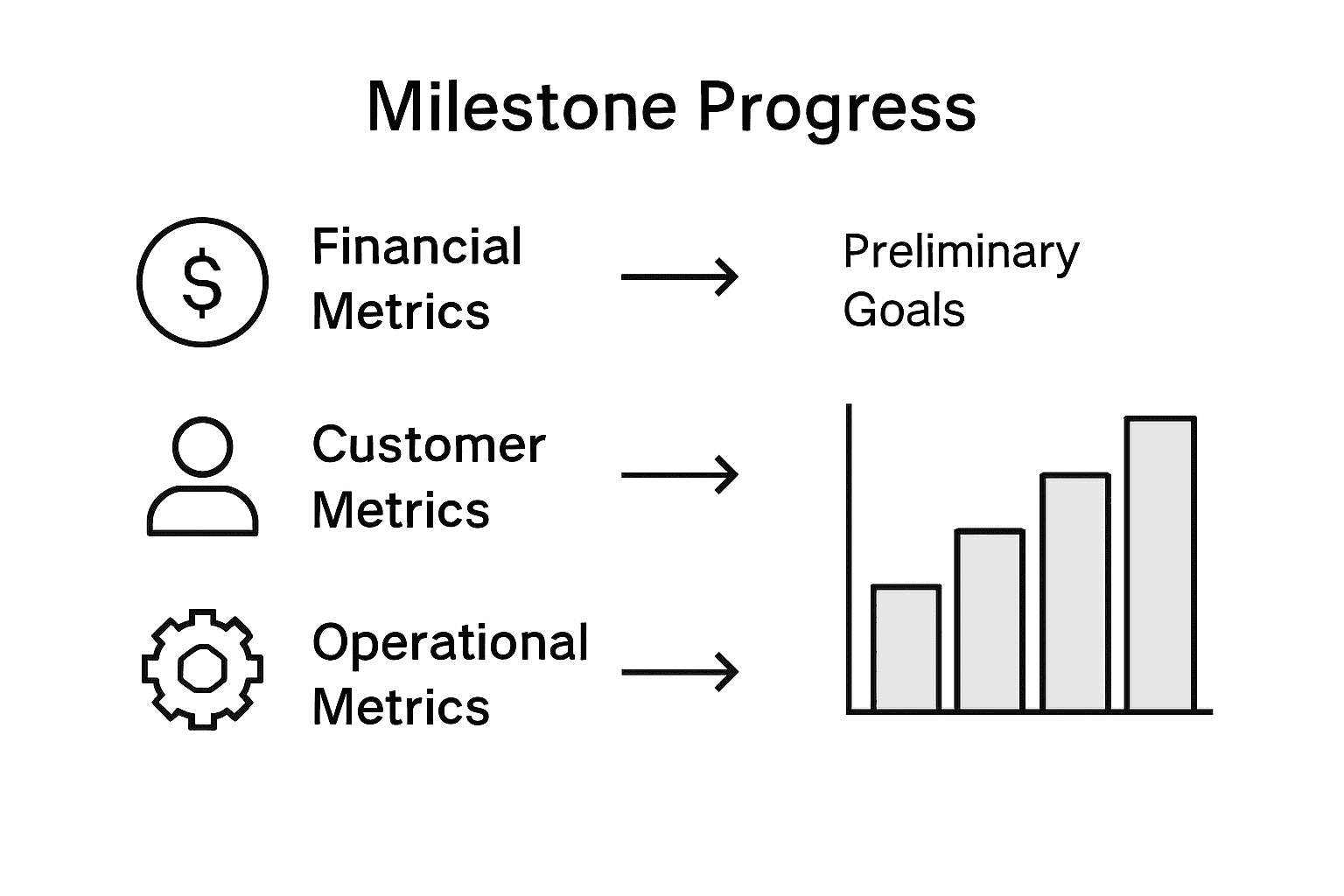
To help structure your progress tracking, here’s a quick reference to common performance metrics:
| Metric Type | Example Metric | What It Reveals |
|---|---|---|
| Financial | Monthly revenue | Sales success and growth pace |
| Customer | New customers per month | Effectiveness in attracting buyers |
| Marketing | Conversion rate | Efficiency turning leads to sales |
| Product/Service | User retention rate | Customer satisfaction and loyalty |
| Operational | On-time delivery percent | Reliability of business processes |
Implement a quarterly review process that combines data analysis with strategic reflection. During these reviews, compare your actual performance against initial projections, identify emerging patterns, and recalibrate your strategies accordingly. Be prepared to make swift, data-driven decisions that optimize your business model. Treat these reviews as opportunities for learning and adaptation, not just performance evaluation.
Pro tip: Create a visual progress tracker that breaks down complex goals into weekly and monthly milestones, making your long-term objectives feel more manageable and immediate.
Accelerate Your Entrepreneurial Journey with Nomad Excel
The “Execution Focused Entrepreneurship Guide for Fast Growth” emphasizes the challenges of turning vision into action, validating impactful ideas, and building scalable systems while maintaining accountability. If you are feeling stuck trying to implement clear processes or overwhelmed by the need for fast, measurable results, Nomad Excel offers solutions designed exactly for these pain points. Our immersive Entrepreneurship Archives provide structured frameworks and mentorship that transform entrepreneurial ambition into daily execution.
Join hands with like-minded founders in our hands-on bootcamps or energizing company retreats where you will gain clarity, sharpen your strategy, and embrace accountability through powerful community support. With direct guidance from seasoned entrepreneurs and practical tools for rapid validation and growth, Nomad Excel helps you bridge the gap between ideas and real outcomes. Start your fast-growth journey today by exploring our offerings at Nomad Excel and discover fresh inspiration in our Inspiration Archives. Take control of your growth path now and convert vision into action that truly scales.
Frequently Asked Questions
How can I create a clear and actionable vision for my business?
To create a clear and actionable vision, reflect on your core motivations and define the specific problem you want to solve. Write your vision statement in powerful language that reflects your long-term goals and the impact you want to create.
What steps should I take to validate my business ideas effectively?
To validate your business ideas, start by conducting comprehensive market research to understand your potential customers and competitors. Develop a structured evaluation matrix to score each idea based on key factors like market size and revenue potential, and focus on the top ideas with the strongest prospects.
How do I design scalable systems for my business?
To design scalable systems, identify your core business processes and document each workflow with clear protocols that can be easily replicated. Integrate technology solutions that allow for automation and adaptability as your business grows, ensuring efficiency and consistency in operations.
What should I look for when engaging mentors and accountability partners?
When engaging mentors and accountability partners, seek individuals who have experience in your industry and align with your values. Establish a structured engagement plan, including regular check-in meetings, to maintain focus on your goals and receive constructive feedback.
How can I track progress and measure results effectively?
To track progress and measure results, establish clear key performance indicators (KPIs) that align with your business objectives. Create a comprehensive tracking system that combines quantitative and qualitative metrics, and conduct quarterly reviews to assess performance and adjust strategies as needed.
Comments are closed.