
Business Idea Validation: Ensuring Real Market Demand
Over half of all American startups fail by their fifth year, yet many of these losses could be avoided with better business idea validation. Testing a concept before diving in saves time, money, and energy. Discover proven strategies to make sure your next big idea matches real market demand so you can set your American venture on a path toward real, lasting growth.
Table of Contents
- Defining Business Idea Validation and Its Importance
- Validation Methods: From MVPs to Customer Interviews
- Crucial Steps to Assessing Market Demand
- Common Pitfalls and How to Avoid Them
- Real-World Examples and Validation Success Stories
Key Takeaways
| Point | Details |
|---|---|
| Business Idea Validation is Essential | It ensures entrepreneurs assess the viability of their business concepts, reducing financial risks before major investments. |
| Utilize Multiple Validation Methods | Employ techniques like Minimum Viable Products and customer interviews to gather actionable insights and refine business offerings. |
| Avoid Common Pitfalls | Stay aware of biases and assumptions that can derail validation; actively seek challenges to initial ideas and validate through customer feedback. |
| Learn from Successful Examples | Study real-world success stories to understand effective validation strategies and the importance of addressing genuine market needs. |
Defining Business Idea Validation and Its Importance
Business idea validation represents a critical strategic process where entrepreneurs systematically evaluate the potential success of a new business concept before investing significant resources. Idea validation involves systematically testing a business concept to determine its viability, enabling founders to understand market dynamics and reduce potential financial risks.
At its core, business idea validation is a methodical approach designed to confirm whether a proposed business solution genuinely addresses an existing market need. This process helps entrepreneurs move beyond assumptions and gather concrete evidence about potential customer interest, market size, and competitive landscape. By assessing the viability of a business concept before significant resources are invested, entrepreneurs can make informed decisions that dramatically improve their chances of success.
The validation process typically involves several key components that transform an abstract concept into a potentially viable business opportunity. These components include:
- Conducting market research to understand target customer segments
- Analyzing competitor offerings and market gaps
- Developing preliminary product or service prototypes
- Gathering direct customer feedback through surveys and interviews
- Assessing financial feasibility and potential revenue models
Pro Tip: Market Validation Strategy: Create a simple landing page or prototype to gauge real customer interest before fully developing your product, measuring engagement through sign-ups or pre-orders to validate your core business concept.
Successful business idea validation ultimately serves as a critical risk mitigation strategy. It transforms entrepreneurial intuition into data-driven insights, helping founders avoid costly mistakes and pivot or refine their concepts based on real-world feedback. By investing time in thorough validation, entrepreneurs significantly increase their probability of building sustainable, profitable businesses.
Validation Methods: From MVPs to Customer Interviews
Minimum Viable Product (MVP) represents one of the most powerful techniques for entrepreneurs to test business concepts with minimal investment. A Minimum Viable Product is a version of a product with just enough features to be usable by early customers, allowing businesses to gather feedback for future development, enabling founders to validate core assumptions quickly and cost-effectively.
Customer interviews form another critical validation method, offering direct insights into market needs and potential product reception. Combining interviews with potential customers and analyzing existing market data are effective methods for understanding customer needs and refining product features. These interviews help entrepreneurs move beyond theoretical assumptions and gather nuanced, qualitative feedback about their business concept.
Entrepreneurs can leverage multiple validation methods to comprehensively assess their business idea:
- Minimum Viable Product (MVP): Create a basic product version
- Customer Interviews: Conduct in-depth conversations with target market
- Landing Page Testing: Build a simple website to measure interest
- Prototype Demonstrations: Show initial product concept to potential users
- Survey Research: Collect quantitative data from broader audience
The key is selecting validation methods that provide meaningful, actionable insights while minimizing resource expenditure. Each method offers unique advantages in understanding market potential and refining business strategies.
Pro Tip: Rapid Validation Approach: Design your MVP to answer specific, measurable questions about your business concept, focusing on core features that demonstrate fundamental value proposition and customer interest.
Successful validation requires a systematic, open-minded approach. Entrepreneurs must be prepared to pivot or modify their original concept based on real-world feedback, transforming initial hypotheses into robust, market-driven business strategies.
Here’s a comparison of popular business idea validation methods and their business impact:
| Validation Method | What It Does | Business Impact |
|---|---|---|
| Minimum Viable Product | Tests essential features with early users | Reduces investment risk |
| Customer Interviews | Reveals in-depth user preferences | Shapes offerings to address real needs |
| Landing Page Testing | Gauges interest via sign-ups or clicks | Validates market demand pre-launch |
| Survey Research | Captures broad quantitative feedback | Informs product direction and pricing |
| Prototype Demonstration | Shows tangible concept to target users | Pinpoints usability and appeal issues |
Crucial Steps to Assessing Market Demand
Market demand assessment is a systematic process that transforms entrepreneurial ideas into validated business opportunities. Assessing market demand involves conducting customer interviews, online surveys, competitor analysis, and market sizing research, providing entrepreneurs with comprehensive insights into potential business viability.

Entrepreneurs can leverage multiple analytical techniques to gauge market potential effectively. Utilizing survey data and Bayesian analysis provides a cost-efficient method to estimate customer equity and assess market demand, enabling founders to make data-driven decisions about their business concepts. This approach helps predict future customer value and understand competitive market dynamics.
The crucial steps for comprehensive market demand assessment include:
- Problem Verification: Confirm the genuine existence of customer pain points
- Market Sizing: Estimate total addressable market and potential revenue
- Competitor Analysis: Evaluate existing solutions and market gaps
- Customer Segmentation: Identify specific target audience characteristics
- Pricing Research: Understand willingness to pay for proposed solution
Each step requires careful investigation and objective analysis. Entrepreneurs must remain open to insights that might challenge their initial assumptions, using data to refine their business strategy.
Pro Tip: Market Research Strategy: Create a structured research plan with clear objectives, combining both quantitative surveys and qualitative interviews to gain nuanced market insights.
Successful market demand assessment goes beyond simple data collection. It requires a holistic approach that integrates multiple research methods, transforming raw information into actionable business intelligence that can guide strategic decision-making.
Common Pitfalls and How to Avoid Them
Entrepreneurs often encounter significant challenges during business idea validation that can derail their most promising concepts. Common pitfalls in business idea validation include neglecting customer feedback, overestimating market demand, and failing to differentiate from competitors, creating substantial risks for new business ventures.
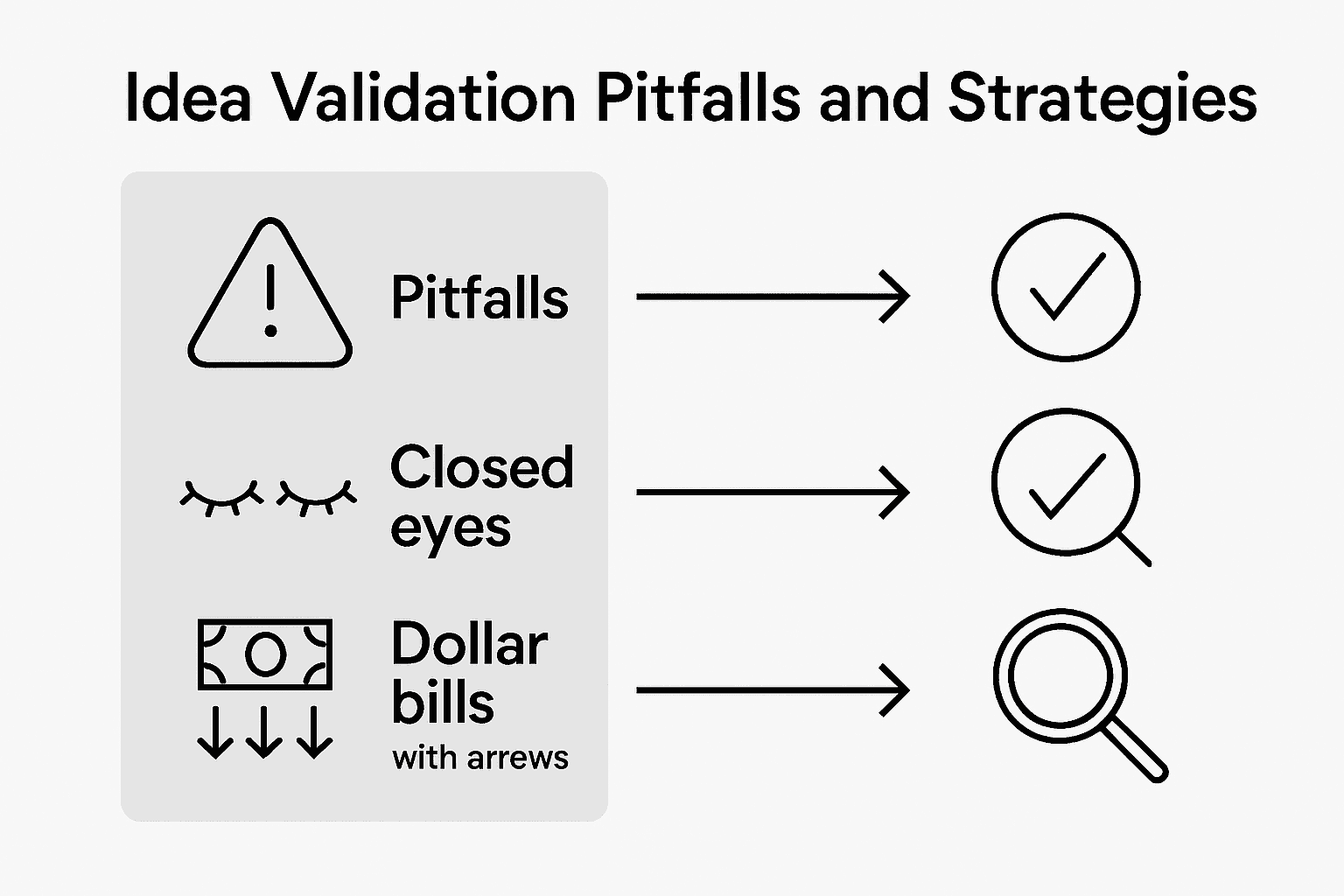
Confirmation bias represents one of the most dangerous traps for entrepreneurs, leading them to selectively interpret information that supports their preconceived notions. Failing to validate a business idea can lead to wasted resources and business failure, making it critical to approach validation with objective, systematic thinking.
Key pitfalls entrepreneurs must vigilantly guard against include:
- Confirmation Bias: Ignoring evidence that contradicts initial assumptions
- Market Misunderstanding: Assuming customer needs without direct validation
- Premature Scaling: Investing heavily before proving core business concept
- Competitive Blindness: Underestimating or overlooking existing market solutions
- Resource Misallocation: Spending money on unvalidated product features
Each potential pitfall represents a critical point where entrepreneurs must remain intellectually honest and open to challenging their original hypotheses. Successful validation requires constant scrutiny and willingness to adapt.
Pro Tip: Objective Validation Approach: Actively seek feedback that might prove your initial idea wrong, treating criticism as valuable information rather than a personal challenge.
Ultimately, avoiding these common pitfalls demands a disciplined, data-driven approach to business idea validation. Entrepreneurs who develop the skill of objective self-assessment and maintain flexibility in their thinking are most likely to transform promising concepts into successful ventures.
Below is a summary of common business idea validation pitfalls and strategies to avoid them:
| Pitfall | Description | How to Avoid |
|---|---|---|
| Confirmation Bias | Favoring data that supports assumptions | Seek disconfirming evidence |
| Market Misunderstanding | Basing plans on assumed needs | Collect direct customer feedback |
| Premature Scaling | Investing heavily without proof of concept | Validate core demand first |
| Competitive Blindness | Ignoring existing market solutions | Analyze market thoroughly |
| Resource Misallocation | Spending on unnecessary features | Prioritize validated requirements |
Real-World Examples and Validation Success Stories
Business idea validation transforms theoretical concepts into real-world success stories, demonstrating the power of systematic market research and customer-focused development. The Lean Startup methodology emphasizes rapid experimentation and customer feedback to validate business ideas, with companies like Dropbox and Airbnb successfully using this approach to test assumptions and achieve market fit, proving that rigorous validation can lead to extraordinary entrepreneurial outcomes.
Some of the most compelling validation success stories emerge from solving genuine market challenges. M-PESA, a mobile money transfer service, validated its business idea by addressing a significant gap in areas with limited banking infrastructure, demonstrating how deep market understanding can create transformative business solutions that generate substantial social and economic impact.
Key insights from successful validation stories include:
- Iterative Development: Continuously refining product based on customer feedback
- Problem-First Approach: Identifying genuine market needs before developing solutions
- Minimal Initial Investment: Testing concepts with low-cost, high-learning strategies
- Rapid Experimentation: Quick iterations and pivots based on real-world data
- Customer-Centric Design: Prioritizing user experience and actual market demands
These successful entrepreneurs share a common characteristic: an unwavering commitment to understanding their potential customers’ true needs and challenges.
Pro Tip: Learning Validation Strategy: Study successful startup case studies, focusing on how they identified and validated their core business hypotheses before significant investment.
True validation success goes beyond theoretical frameworks. It represents a profound commitment to transforming abstract ideas into meaningful solutions that genuinely address market challenges and create substantial value for customers.
Accelerate Your Business Idea Validation with Expert Guidance and Community Support
Validating your business idea to ensure real market demand can be challenging. You might be struggling with confirming customer needs, avoiding common pitfalls like confirmation bias, or figuring out how to efficiently gather market feedback. If the thought of creating an MVP or conducting customer interviews feels overwhelming, you are not alone. This process requires clarity, methodical research, and a supportive environment to transform assumptions into actionable insights.
At Nomad Excel, we provide immersive Entrepreneurship Archives bootcamps designed specifically to tackle these challenges head-on. Our step-by-step frameworks guide you through idea validation, refining your offer, and building scalable business strategies. With hands-on mentorship and a powerful community, you gain the confidence to test, pivot, and prove your concept before heavy investment. Don’t let uncertainty stall your progress. Join our programs to accelerate your journey from idea to market-ready business treated with focus, execution, and support.
Take the next step toward ensuring your business idea meets real market demand by exploring how Nomad Excel can help you grow faster through action. Visit Nomad Excel today and start turning your vision into validated success.
Frequently Asked Questions
What is business idea validation?
Business idea validation is a strategic process where entrepreneurs systematically evaluate the potential success of a business concept before investing significant resources, helping to confirm if it addresses an existing market need.
Why is business idea validation important?
It is crucial because it allows entrepreneurs to make informed decisions, reducing financial risks by gathering concrete evidence about customer interest, market size, and competition before launching a product or service.
What are some common methods for validating a business idea?
Common methods include creating a Minimum Viable Product (MVP), conducting customer interviews, testing landing pages, collecting survey data, and demonstrating prototypes to potential users for feedback.
How can entrepreneurs assess market demand for their business ideas?
Entrepreneurs can assess market demand by conducting customer interviews, market sizing research, competitor analysis, and gathering feedback through surveys to gain comprehensive insights into their business viability.
Recommended
- What Is Business Ideation? Complete Expert Guide – Nomad Excel – Your Entrepreneurial Adventure Starts Here
- Step by Step Business Launch: Guide to Starting Strong
- 7 Must-Have Skills for an Entrepreneurship Skills Checklist – Nomad Excel – Your Entrepreneurial Adventure Starts Here
- Before You Build: 8 Signals Your Niche Has Real Money – Nomad Excel – Your Entrepreneurial Adventure Starts Here
Comments are closed.