
Entrepreneurship Bootcamp Step by Step: Launch and Scale Fast
Every year, more than 4 million new american businesses launch yet only a fraction achieve lasting success. Vision, feedback, testing, systems, mentorship, and constant evaluation play a key role in transforming an idea into a robust enterprise. Whether you are just starting your entrepreneurial journey or looking to fine-tune your current approach, understanding these critical steps can help you build a foundation for sustained growth in a competitive market.
Table of Contents
- Step 1: Define Your Vision And Set Actionable Goals
- Step 2: Validate Your Business Idea With Expert Feedback
- Step 3: Refine Your Offer Through Iterative Testing
- Step 4: Build Scalable Systems For Execution
- Step 5: Leverage Mentorship And Community For Growth
- Step 6: Evaluate Results And Optimize Your Strategy
Quick Summary
| Key Insight | Explanation |
|---|---|
| 1. Define a clear vision | Establish a focused entrepreneurial vision by articulating the problem you solve and the unique value you provide. |
| 2. Set SMART goals | Formulate goals that are Specific, Measurable, Achievable, Relevant, and Time-bound to turn your vision into actionable plans. |
| 3. Validate with expert feedback | Seek constructive criticism from industry experts and mentors to refine your business idea and ensure its market viability. |
| 4. Use iterative testing | Develop a Minimum Viable Product (MVP) and gather customer feedback through testing to improve your offering continuously. |
| 5. Build scalable systems | Create automated and standardized processes that can grow with your business, facilitating efficient operation and management. |
Step 1: Define your vision and set actionable goals
Building a successful entrepreneurial journey starts with crystal clear vision and strategic goal setting. According to the SMART framework outlined by OpenStax, your goals need to be precise roadmaps that transform abstract dreams into tangible achievements.
Crafting an effective vision requires deep personal reflection and honest assessment of your entrepreneurial aspirations. Begin by asking yourself fundamental questions: What problem am I solving? Who will benefit from my solution? What unique value can I bring to the marketplace? Write down your responses in a clear, concise statement that captures the essence of your entrepreneurial mission.
To transform your vision into actionable goals, apply the SMART criteria rigorously. Each goal should be Specific (clearly defined), Measurable (quantifiable), Achievable (realistic), Relevant (aligned with your vision), and Time-bound (with precise deadlines). For instance, instead of saying “I want to grow my business,” a SMART goal would be “Increase monthly revenue by 25% within the next six months by developing three new service offerings and expanding my client base.”
Warning: Avoid the common trap of setting vague or overly ambitious goals. Your objectives should stretch your capabilities without breaking your motivation. Break larger goals into smaller, manageable milestones that provide consistent momentum and allow for strategic adjustments along your entrepreneurial path.
As you complete this vision and goal-setting stage, you are laying the critical foundation for your entrepreneurial blueprint.
 The next step will involve translating these strategic intentions into concrete action plans that will propel your business forward.
Step 2: Validate your business idea with expert feedback
Validating your business concept requires strategic insights and targeted feedback from experienced professionals. According to research from arXiv, successful entrepreneurs leverage structured experimentation and expert perspectives to transform creative ideas into viable solo businesses.
Start by developing a preliminary business model that clearly articulates your value proposition. Seek out mentors, industry experts, and potential customers who can provide candid and constructive criticism. The Market Opportunity Navigator recommends systematically evaluating market opportunities by generating multiple potential scenarios and rigorously assessing their attractiveness and feasibility.
To gather meaningful feedback, prepare a concise pitch that outlines your business concept, target market, unique value proposition, and initial revenue model. Attend networking events, join entrepreneurial groups, participate in startup meetups, and leverage online platforms to connect with experienced professionals who can offer nuanced insights. Be open to critical feedback and view each conversation as an opportunity to refine and strengthen your business idea.
Warning: Avoid the trap of confirmation bias. Not all feedback will be positive, and that is precisely the point. Constructive criticism helps identify potential weaknesses in your business model before you invest significant time and resources.
As you complete this validation stage, you will have a much clearer understanding of your business idea’s potential and the necessary adjustments to increase its market viability.
The next step involves transforming these insights into a more robust and refined business strategy.
Step 3: Refine your offer through iterative testing
Iterative testing represents the critical bridge between initial business concepts and market success. According to research from arXiv, successful entrepreneurs utilize systematic testing frameworks to progressively improve their business offerings through strategic experimentation.
Begin by creating a minimum viable product (MVP) that captures the core value of your business proposition. Entrepreneurship research emphasizes that innovation thrives on continuous refinement. Test your MVP with a small group of target customers, gathering detailed feedback on functionality, perceived value, and potential improvements. Pay close attention to both quantitative metrics and qualitative insights that reveal deeper customer needs and preferences.
Develop a structured feedback collection process that goes beyond surface level responses. Use surveys, direct interviews, and observation to understand how customers interact with your product. Create multiple iterations of your offering, making incremental improvements based on real world user experiences. Track key performance indicators that demonstrate the impact of each refinement, such as user engagement, satisfaction rates, and conversion metrics.
Warning: Avoid falling in love with your initial concept. Successful entrepreneurs remain flexible and willing to pivot when data suggests fundamental changes are necessary. Your ability to objectively analyze feedback and make strategic adjustments will ultimately determine your business success.
As you complete this testing phase, you will have transformed your initial idea into a more robust and market responsive offering. The next step involves developing a comprehensive strategy to bring your refined product to a broader audience.
Step 4: Build scalable systems for execution
Building scalable systems is the critical infrastructure that transforms entrepreneurial potential into sustainable business growth. According to Entrepreneurship research, successful businesses establish robust frameworks that can adapt and expand as their operations evolve.
Start by identifying key repeatable processes in your business model. arXiv research suggests leveraging technological solutions to automate and optimize workflows, effectively creating digital systems that function like co-founders. Focus on developing standardized procedures for critical business functions such as customer acquisition, service delivery, financial management, and communication protocols. Document each process meticulously, ensuring that any team member can understand and execute the workflow with minimal guidance.
Implement technology tools that enable seamless scalability. Select software platforms and digital solutions that can grow alongside your business, integrating customer relationship management systems, project management tools, automated marketing platforms, and cloud based collaboration technologies. Prioritize solutions that offer API integrations and allow for future customization as your business needs become more complex.
Warning: Avoid the temptation to over engineer your systems early on. Start with lean, flexible infrastructure that can be incrementally enhanced. Your systems should support your business growth without becoming unnecessarily complicated or cost prohibitive.
As you complete this systems building stage, you will have established a solid operational foundation that enables consistent performance and future expansion. The next step involves creating strategies for sustainable team growth and organizational development.
Step 5: Leverage mentorship and community for growth
Mentorship and community engagement represent powerful accelerators for entrepreneurial success. According to arXiv research, strategic human connections can dramatically transform an entrepreneur’s trajectory, complementing technological solutions with invaluable personal insights.
Proactively build your professional network by attending industry events, joining entrepreneurial groups, and connecting with experienced professionals in your field. Entrepreneurship research highlights that meaningful mentorship goes beyond casual advice. Seek mentors who have successfully navigated challenges similar to your current business stage and who can provide targeted guidance. Develop genuine relationships by offering value, demonstrating commitment, and showing a willingness to learn and implement feedback.
Create a diverse support ecosystem that includes mentors, peer entrepreneurs, and potential collaborators. Participate in mastermind groups, online forums, and professional communities where you can exchange ideas, receive constructive criticism, and gain perspective from individuals with varied experiences. Look for mentorship opportunities that accelerate growth through structured programs, workshops, and collaborative environments that challenge your thinking and expand your strategic capabilities.
Warning: Not all mentorship relationships are created equal. Be selective about whose advice you internalize. Look for mentors who have demonstrable success in areas directly relevant to your entrepreneurial goals and who can provide both strategic insights and emotional support.
As you complete this mentorship and community building stage, you will have established a robust support network that provides ongoing learning, accountability, and inspiration. The next step involves translating these relationships and insights into concrete business strategies and actionable growth plans.
Step 6: Evaluate results and optimize your strategy
Successful entrepreneurs understand that continuous improvement requires systematic result evaluation and strategic optimization. arXiv research highlights the importance of leveraging data driven insights to refine business approaches, with emerging technologies offering powerful analytical capabilities.
Establish a comprehensive performance tracking system that captures key metrics across all critical business dimensions. According to Goal Setting research, effective evaluation requires setting clear benchmarks and measuring progress against predefined objectives. Create a dashboard that tracks financial performance, customer acquisition rates, product development milestones, and operational efficiency. Schedule regular review sessions where you critically analyze these metrics, identifying patterns of success and areas requiring strategic adjustment.
Develop a disciplined approach to strategic optimization by treating each data point as an opportunity for improvement. Break down your performance metrics into granular components, understanding the underlying drivers of both successful and underperforming areas. Implement a continuous feedback loop where insights from one evaluation cycle directly inform strategy modifications in the next. Be prepared to make swift, decisive changes when data suggests a particular approach is not yielding expected results.
Warning: Avoid analysis paralysis. While data is crucial, do not get so caught up in measurement that you lose momentum. Use metrics as a guide, not a constraint. Maintain the agility to make intuitive decisions when quantitative data does not tell the complete story.
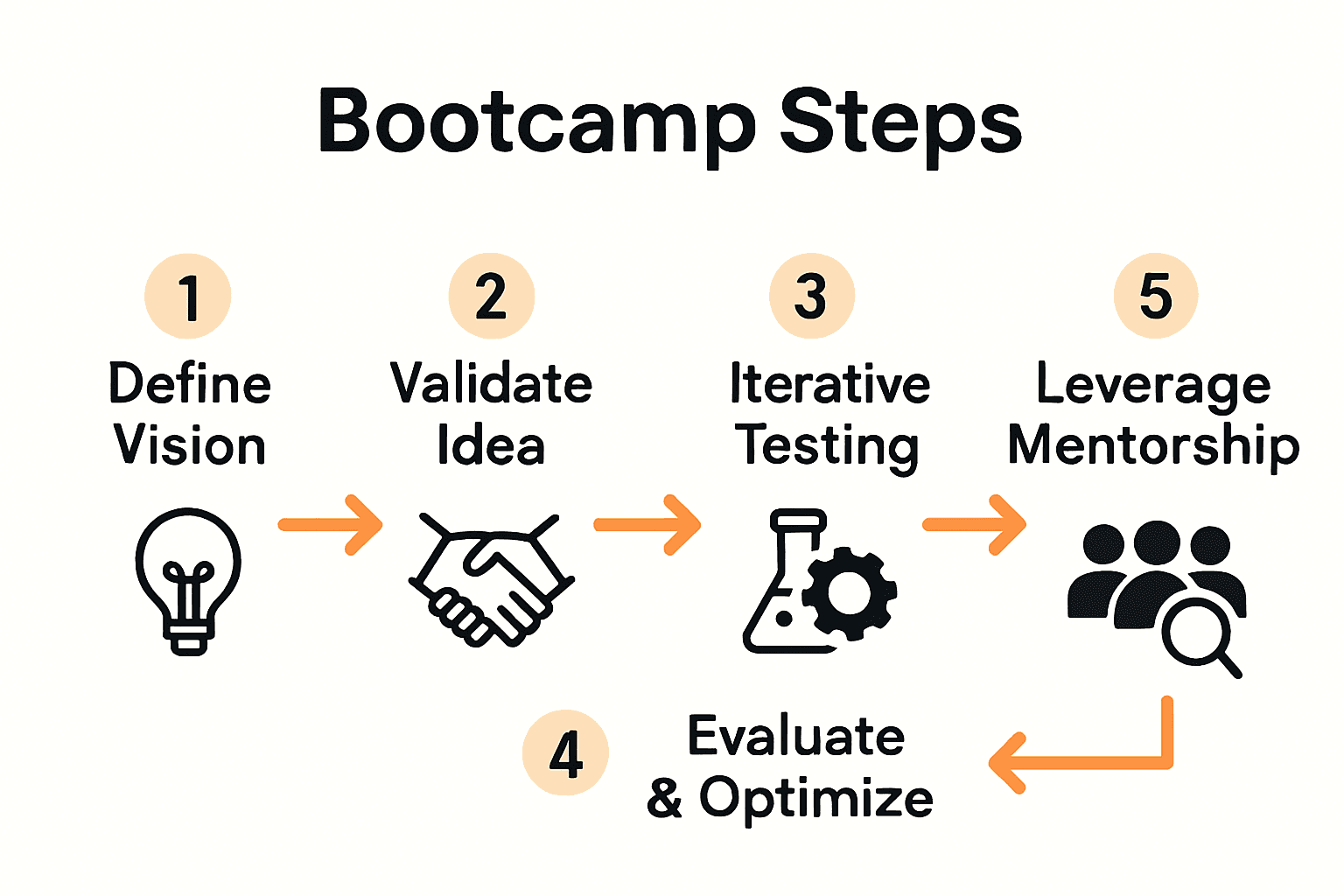
As you complete this evaluation and optimization stage, you will have developed a robust framework for ongoing business refinement. The next phase involves scaling your validated strategies and preparing for sustainable, long term growth.
Accelerate Your Entrepreneurial Journey with Nomad Excel
If you are striving to translate your vision into clear goals and build scalable systems but feel overwhelmed by the complexity of launching and growing your business fast you are not alone. This article highlights the critical challenges around validating ideas, refining offers through iterative testing and leveraging mentorship and community for sustained growth. The struggle to balance strategic planning with hands-on execution can leave many entrepreneurs stuck in planning without meaningful progress.
Nomad Excel’s Entrepreneurship Archives address these exact pain points through immersive bootcamps designed to help you move from goals to consistent action. Experience step-by-step frameworks, mentorship from seasoned founders, and the power of a driven community focused on real-world results. Your journey from idea validation to scaling operations becomes clearer and faster when you do not have to figure it all out alone.
Discover programs tailored for entrepreneurs ready to launch or scale at Program Archives. Don’t let uncertainty hold you back. Take bold steps today by exploring how Nomad Excel can sharpen your strategy and accelerate growth. Visit Nomad Excel to join a bootcamp that transforms entrepreneurial ambitions into thriving businesses.
Frequently Asked Questions
How do I define my entrepreneurial vision?
To define your entrepreneurial vision, reflect on what problem you aim to solve and who will benefit from your solution. Write a clear statement that encapsulates your aspirations and unique value. Spend time on this step to ensure clarity in your objectives and direction.
What are the SMART criteria for setting goals?
SMART stands for Specific, Measurable, Achievable, Relevant, and Time-bound. Ensure that your goals are clearly defined and have specific deadlines, like “Increase monthly revenue by 25% within the next six months” to maintain focus and motivational momentum.
How can I validate my business idea?
Validate your business idea by seeking feedback from mentors, industry experts, and potential customers. Pitch your concept and ask for constructive criticism to strengthen your business model before investing further resources.
What steps should I take for iterative testing of my product?
Start by creating a minimum viable product (MVP) that captures the core value of your idea. Test it with target customers and gather comprehensive feedback to make data-driven improvements over several iterations, each ideally taking 4–6 weeks.
How do I build scalable systems for my business?
Identify key repeatable processes in your business and document them accurately. Implement technology solutions that can grow with your business, establishing standardized procedures for efficient operations and creating a foundation for sustainable growth.
What are effective ways to engage with mentorship and community?
Proactively build your network by attending entrepreneurial events and joining professional groups. Look for mentors who can provide targeted guidance based on their successes in similar business stages and engage consistently for maximum value.
Recommended
- The Founder Journey Map: Navigating the Startup Phase
- Entrepreneurship Skills Guide for Launching Your Own Venture – Nomad Excel – Your Entrepreneurial Adventure Starts Here
- What Is Early-Stage Entrepreneurship? Complete Guide – Nomad Excel – Your Entrepreneurial Adventure Starts Here
- 7 Key Benefits of Entrepreneurship Bootcamps for Growth – Nomad Excel – Your Entrepreneurial Adventure Starts Here
- 3rd Bootcamp : Create Website + Blog Articles + Social Media Content in 6 hours – team I
Comments are closed.