
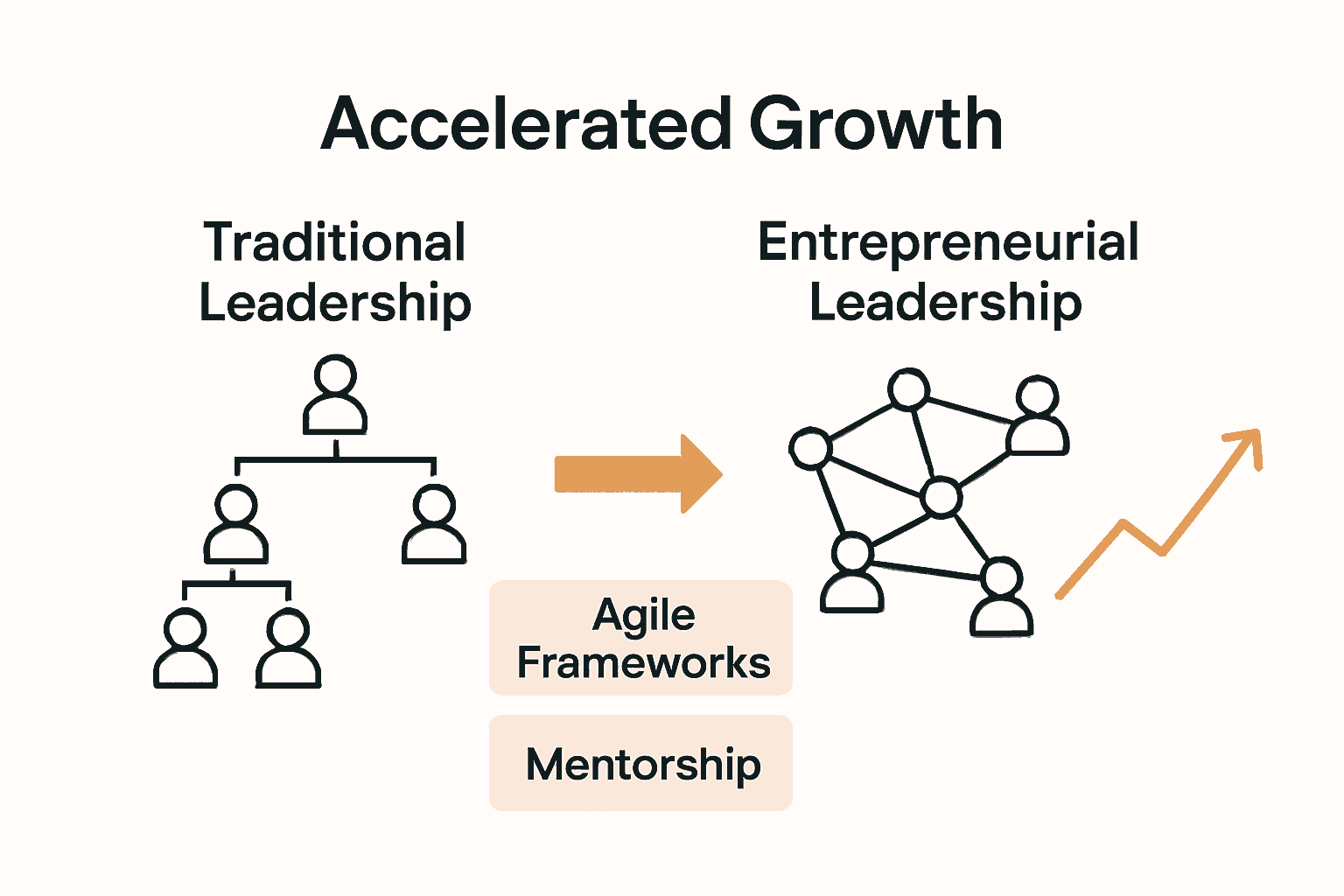
Entrepreneurial Leadership Guide for Accelerated Growth
Did you know that entrepreneurs who clearly define their vision are up to 60 percent more likely to achieve lasting business growth? Setting a powerful direction helps you rally your team and adapt swiftly in a changing market. Whether you are launching a startup or scaling an existing business, learning how to craft your vision, build strong teams, and measure success can transform your leadership approach in practical, measurable ways.
Table of Contents
- Step 1: Define Your Vision And Leadership Objectives
- Step 2: Build An Empowered And Aligned Team Culture
- Step 3: Implement Agile Execution Frameworks
- Step 4: Foster Mentorship And Collaborative Community
- Step 5: Evaluate Outcomes And Adapt For Continual Growth
Quick Summary
| Key Point | Explanation |
|---|---|
| 1. Define a clear vision | Develop a compelling business vision that goes beyond financial goals to inspire your team and guide your strategy. |
| 2. Build an empowered team culture | Foster a collaborative environment where team members feel valued and engaged, leading to enhanced performance and innovation. |
| 3. Implement agile execution frameworks | Break down goals into short-term sprints to stay adaptable and continuously improve based on feedback and insights. |
| 4. Establish mentorship opportunities | Create structured mentorship programs to facilitate knowledge sharing and mutual growth among team members. |
| 5. Regularly evaluate and adapt strategies | Use a comprehensive framework for ongoing performance assessment to make informed adjustments that support long-term growth. |
Step 1: Define your vision and leadership objectives
As an entrepreneur, defining a clear vision and leadership objectives is your strategic roadmap to transformative business success. According to research from ecu.edu.au, entrepreneurial leadership fundamentally involves articulating a compelling vision and setting strategic objectives that drive innovation and business growth.
Start by reflecting deeply on your core mission. What problem are you solving? Who are you serving? Your vision should transcend mere financial goals and connect with a meaningful purpose that energizes both you and your team. Sketch out a vivid picture of where you want your business to be in 3 to 5 years. This isn’t about creating a rigid blueprint but developing a flexible strategic narrative that can adapt as you learn and grow.
To crystallize your objectives, break down your overarching vision into specific, measurable goals. Research from mdpi.com emphasizes that effective entrepreneurial leaders establish long-term objectives guiding their organizations toward sustainable development. Consider creating objectives across multiple dimensions:
- Business performance metrics
- Team development and culture
- Personal leadership growth
- Customer impact and value creation
Pro Tip: Review and recalibrate your vision quarterly. Successful entrepreneurs treat their strategic vision as a living document that evolves with market insights and personal growth.
As you move forward, your clearly defined vision will become a powerful compass guiding critical decisions and inspiring your team toward collective achievement. The next step is transforming these objectives into actionable strategies that propel your entrepreneurial journey.
Step 2: Build an empowered and aligned team culture
Transforming your entrepreneurial vision into reality requires building a team culture that is not just functional but truly extraordinary. According to research from mdpi.com, fostering an organizational culture that emphasizes empowerment, collaboration, and emotional intelligence is critical for enhancing team effectiveness.
Start by establishing clear communication channels that promote transparency and mutual respect. This means creating an environment where every team member feels comfortable sharing ideas and providing honest feedback. Create regular opportunities for open dialogue through weekly check-ins, collaborative brainstorming sessions, and structured feedback mechanisms. Recognize that each team member brings unique perspectives and skills that contribute to your collective success.
Research from link.springer.com highlights that leadership promoting autonomy and a supportive structure cultivates an entrepreneurial orientation among team members. This means giving your team meaningful responsibilities and the freedom to make decisions. Set clear expectations and goals, but allow flexibility in how team members approach their work. Implement a framework that balances accountability with creative freedom.
- Establish transparent communication protocols
- Define clear roles and responsibilities
- Create opportunities for skill development
- Recognize and celebrate individual and team achievements

Pro Tip: Invest in team building activities that go beyond traditional professional settings. These experiences help build trust, understand individual strengths, and create deeper connections.
By intentionally designing a culture of empowerment and alignment, you transform your team from a group of individuals into a unified force capable of achieving exceptional results. Your next step is to develop systems that support this collaborative and dynamic team environment.
Step 3: Implement agile execution frameworks
Taking your entrepreneurial vision from concept to reality requires a strategic approach to execution that remains flexible and responsive. According to research from jbem.vilniustech.lt, adopting agile methodologies in leadership practices significantly enhances adaptability and responsiveness during different phases of entrepreneurship.
Begin by breaking down your overarching vision into smaller, manageable sprint cycles. This means creating short term goals typically spanning 2 to 4 weeks that allow you to test assumptions, gather feedback, and make rapid adjustments. Each sprint should have clear objectives, measurable outcomes, and built in mechanisms for reflection and learning. Prioritize tasks based on their potential impact and alignment with your core business strategy.
Research from mdpi.com emphasizes that entrepreneurial leaders who implement flexible and adaptive execution frameworks are better equipped to navigate uncertainties and drive sustainable growth. Consider implementing key agile practices such as:
- Daily standup meetings to synchronize team efforts
- Regular retrospective sessions to analyze performance
- Continuous feedback loops with customers and stakeholders
- Iterative product development with rapid prototyping
Pro Tip: Embrace the concept of “productive failure.” View setbacks not as obstacles but as valuable learning opportunities that refine your strategy and strengthen your team’s resilience.
By adopting an agile mindset, you transform execution from a rigid process into a dynamic journey of continuous improvement.
Your next step is to develop robust tracking and evaluation mechanisms that support this iterative approach to business growth.
Step 4: Foster mentorship and collaborative community
Building a thriving entrepreneurial ecosystem requires intentionally creating spaces where knowledge sharing and mutual growth become the cornerstone of your organizational culture. According to research from ouci.dntb.gov.ua, developing entrepreneurial leadership within teams involves creating a collaborative environment that supports mentorship and shared learning.
Start by establishing structured mentorship programs that connect team members across different skill levels and expertise. This means creating deliberate opportunities for experienced professionals to guide emerging talent through regular one on one sessions, skill transfer workshops, and cross functional project collaborations. Recognize that mentorship is a two way street where both mentors and mentees gain valuable insights and perspectives. Design these interactions to be organic and meaningful rather than formulaic or transactional.
Research from mdpi.com emphasizes that encouraging a culture of mentorship and collaboration among leaders and team members fosters innovation and collective problem solving. Implement strategies that create an open knowledge ecosystem:
- Create internal knowledge sharing platforms
- Host monthly learning and development workshops
- Establish peer to peer coaching circles
- Develop cross team project opportunities
Pro Tip: Encourage vulnerability and transparency in mentorship relationships. The most powerful learning happens when team members feel safe sharing both successes and challenges.
By cultivating a collaborative community that values continuous learning and mutual support, you transform your organization from a group of individual contributors into a dynamic learning network. Your next step is to develop systems that sustain and enhance this culture of collective growth and shared achievement.
Step 5: Evaluate outcomes and adapt for continual growth
Successful entrepreneurial leadership demands a rigorous approach to measuring performance and strategically evolving your business model. According to research from jbem.vilniustech.lt, assessing the impact of leadership factors across different entrepreneurship phases provides critical insights for making strategic adjustments that support sustained growth.
Develop a comprehensive evaluation framework that goes beyond traditional financial metrics. This means creating a holistic assessment system that captures quantitative and qualitative data across multiple dimensions of your business. Track key performance indicators, but also measure less tangible elements like team engagement, customer satisfaction, innovation potential, and alignment with your core vision. Use both quantitative metrics and narrative feedback to build a nuanced understanding of your organization’s performance and potential.
Research from mdpi.com emphasizes that continuous evaluation of leadership strategies enables organizations to adapt and thrive in dynamic environments. Implement a structured approach to outcome assessment:
- Conduct quarterly strategic review sessions
- Use data visualization tools for performance tracking
- Gather 360 degree feedback from team members
- Benchmark against industry standards and innovative competitors
Pro Tip: Treat your evaluation process as a learning opportunity. Approach performance data with curiosity and openness rather than judgment.
By creating a culture of continuous assessment and adaptive strategy, you transform periodic reviews from static reporting into a dynamic engine of organizational learning and growth. Your entrepreneurial journey becomes a responsive, intelligent system capable of constant refinement and breakthrough innovation.
Accelerate Your Entrepreneurial Leadership Journey with Nomad Excel
Entrepreneurial leadership is demanding. Defining a clear vision, building an empowered team culture, and executing with agility can feel overwhelming without the right support. This guide identifies the critical pain points many founders face — from maintaining strategic clarity to fostering collaboration and adapting swiftly in dynamic markets. If you want to move beyond theory and actually transform these challenges into revolutionary growth, you need a structured approach that combines mentorship, community, and real-world frameworks.
Nomad Excel offers immersive programs designed to help entrepreneurs like you sharpen leadership skills and speed up business success. Whether through our hands-on Entrepreneurship Archives bootcamps or tailored company retreats, you will gain access to proven frameworks, expert mentors, and a powerful network that sustains your growth beyond the classroom. Take control of your leadership journey today by exploring our Program Archives or jump right into an experience crafted to elevate your execution. Don’t wait to turn your vision into actionable results visit us at Nomad Excel and start accelerating your entrepreneurial adventure now.
Frequently Asked Questions
How can I effectively define my entrepreneurial vision for growth?
To define your entrepreneurial vision, reflect on the core mission of your business and the problems you aim to solve. Sketch a picture of where you want your business to be in 3 to 5 years, focusing on meaningful purpose beyond financial goals.
What are the key components of an empowered team culture?
An empowered team culture includes clear communication, defined roles, and opportunities for skill development. Establish transparent processes where team members can share their ideas freely, allowing for a collaborative environment that drives innovation.
How do I implement agile execution frameworks in my business?
To implement agile execution frameworks, break your vision into smaller sprint cycles, typically lasting 2 to 4 weeks. Each sprint should have clear objectives and allow for regular reflection and adjustments based on outcomes and team feedback.
What strategies can I use to foster mentorship within my team?
Foster mentorship by creating structured programs that connect team members of varying skill levels through one-on-one sessions and collaborative workshops. Focus on making these mentorship interactions meaningful and ongoing, encouraging both mentors and mentees to share insights.
How can I assess the effectiveness of my entrepreneurial leadership?
To assess your entrepreneurial leadership effectiveness, develop a holistic evaluation framework that measures both quantitative and qualitative outcomes. Conduct regular reviews, gather feedback from team members, and track performance indicators to inform adjustments and strategy.
What actions should I take for continual growth in my leadership approach?
For continual growth in your leadership approach, treat evaluations as learning opportunities, actively seeking insights from both successes and challenges. Aim to adjust strategies quarterly based on performance data, fostering a culture of adaptability and innovation.
Comments are closed.