
Business Growth in 2025: The Essential Guide
Most companies in 2025 are finding growth looks very different from just a few years ago. Nearly 80 percent of executives now say technological adaptability is the top driver of business success. The rise of generative AI and data-driven strategy means growth is about far more than sales numbers. If you want to keep up and thrive, you need to understand the fresh mix of innovation, agility, and digital transformation that defines business growth now.
Table of Contents
- Defining Business Growth in 2025
- Emerging Trends Shaping Growth Strategies
- Digital Nomadism and Remote Team Expansion
- Key Growth Drivers for Startups and SMEs
- Common Pitfalls and Mistakes to Avoid
Key Takeaways
| Point | Details |
|---|---|
| Holistic Growth Perspective | Business growth in 2025 involves viewing growth as a holistic ecosystem driven by technological advancements rather than just revenue increase. |
| Technological Convergence | Key trends such as AI, decentralized platforms, and personalization will reshape competitive positioning in organizations. |
| Digital Nomadism | Embracing remote work structures enables businesses to access global talent and create agile teams that can adapt swiftly. |
| Strategic Technology Integration | Successful companies will strategically integrate AI and data-driven methods while being mindful of ethical considerations and operational risks. |
Defining Business Growth in 2025
Business growth in 2025 is no longer just about increasing revenue or expanding market share. According to research from arXiv, the emergence of generative artificial intelligence (GenAI) is fundamentally transforming how businesses conceptualize and achieve growth.
Traditional growth metrics are being reimagined through the lens of technological innovation and adaptive capabilities. As insights from Wikipedia suggest, data has become a critical economic asset that drives strategic decision making and competitive advantage. Business growth now encompasses multiple interconnected dimensions:
- Technological adaptability
- Data-driven strategic planning
- AI-enhanced operational efficiency
- Scalable digital infrastructure
- Continuous learning and innovation
The most successful organizations in 2025 will view growth as a holistic ecosystem rather than a linear progression.
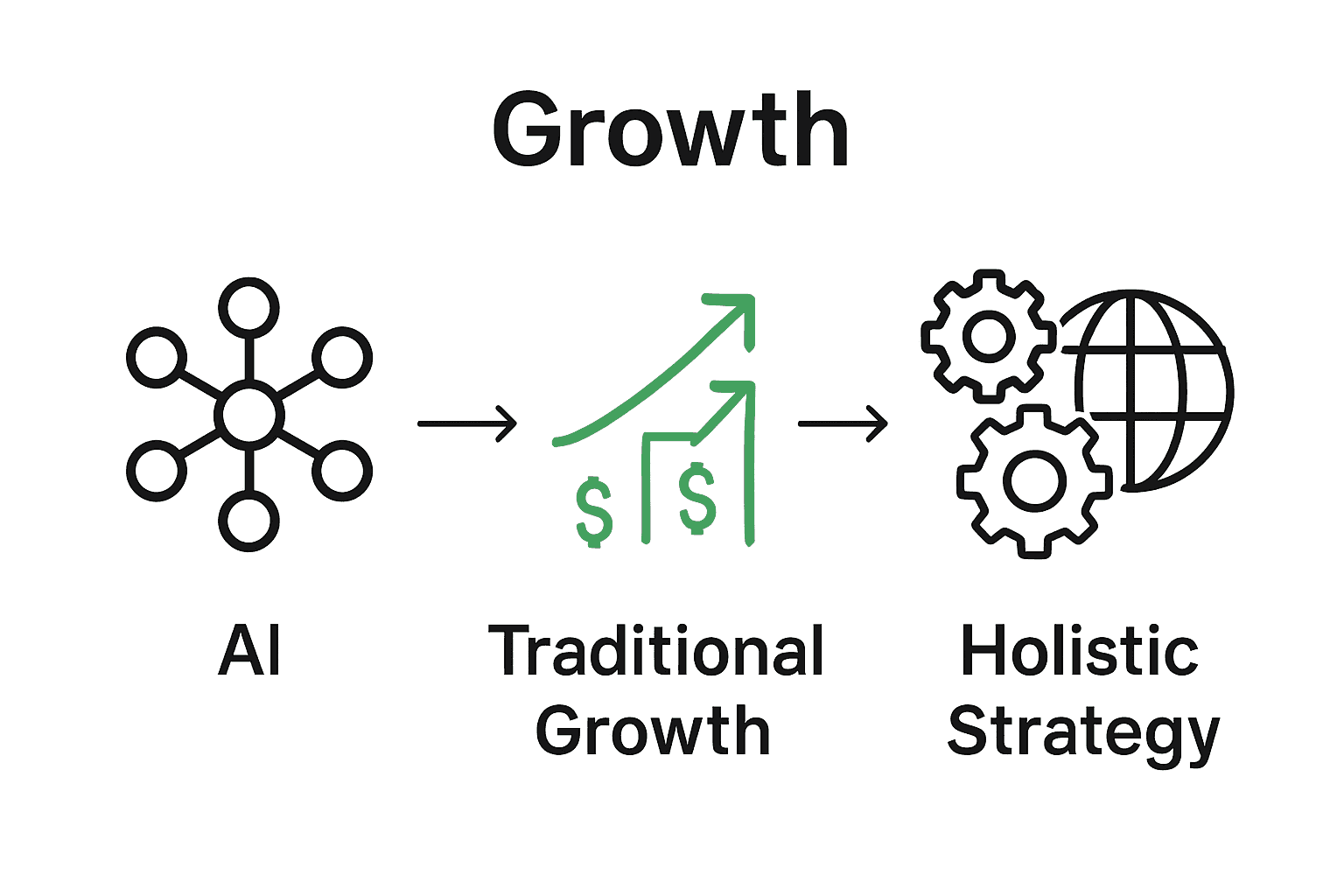 They’ll leverage advanced technologies like generative AI to create agile, responsive business models that can rapidly evolve with market dynamics. This means investing not just in products or services, but in intelligent systems that can learn, predict, and adapt in real time.
By understanding growth as a multifaceted journey of technological and human potential, businesses can position themselves to thrive in an increasingly complex and interconnected global marketplace.
Our comprehensive guide on personal business growth offers deeper insights into navigating these transformative changes.
Emerging Trends Shaping Growth Strategies
The business landscape of 2025 is being dramatically reshaped by a constellation of technological and strategic innovations. According to research from Promote Project, key trends are fundamentally transforming how organizations approach growth and competitive positioning.
The most significant trend is the technological convergence driving business strategy. As insights from the OECD highlight, the intersection of technologies like artificial intelligence, synthetic biology, and advanced data analytics is creating unprecedented opportunities for businesses willing to adapt and innovate.
Key emerging trends include:
- Digital payment ecosystem expansion
- Advanced cybersecurity frameworks
- AI-driven personalization strategies
- Decentralized technology platforms
- Cross-sector technological integration
Successful organizations in 2025 will be those that can rapidly incorporate these technological shifts into their core business models. This means developing adaptive strategies that aren’t just reactive, but proactively anticipate market transformations. The goal is creating resilient, intelligent business systems that can pivot quickly and leverage emerging technologies as competitive advantages.
Our team building resources can help organizations develop the collaborative skills necessary to navigate these complex, rapidly evolving strategic landscapes.
Digital Nomadism and Remote Team Expansion
The landscape of work is undergoing a radical transformation, with digital nomadism emerging as a powerful paradigm for business growth in 2025. According to research from TMC, technological advancements like virtual reality and AI-enhanced collaboration are breaking down traditional geographical barriers and creating unprecedented opportunities for remote team expansion.
The global workforce revolution is driven by technological convergence and changing organizational perspectives. As insights from the OECD suggest, societal shifts and technological innovations are fundamentally reshaping how businesses conceptualize talent, productivity, and team dynamics.
Key characteristics of digital nomad teams in 2025 include:
- Distributed global talent networks
- Asynchronous communication frameworks
- Technology-enabled collaboration platforms
- Flexible work arrangements
- Continuous skill development ecosystems
Successful organizations are recognizing that digital nomadism isn’t just a work style—it’s a strategic approach to building agile, diverse, and highly adaptive teams. By embracing location-independent work models, companies can tap into global talent pools, reduce operational costs, and create more resilient organizational structures.

Learn how to transition to a fully remote career and unlock the potential of digital nomadism for your professional journey.
Key Growth Drivers for Startups and SMEs
The entrepreneurial landscape of 2025 demands a strategic approach to growth that goes beyond traditional business models. According to research from arXiv, artificial intelligence has emerged as a critical catalyst for transformation, offering startups and small to medium enterprises unprecedented opportunities to scale and innovate.
The digital transformation imperative is reshaping how small businesses compete and grow. Insights from another arXiv systematic review highlight that generative AI is not just a technological tool, but a fundamental reimagining of entrepreneurial strategy, enabling data-driven decision making and operational efficiency.
Key growth drivers for startups and SMEs in 2025 include:
- AI-powered strategic insights
- Adaptive digital infrastructure
- Predictive market intelligence
- Automated operational workflows
- Personalized customer engagement platforms
Successful entrepreneurs are recognizing that technological integration is no longer optional—it’s essential for survival. By embracing AI and data-driven strategies, startups can level the playing field, competing with larger organizations through agility, precision, and intelligent resource allocation.
Explore the essential skills for entrepreneurial success and prepare yourself for the dynamic business landscape of 2025.
Common Pitfalls and Mistakes to Avoid
Navigating the complex business landscape of 2025 requires strategic awareness and proactive risk management. According to research from arXiv, entrepreneurs face significant challenges when adopting new technologies, particularly in understanding the ethical and regulatory implications of emerging tools like generative AI.
The technological transformation journey is fraught with potential missteps. Insights from another arXiv study highlight the critical need for businesses to approach technological integration with careful consideration, recognizing that unchecked implementation can lead to substantial operational and ethical risks.
Common pitfalls for businesses in 2025 include:
- Overreliance on AI without human oversight
- Neglecting data privacy and security protocols
- Insufficient understanding of AI ethical frameworks
- Failing to develop adaptive technological skills
- Ignoring potential algorithmic bias
Successful organizations understand that technological adoption is not about blind implementation, but strategic integration. This means developing a nuanced approach that balances technological innovation with human judgment, ethical considerations, and comprehensive risk assessment.
Learn about navigating your entrepreneurial journey and develop the strategic awareness needed to avoid critical business mistakes.
Accelerate Your Business Growth in 2025 with Nomad Excel
The challenges outlined in the article show that business growth in 2025 goes far beyond simple revenue increases. You face the need to harness AI technologies, build adaptable teams, and develop strategic clarity to thrive. This can feel overwhelming without expert guidance and a supportive community focused on execution and innovation.
At Nomad Excel, we specialize in transforming your growth journey with hands-on entrepreneurship bootcamps and custom company retreats. Our programs focus on the exact concepts discussed in the article including AI-powered strategies, agile team building, and digital transformation. Through step-by-step frameworks, mentorship from proven entrepreneurs, and ongoing community support, you gain the skills to build scalable businesses and resilient teams.
Explore practical insights in our Entrepreneurship Archives and discover how our immersive experiences can help you move from ideas to impactful action. There is no better time than now to leap ahead in a rapidly evolving market. Visit Nomad Excel and start accelerating your growth with clarity, execution, and community.
Frequently Asked Questions
What are the key trends influencing business growth in 2025?
Key trends influencing business growth in 2025 include technological convergence, digital payment ecosystem expansion, advanced cybersecurity frameworks, AI-driven personalization strategies, and decentralized technology platforms.
How will generative AI impact business strategies in 2025?
Generative AI will fundamentally reimagine business strategies by providing data-driven insights, enhancing operational efficiency, and enabling organizations to create agile, responsive business models that rapidly adapt to market changes.
What role does digital nomadism play in organizational growth?
Digital nomadism allows organizations to tap into global talent pools, reduce operational costs, and create resilient structures through location-independent work models, promoting agility and diverse teams.
What common pitfalls should businesses avoid in the technological transformation journey?
Businesses should avoid overreliance on AI without human oversight, neglecting data privacy, lacking understanding of ethical AI frameworks, failing to develop adaptive technological skills, and ignoring potential algorithmic bias.
Comments are closed.