
The Role of Real-World Business Results in Building a Company
Real-world business results are the measurable things that happen outside your head and your spreadsheet: a customer pays, a lead replies, a client renews, a campaign loses money. They matter because they are the only reliable way to tell whether your plan works. Activity shows effort and forecasts show hope, while results show what the market actually did. For freelancers, remote professionals and early-stage founders, learning to collect results quickly and read them honestly is one of the most useful skills in the first years of a business.
This guide explains what counts as a result, which ones deserve your attention, what the research says about acting on them, and how to avoid the most common mistake: reading too much into a single number.
TL;DR
- A real-world result is an outcome in the market (revenue, profit, conversion, retention), not an activity (posts published, calls made) and not a forecast.
- Small, simple measurements can change decisions: Spanish businesses that used basic sales-comparison reports raised card revenue by 4.5%.
- Testing only helps when you also have a clear theory of why the business should work; a large trial found that theory quality, not testing volume, tracked with gains.
- One result never tells the whole story. Luck, timing and disruptions shape numbers, so judge the decision as well as the outcome.
- Building a habit of weekly measurement in a structured, hands-on setting speeds up the learning loop.
Table of Contents
- What counts as a real-world business result
- Why results matter more than opinions
- Which results to track when you are small
- What the evidence says about acting on results
- Testing ideas against reality
- Reading results without fooling yourself
- How to build a results habit as a remote founder
- Our perspective
- Where to start with Nomad Excel
- FAQ
- Sources
What counts as a real-world business result
Three things are easy to confuse, and separating them is the first step.
- Activities are effort: you sent 200 cold emails, posted five times this week, attended three networking events.
- Outputs are the immediate products of that effort: 200 emails delivered, a landing page live, a deck finished.
- Outcomes are what changed in the market because of it: 12 replies, 3 booked calls, 1 paying client at a price that leaves you a profit.
A real-world result is an outcome. It involves another person making a decision with their own money, time or attention. That is why it carries information that no amount of planning can supply.
A forecast is different again. A projection that you will earn $8,000 a month by spring is a hypothesis. It becomes a result only when the invoices are paid. Forecasts are useful for planning, but they should always be checked against what actually arrived.
This matters most for people working alone or in very small teams. Without a boss or a board asking for numbers, it is easy to feel productive while the business stands still. Results are the honest feedback loop.
Why results matter more than opinions
Everyone around a new business has an opinion: friends, online communities, the voice in your own head. Results are the tiebreaker. Harvard Business School Online notes that data can benchmark current performance and help you assess the impact of decisions, while also warning that flawed collection or interpretation leads to inaccurate conclusions. Both halves of that sentence are useful: measure, and measure carefully.
Results also protect you from two opposite mistakes:
- Quitting too early, because a weak first week felt like failure when the data was too thin to mean anything.
- Persisting too long, because you are emotionally attached to an offer the market has already declined three times.
A written record of results lets you see which situation you are in. Two months of flat conversion after real changes to your offer is a signal. Two bad days after a launch are noise.
Which results to track when you are small
You do not need an analytics department. Microsoft’s KPI guide for small and mid-size businesses suggests measuring outcomes such as revenue, profit, customer satisfaction and conversion against targets or benchmarks, and adding leading indicators, such as response times, so you can adjust before the outcome arrives. It lists customer acquisition cost, customer lifetime value, conversion rate and marketing return on investment among the marketing measures, and lead-response time and sales-cycle length among the sales indicators.
For a freelancer or early-stage founder, a practical starter set looks like this:
| Question | Result to track | Type |
|---|---|---|
| Is anyone willing to pay? | Paid orders or signed clients per month | Outcome |
| Is it profitable? | Revenue minus all costs, including your own time at a fair rate | Outcome |
| Is my message working? | Share of visitors or leads who take the next step | Outcome |
| Is acquiring customers affordable? | Cost to win one customer | Outcome |
| Do customers come back? | Repeat purchases, renewals, referrals | Outcome |
| Am I on pace? | Time to reply to a lead, proposals sent per week | Leading indicator |
Leading indicators are the ones you control this week. Outcomes confirm whether controlling them was worth it. Track both, but never mistake the first kind for the second.
Choose measures that connect to your goal
Writing in Harvard Business Review, Michael Mauboussin argues that good performance measures should be causally linked to the objective, predictive of it, persistent over time and reviewed as the drivers of value change. In plain terms: before you track a number, ask whether moving it would actually move the thing you care about. Newsletter subscribers are comforting to count, but if none of them ever buys, the number is a vanity measure for your business.
What the evidence says about acting on results
Several large studies point the same way: businesses that measure and adjust tend to do better, and the changes required are often modest.
Simple reports can change behavior
Research covered by IESE Insight looked at more than 487,000 Spanish establishments. Businesses that adopted a bank’s sales-comparison reports raised revenue from card transactions by 4.5%. The reports were descriptive, with no complicated tools: owners used them to spot opportunities and adjust promotions, schedules, resources or inventory. If you sell through a small shop or a service calendar, the same logic applies. Compare this week with last week and the same week last year, then ask what you would change. Guides on using causality in business decisions go deeper on separating what caused a change from what merely coincided with it.
Better routines go with better firms
A 2016 study in Management Science covered micro and small firms in seven countries, including Bangladesh, Chile, Ghana, Kenya, Mexico, Nigeria and Sri Lanka. It found that 26 measured practices in marketing, stock-keeping, record-keeping and financial planning explained differences in sales, profits and productivity. Panel data from three of those countries linked better practices with higher survival and faster sales growth. These are not glamorous habits, which is exactly the point. If you want a feel for what a disciplined advertising routine looks like for a small firm, this guide to starting and scaling a Facebook ads budget shows how to begin small and let results set the pace.
Training tied to practice shows up in the numbers
Field evidence on business training is encouraging, with some important details:
- A 2022 account from Stanford GSB reports that six months of remote coaching for Ugandan businesses was associated with higher sales, profits, employment and assets, with sales gains of roughly 30% to 50% depending on firm size or measurement. South African small firms that received finance and accounting or marketing training increased profits by about 25% to 30%.
- A 2025 policy brief from the International Growth Centre on high-potential Ugandan firms reports training-associated gains of 0.44 standard deviations in revenue and 0.32 in profits. Costs rose too, by 0.19 standard deviations, and the authors’ rough estimate is a revenue increase of slightly over $4,000 and a profit increase of about $2,300. The brief also argues that hands-on basics such as bookkeeping, inventory, client management and digital tools may yield more than abstract management training when operational foundations are weak.
These studies come from specific countries and programs, so treat them as evidence of what is possible when learning is practical and measured, not as a promise for any one business. They do support a clear conclusion: skills that connect directly to everyday results pay off.
Testing ideas against reality
The most direct way to produce real-world results is to run small experiments. Two research findings help you do it well.
A Harvard Business School study of more than 35,000 startups found that adopting A/B testing was associated with roughly 10% more page visits in the first months and gains from 30% to 100% after a year in its sample. Adopters also launched new products at a 9% to 18% higher rate, which the authors tie to learning faster and dropping weak ideas sooner. An A/B test simply shows two versions of something, such as a headline or a price, to similar people and compares what each produces.
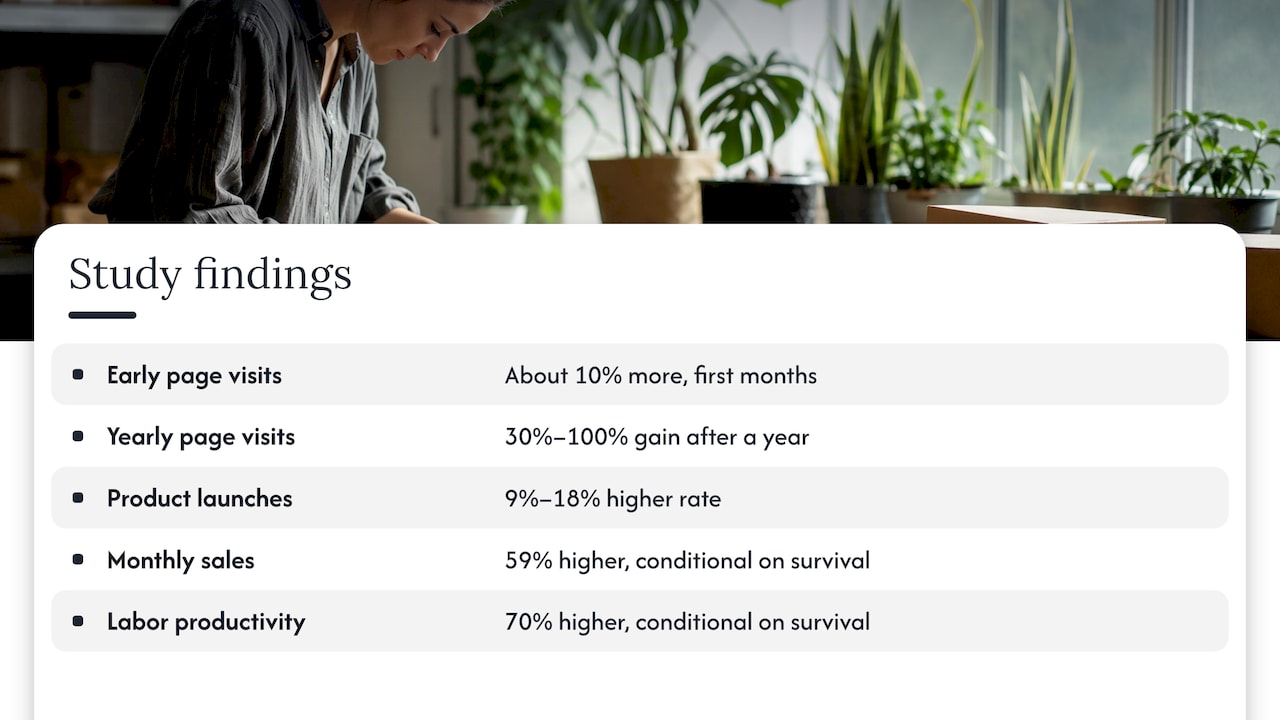
The second finding adds a refinement. A CEPR discussion paper reports eight randomized trials with 1,552 early-stage startups across eight countries. Entrepreneurs trained to build causal theories of their business had 59% higher monthly sales and 70% higher labor productivity, conditional on survival, than the control group. Training in evidence alone had no significant effect, and gains were linked to the quality of the theory rather than to how many tests were run.
In practice, that means each experiment should start with a sentence like this: “I believe freelance designers will pay $900 for a fixed-scope brand package because they lose time on scoping, and I will know I am right if 3 of 20 qualified prospects say yes.” The sentence states who, why, and what result would prove you right or wrong. Without the theory, a test is just a pile of numbers.
A simple weekly loop
- State the belief you are testing in one sentence.
- Define the result that would confirm or reject it before you start.
- Run the smallest real test: a pre-sale, a pilot with one client, a landing page with a real price.
- Record the outcome in the same place every week.
- Decide: keep, change or stop. Then write down why.
Step 2 is the one people skip, and it is the one that keeps you honest. Deciding the finish line after you see the data lets you read any result as a win.
Reading results without fooling yourself
Results are powerful, which makes misreading them costly. Four habits help.
Separate the decision from the outcome. A London Business School discussion explains that results alone do not establish decision quality: uncertain, uncontrollable events can turn a good decision into a bad outcome and the reverse. If a client cancels because their company was acquired, your offer did not fail. If a launch succeeds because a famous account happened to share it, your process may not be repeatable. Ask what you controlled and what you did not.
Respect disruptions. A 2024 Management Science paper on small firms in Uganda associated multiple severe disruptions in a six-month period with monthly sales falling 13.8% and sales growth falling 18.8 percentage points. Illness, a platform change or a lost key client can depress a month’s numbers whatever your strategy. Keep notes beside the numbers so you remember why a month looked odd.
Do not lean on one metric. Mauboussin points out that sales growth and earnings-per-share growth have only a shaky connection to value creation, and recommends statistics that are both persistent and predictive. For a solo business, that translates to looking at revenue, margin and repeat business together. Revenue that needs constant new customers and leaves no profit is a treadmill.
Let evidence test your intuition, not replace it. Jeffrey Pfeffer and Robert Sutton argue in Strategy+Business that analysis of outcomes and field observation can challenge assumptions, while evidence should test, not suppress, intuition and innovation. New ideas rarely have data yet. Use results to refine your instincts, and keep room for bets that have not been measured.
How to build a results habit as a remote founder
Nomads, freelancers and remote professionals have a particular difficulty: the feedback loop is long. You may work alone in a different time zone each month, with nobody asking how the quarter is going. A few habits close that gap.
- Pick a single weekly review slot and keep it the same wherever you are working from.
- Keep one results sheet with five to seven numbers, not thirty.
- Set a 30-day target for one outcome, such as three paying clients or a first $1,000 month, and review it at day 30.
- Talk to customers directly. A number tells you what happened; a conversation tells you why.
- Share your numbers with peers. Telling someone else your results makes self-deception harder.
The last point is where community earns its place. Peers who are at a similar stage will ask the uncomfortable question about a stalled metric that you have been avoiding. Our guide on hands-on business training explains why learning by doing, with feedback, tends to stick better than learning by reading.
Our perspective
We built Nomad Excel around one idea: founders learn fastest when they are forced to meet the market early and often. A course can explain pricing, but a day spent actually pricing your offer and showing it to people teaches something a slide cannot.
That is why our bootcamps focus on execution: daily accountability, structured sprints and real-world results over theory. Each program brings together a curated group of driven founders for one to four weeks of hands-on learning, with direct guidance from experienced entrepreneurs, marketers and operators. We want you to leave with sharper strategy, new revenue-driving skills and a community that keeps challenging you after the program ends.
We also believe results need company. When you share your numbers with peers and mentors, you see your business more clearly, and you are more likely to act on what you see. Clarity, execution and community are the three things we try to give every participant.
Amichai
Where to start with Nomad Excel
If you want to practice this loop with structure and peers, our online programs are the lowest-commitment way in. The 5-Day Online AI Bootcamp costs €300, and the Online Business Bootcamp costs €500. Both are one-off fees.
For a full in-person immersion, we run Entrepreneurship Sprint Bootcamps in Lisbon at €1,350 (Idea Space) and €1,500 (Second Home), plus bootcamps in Playa Venao, Panama, Pipa, Brazil, and Agaete in the Canary Islands, each with a €400 registration fee. See our program page for the current offers and formats. If you are curious about what participants take away, read what founders actually gain from bootcamp learning.
FAQ
What does “real-world business results” mean?
It means measurable outcomes in the market, such as revenue, profit, paying customers, conversion and retention. They differ from activities (effort you put in) and forecasts (what you expect to happen). A result exists only when another person has acted, usually by paying, replying, subscribing or renewing.
Which results should a new business track first?
Start with paying customers per month, profit after all costs, and the share of leads who take the next step. Add a leading indicator you control, such as response time to inquiries. Keeping the list to five to seven numbers makes it realistic to review every week.
How long should I wait before judging a test?
Wait until you have enough real interactions to see a pattern, and decide in advance what result counts as success. Two bad days after a launch usually reflect noise, while several weeks of flat results after genuine changes are a signal worth acting on.
Can good results come from a bad decision?
Yes. Luck, timing and outside events can produce a good outcome from a weak decision, and the reverse. Review the reasoning behind each choice as well as the number it produced, so you repeat the process and not the coincidence.
Does business training actually improve results?
Studies of small firms in several countries have linked practical training and coaching with higher sales and profits, for example gains of about 25% to 30% in profits for South African small firms in Stanford GSB’s account. Outcomes depend on the program and the business, so choose training that has you apply what you learn to your own company.
Sources
- The Advantages of Data-Driven Decision-Making, HBS Online
- Essential Key Performance Indicators for Small and Mid-Size Businesses, Microsoft
- The True Measures of Success, Harvard Business Review
- Simple data reports boost sales and empower small businesses, IESE Insight
- Business Practices in Small Firms in Developing Countries, Management Science
- Masterclass: Driving Business Growth, Stanford GSB
- Enabling high-potential entrepreneurs, International Growth Centre
- Causal Theories and Performance, CEPR
- Experimentation and startup performance: Evidence from A/B testing, Harvard Business School
- Decisions Are More Important Than Results, London Business School
- Disruptions, Redundancy Strategies and Performance of Small Firms, LBS Research Online
- Why Managing by Facts Works, Strategy+Business
- How to Use AI and Causality for Better Business Decisions
- Facebook Ads Budget for Small Businesses