The Role of Business Community Support in Growth
TL;DR:
- Business community support provides entrepreneurs with resources, connections, and mental health benefits that enhance stability and growth. Active participation, formalized partnerships, and government collaborations boost resilience, network reach, and access to funding. Consistent engagement builds trust, reduces stress, and creates a competitive advantage for small businesses.
Business community support is defined as the collective network of organizations, institutions, and peers that provide entrepreneurs with resources, connections, and services to sustain and grow their businesses. The role of business community support extends well beyond goodwill. It directly shapes business survival, mental health, and local economic strength. Entities like Chambers of Commerce, county governments, and structured mentorship programs form the backbone of this ecosystem. Recent 2026 research confirms that perceived community support measurably reduces psychological distress among entrepreneurs, making it both a business and a wellness asset.
What measurable impacts does business community support have on entrepreneurs?
Community support produces concrete, documented outcomes for entrepreneurs. It is not a soft benefit. A 2026 study found that loneliness mediates 63.8% of perceived support’s effect on psychological distress. That figure tells you something critical: when entrepreneurs feel connected, they are significantly less likely to experience the kind of stress that derails decision-making and business performance.
The networking dimension is equally well documented. About 90% of small business owners participate in local Chambers of Commerce to build networks and community ties. That participation rate reflects how central these organizations are to the daily operations of small businesses, not just their growth ambitions.
County governments add another layer of measurable impact. Counties invested over $65 billion in federal funds toward small business support and workforce development during post-pandemic recovery. That scale of investment signals that public institutions treat business community support as infrastructure, not charity.
| Impact Area | What the Evidence Shows |
|---|---|
| Mental health | Perceived support reduces psychological distress; loneliness mediates 63.8% of that effect |
| Networking access | 90% of small business owners use Chambers of Commerce as their primary network vehicle |
| Public investment | Counties directed over $65 billion in federal funds to small business and workforce programs |
| Crisis resilience | Programs like R4R provide grants that stabilize businesses during disasters and disruptions |
| Marketing reach | Joint campaigns and cross-promotion generate measurable new customer referrals |
The pattern across all these data points is consistent. Community support is a multiplier. It amplifies what individual entrepreneurs can achieve alone, whether that means accessing capital, finding customers, or simply staying mentally fit enough to keep building.
How do formal partnerships and informal alliances differ?
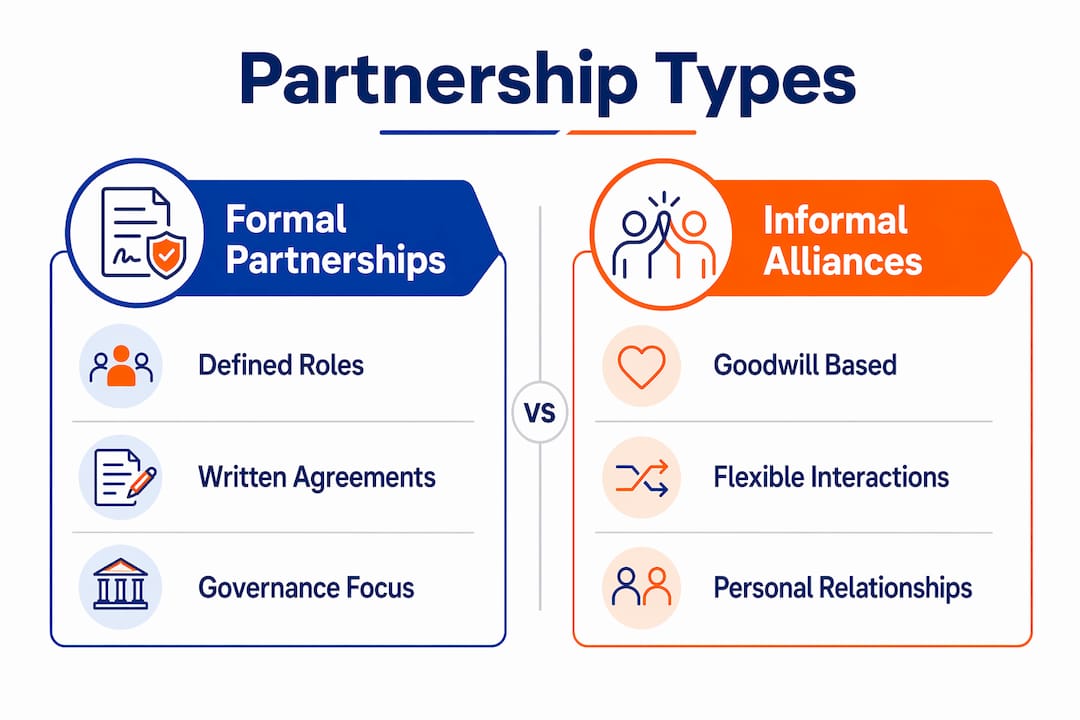
Not all business community relationships carry the same weight. Informal networking, such as attending local events or joining online groups, builds familiarity and goodwill. Formal written agreements, by contrast, define roles, deliverables, and accountability. The difference matters enormously when resources or reputation are on the line.
Research on strategic alliances and governance confirms that misalignment and weak governance are the leading causes of partnership failure. Absorptive capacity, meaning a business’s ability to recognize and apply external knowledge, determines how much value it actually extracts from an alliance. Without it, even well-intentioned partnerships stall.
Pro Tip: Set quarterly reviews into every formal partnership agreement from day one. Reviewing shared metrics every 90 days catches misalignment early, before it becomes expensive.
Practical best practices for building partnerships that last:
- Start with shared values, not just shared goals. Values alignment prevents conflict when priorities shift.
- Put the terms in writing, even for informal arrangements. A one-page memo of understanding protects both parties.
- Define what success looks like before the partnership begins. Vague outcomes produce vague results.
- Limit due diligence to what is genuinely necessary. Excessive scrutiny with familiar partners creates bureaucratic friction and slows momentum.
- Assign a relationship owner on each side. Partnerships without a named point of contact drift.
One counterintuitive finding from alliance research: due diligence loses effectiveness when partners already know each other well or operate across significant geographic distance. The implication is that experienced entrepreneurs should spend less time on formal vetting of known partners and more time on governance and communication structures.
What role do local governments and public institutions play?
County governments are the most underutilized resource in most entrepreneurs’ community support toolkit. Effective county governments act as coordinators, aligning public and private resources to sustain entrepreneurial ecosystems. The Brookings Institution describes this function as acting like a “quarterback for local ecosystems,” calling plays that no single private actor could execute alone.
The practical benefits of engaging with government entities include:
- Grant access. Programs like the Ready for Recovery (R4R) initiative provide disaster preparedness grants that stabilize businesses during crises and incentivize risk mitigation before emergencies occur.
- Infrastructure support. County investments in broadband, transportation, and commercial zoning directly reduce operating costs for local businesses.
- Workforce development. Publicly funded training programs build the talent pipelines that growing businesses need.
- Regulatory navigation. County economic development offices often provide free guidance on permits, licensing, and compliance.
Entrepreneurs who treat government as a bureaucratic obstacle miss real money and real support. The R4R program, for example, rewards businesses that invest in preparedness with grants that offset costs and build community-wide resilience. Preparedness, in this framing, is a form of community advocacy. It preserves local jobs and services when disruptions hit.
The key is knowing where to look. Your county’s economic development office, your state’s Small Business Development Center (SBDC), and the U.S. Chamber Foundation’s disaster preparedness resources are all starting points worth bookmarking.

How does active community participation improve mental health and sustainability?
Belonging is a biological need, not a preference. Community support buffers the physiological impact of stress and builds the kind of resilience that keeps entrepreneurs functioning through market disruptions, personal setbacks, and economic uncertainty. This is not motivational language. It is documented in psychology research.
“Active participation yields stronger mental health benefits than passive attendance. Repeated, low-stakes interaction fosters belonging and sustained business-community benefits.” — Simply Psychology, 2026
The distinction between active and passive engagement is where most entrepreneurs leave value on the table. Passive attendance at networking events yields far fewer benefits than consistent, role-based participation. Showing up to a Chamber of Commerce breakfast every month is good. Volunteering to lead a committee, mentor a newer member, or co-organize an event is transformative.
Pro Tip: Take on a visible role in at least one community organization this quarter. Even a small commitment, like moderating a monthly discussion group, builds trust and identity faster than years of passive attendance.
Active engagement also produces business stability during crises. Entrepreneurs with strong community ties have pre-built networks to call on when supply chains break, when a key employee leaves, or when a new competitor enters the market. The community becomes a real-time intelligence and support network, not just a social outlet.
What practical steps build lasting community support?
Building genuine community support requires consistency over time. One-off appearances at networking events produce little. Sustained, intentional engagement produces compounding returns.
- Identify your values alignment first. Before joining any organization or pursuing any partnership, confirm that the other party’s mission and culture match yours. Misaligned values surface as conflict under pressure.
- Attend local Chamber of Commerce events consistently. Consistent presence builds recognition. Recognition builds trust. Trust opens doors that cold outreach never will.
- Formalize your key relationships. Convert your most productive informal partnerships into written agreements. Define roles, contributions, timelines, and success metrics.
- Pool marketing resources with aligned partners. Joint social media campaigns and cross-promotion expand your collective audience reach beyond what either business achieves alone.
- Review and adapt regularly. Schedule quarterly check-ins with your key community partners. Measure outcomes against the goals you set at the start. Adjust what is not working before it becomes a liability.
- Invest in reciprocity. Successful business community partnerships are synergistic. Both parties contribute equal value, whether that is marketing reach, expertise, or resources. One-sided relationships do not last.
The entrepreneurs who build the strongest community support systems treat them like any other business asset. They invest deliberately, measure returns, and reinvest in what works.
Key Takeaways
Business community support is a documented driver of entrepreneur resilience, mental health, and economic growth, not an optional social activity.
| Point | Details |
|---|---|
| Community reduces distress | Perceived support measurably lowers psychological distress; loneliness mediates 63.8% of that effect. |
| Chambers of Commerce are central | 90% of small business owners use local Chambers as their primary networking vehicle. |
| Government is an underused resource | Counties invested over $65 billion in small business support; grants like R4R are accessible to prepared businesses. |
| Active beats passive engagement | Role-based participation builds trust, identity, and resilience faster than passive attendance. |
| Formal agreements protect partnerships | Written terms, quarterly reviews, and defined success metrics prevent the misalignment that kills alliances. |
Why community support is your most underrated business asset
Most entrepreneurs I talk to think of community support as something they will get to eventually, once the business is more stable. That framing is exactly backwards. Community support is what creates stability, not what you enjoy after you have achieved it.
The misconception I see most often is treating community engagement as charity or networking theater. Attending events to hand out business cards and then disappearing is not community. It is performance. Real community support, the kind that produces measurable business and mental health outcomes, requires you to show up consistently and contribute something of value.
The government partnership angle is the most overlooked piece. Entrepreneurs who engage with county economic development offices, apply for programs like R4R, and build relationships with their local SBDC gain access to capital and infrastructure support that their competitors are simply not using. That is a genuine competitive advantage hiding in plain sight.
The mental health dimension also deserves more honest attention. Running a business is genuinely hard. The psychological benefits of community are not a soft add-on. They are what keeps you making clear decisions under pressure. Entrepreneurs who invest in community are investing in their own cognitive and emotional capacity to lead.
Treat community as a core business asset. Build it with the same rigor you bring to product development or financial planning. The returns compound in ways that are hard to predict and impossible to replicate through any other means.
— Amichai
Nomadexcel’s programs put community at the center of growth
Nomadexcel builds entrepreneurship programs where community is not a side benefit. It is the core mechanism. The Online Entrepreneurship Bootcamp brings together early-stage founders for structured learning, direct mentorship, and a peer network that continues delivering value long after the program ends. For teams, Nomadexcel’s business networking retreats combine goal alignment with genuine relationship building in immersive settings. If you are ready to build the kind of community support that actually moves your business forward, Nomadexcel’s programs are designed to get you there faster, with the right people around you.
FAQ
What is the role of business community support for entrepreneurs?
Business community support provides entrepreneurs with networks, resources, and psychological resilience that individual effort cannot replicate. It reduces distress, expands market reach, and connects founders to funding and infrastructure.
How do Chambers of Commerce support small businesses?
Chambers of Commerce serve as the primary networking vehicle for small businesses, with about 90% of small business owners participating to build community ties and access shared resources.
What is the difference between formal and informal business partnerships?
Informal partnerships rely on goodwill and personal relationships, while formal agreements define roles, deliverables, and accountability in writing. Research shows that governance and absorptive capacity determine whether formal alliances succeed.
How does community engagement affect entrepreneur mental health?
Active community participation buffers the physiological impact of stress and reduces psychological distress. Consistent, role-based engagement produces stronger mental health benefits than passive attendance.
How can entrepreneurs access government business support programs?
Entrepreneurs can contact their county economic development office, local Small Business Development Center, or the U.S. Chamber Foundation to access grants, workforce programs, and disaster preparedness resources like the R4R initiative.
Comments are closed.