
Why Pursue Professional Growth: A 2026 Career Guide
TL;DR:
- Professional growth enhances skills, knowledge, and career opportunities, leading to higher earnings and job security. It also builds resilience by developing lateral skills, soft skills, and a portfolio of versatile capabilities to adapt to workplace disruptions. Practically, setting clear goals, seeking stretch assignments, and effectively communicating progress are essential for career advancement.
Professional growth is the intentional process of enhancing your skills, knowledge, and career trajectory to increase your effectiveness and opportunity. For professionals and entrepreneurs, it is the clearest path to higher earnings, greater job security, and lasting relevance in a workplace that changes faster every year. The question of why pursue professional growth has a measurable answer: documented continuous professional development links directly to promotions, salary increases, and career resilience. This guide breaks down the evidence, the strategies, and the mindset shifts that separate professionals who advance from those who stagnate.
What are the key benefits of pursuing professional growth?
The benefits of career development are both tangible and deeply personal. Professionals who invest in their growth consistently outperform peers across salary, promotion rate, and job satisfaction. The data is specific enough to act on.
Professionals maintaining documented continuous professional development records are 58% more likely to secure promotions and enjoy 17–23% higher salary growth when changing jobs. That single finding reframes professional development from a nice-to-have into a financial strategy. Certifications, structured learning, and mentorship are not resume decorations. They are negotiating tools.
Beyond compensation, the benefits extend to confidence and engagement:
- Increased confidence. Continuous learning improves employee confidence by 37%, which directly improves communication, collaboration, and the willingness to take on harder challenges.
- Reduced burnout risk. Employees lacking career progression paths are significantly more prone to burnout, lower motivation, and disengagement. Career development programs reverse that pattern.
- Stronger retention. Organizations with strong learning cultures achieve 57% employee retention versus 27% in moderate cultures. That gap reflects how much professionals value growth over static roles.
- Leadership readiness. Professionals who actively develop skills are first in line when leadership roles open. Growth builds the track record that sponsors and managers look for.
- Expanded networks. Structured programs, bootcamps, and mentorships connect professionals with peers and leaders who accelerate opportunities beyond what any single job can offer.
“Career growth is not passive. Professionals with a growth mindset proactively seek feedback and treat work challenges as learning opportunities.” — Cornerstone OnDemand
The value of personal development compounds over time. Each skill you add increases the number of problems you can solve, the roles you qualify for, and the income you can command. Professionals who treat growth as a career-long practice build advantages that are genuinely difficult to replicate.
How does professional growth protect your career against change and disruption?
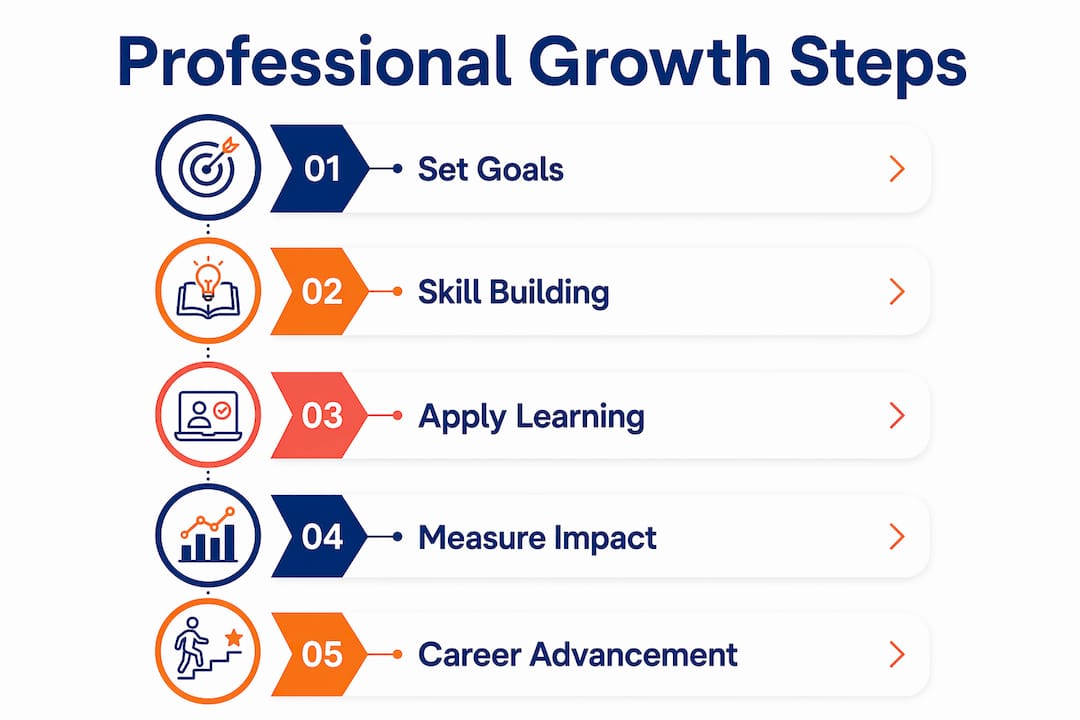
Career resilience is the ability to absorb change without losing momentum. Professional growth is the primary way to build it. The workplace is not getting more stable. The 2025 WEF Future of Jobs Report projects that 39% of core workplace skills will be disrupted or require significant change by 2030. That is not a distant threat. It is a planning horizon that starts now.

The most effective response is what researchers call lateral skill expansion. Rather than climbing a single career ladder, professionals who acquire knowledge across functions become more versatile, more satisfied, and less vulnerable to burnout than those who specialize narrowly. A marketing manager who also understands data analytics and project management is far harder to replace than one who only knows brand campaigns.
Relying on a single professional identity is a genuine career risk. Professionals who build a flexible, multi-skilled identity absorb disruption and transition more smoothly when industries shift. This is not about becoming a generalist. It is about building enough range that no single market change can eliminate your value.
Soft skills are the most portable form of career insurance. Resilience, adaptability, and complex problem-solving travel across industries, roles, and economic cycles. They are the skills that sustain long-term career success precisely because they cannot be automated or outsourced as easily as technical tasks.
Pro Tip: Map your current skill set against the top five roles you want to qualify for in the next three years. The gaps you find are your growth priorities. Address the two most critical ones before adding anything else.
What practical strategies enable effective professional growth?
The importance of skill enhancement is clear. The harder question is how to achieve professional growth in a way that actually moves your career forward rather than just filling your calendar with courses. These strategies work because they connect learning to real outcomes.
Identify your skill gaps with intention. Review job postings for roles one level above yours. Note the skills that appear consistently but that you do not yet have. Target those gaps with specific courses, certifications, or projects rather than learning broadly.
Pursue stretch assignments. Stretch assignments and cross-functional collaboration accelerate institutional influence and skill expansion faster than isolated study. Volunteer for projects outside your core function. The discomfort is the point.
Build a mentorship relationship. A mentor who has navigated the path you want to take compresses your learning curve significantly. Nomadexcel’s mentorship programs for entrepreneurs pair founders with experienced operators who provide direct, experience-backed guidance rather than generic advice.
Align your learning with organizational priorities. Aligning personal growth goals with business outcomes creates visible development that managers recognize and reward. When your skill-building solves a problem your organization cares about, it gets noticed.
Balance hard and soft skills deliberately. Technical skills open doors. Soft skills determine how far you go once inside. Build both in parallel rather than treating one as more important than the other.
Use structured programs for accountability. Entrepreneurship bootcamps like those offered by Nomadexcel combine mentorship, peer accountability, and hands-on execution to accelerate growth in ways that self-directed learning rarely matches. The community element alone is a force multiplier.
Pro Tip: Before enrolling in any course or program, write down the specific outcome you expect within 90 days. If you cannot name it, the program is probably not the right fit yet.
Ways to improve job skills work best when they are tied to a clear goal and a deadline. Learning without application is information without value. The professionals who grow fastest are those who immediately use what they learn on real projects with real stakes.
How to measure and communicate your professional growth for career advancement
Measuring growth matters as much as achieving it. Managers and hiring teams cannot reward development they cannot see. Communicating your growth clearly is a core skill in itself, and it is one most professionals underinvest in.
The foundation is a documented continuous professional development record. This is a running log of courses completed, certifications earned, projects led, feedback received, and skills applied. Professionals who maintain this record are far better positioned in performance reviews and job interviews because they speak in specifics rather than generalities.
Here is what an effective growth communication strategy includes:
- Project outcomes with metrics. “I led the product launch that generated $240,000 in first-quarter revenue” is more persuasive than “I improved my project management skills.”
- Certifications tied to business needs. A certification in data analysis means more when you connect it to a cost-saving initiative you ran.
- Leadership roles and scope expansion. Mentoring junior colleagues, leading cross-functional teams, and presenting to senior leadership all signal readiness for the next level.
- Feedback as evidence. Positive feedback from managers, clients, or peers, especially in writing, is credible third-party validation of your growth.
| Growth Signal | How to communicate it |
|---|---|
| New certification | Link it to a project outcome it enabled |
| Stretch assignment | Quantify the result and your specific contribution |
| Mentorship received | Name the skills gained and how you applied them |
| Leadership role | Describe the team size, scope, and measurable impact |
| Cross-functional work | Highlight the new perspective and skills it added |
Visible development that aligns personal learning with strategic business priorities distinguishes professionals who advance from those who stay in place. The goal is not to list everything you have done. It is to show that your growth serves the organization’s future, not just your own ambitions.
Key takeaways
Pursuing professional growth is the single most reliable way to increase your earning potential, career resilience, and long-term relevance in a rapidly changing workplace.
| Point | Details |
|---|---|
| CPD drives measurable results | Documented development links to 58% higher promotion rates and 17–23% salary gains. |
| Lateral skills build resilience | Expanding across functions protects against disruption better than narrow specialization. |
| Stretch assignments accelerate growth | Cross-functional projects build influence and skills faster than courses alone. |
| Visible development gets rewarded | Aligning learning with business goals makes growth legible to managers and sponsors. |
| Soft skills are career insurance | Resilience, adaptability, and problem-solving remain valuable across every industry shift. |
What I have learned about growth that most career advice misses
The conventional wisdom on professional development tends to focus on credentials. Get the certification. Finish the course. Add it to LinkedIn. That advice is not wrong, but it misses the mechanism that actually drives career advancement.
The professionals I have seen grow fastest are not the ones who collect the most credentials. They are the ones who take on problems that scare them slightly and then stay in the room long enough to figure them out. Stretch assignments, cross-functional projects, and entrepreneurship bootcamps work because they force you to apply knowledge under pressure, in front of real stakeholders, with real consequences. That is where growth actually happens.
One pattern I have noticed consistently: professionals who build a growth mindset for entrepreneurial success treat every setback as data rather than judgment. They do not wait for permission to develop. They identify the gap, find the resource, and close it. That proactive posture is what separates the professionals who get sponsored from those who wait to be noticed.
The other thing most career advice skips is the cost of a narrow identity. When your entire professional value is tied to one skill or one industry, you are one market shift away from irrelevance. The professionals who sustain long careers are the ones who keep adding dimensions to who they are professionally. Not because they are chasing trends, but because they are genuinely curious and disciplined enough to act on that curiosity.
The best investment you can make in 2026 is not a single course. It is a commitment to continuous, deliberate, and well-documented growth that you can articulate clearly when the opportunity arrives.
— Amichai
Nomadexcel programs built for professionals ready to grow
Nomadexcel designs programs specifically for professionals and entrepreneurs who want structured, high-impact growth rather than passive learning. The online entrepreneurship bootcamp combines expert mentorship, peer accountability, and hands-on execution to build the skills and networks that advance careers and businesses. For teams, Nomadexcel’s business retreats for remote teams create the alignment and creative energy that sustained growth requires. If you are ready to move from knowing what growth looks like to actually experiencing it, Nomadexcel’s upcoming bootcamps are the clearest next step.
FAQ
Why is professional growth important for long-term career success?
Professional growth builds the skills, networks, and track record that make you promotable and resilient. Professionals with documented development are 58% more likely to secure promotions and earn significantly higher salaries when changing jobs.
What is the difference between vertical and lateral professional growth?
Vertical growth means moving up in seniority within one function. Lateral growth means acquiring skills across functions. Lateral expansion increases versatility and reduces burnout risk more effectively than vertical climbing alone.
How do soft skills contribute to career advancement?
Soft skills like resilience, adaptability, and complex problem-solving are portable across industries and roles. They are the skills that sustain long-term career success because they cannot be easily automated or outsourced.
How should professionals communicate their growth to managers?
Link every skill or certification to a specific business outcome. Quantified project results, leadership roles, and written feedback from peers or clients are the most credible signals of real development.
How does the WEF Future of Jobs Report affect career planning?
The 2025 WEF Future of Jobs Report projects that 39% of core workplace skills will be disrupted by 2030. That finding makes continuous skill enhancement a career necessity, not an optional investment.
Comments are closed.