
What Is Remote Leadership? A Guide for Managers in 2026
TL;DR:
- Remote leadership involves guiding distributed teams through clear communication, trust, and technology to achieve better outcomes. It emphasizes outcome-based management, deliberate connection, and consistent trust-building practices rather than physical oversight. Effective remote leaders balance empathy and accountability to foster engagement and high performance.
Remote leadership is the intentional practice of guiding geographically distributed teams through clear communication, trust, and technology rather than physical oversight. The standard industry term for this discipline is distributed team management, though “remote leadership” captures the human side of the practice more precisely. Frameworks like LEAD (technology use, virtual presence, engagement amplification, trust development) and ACTS (Authenticity, Connection, Tension, Synthesis) give managers a structured path forward. Teams using structured remote management frameworks report 35% higher engagement and 28% lower turnover compared to ad hoc approaches. Those numbers tell you this is not a soft skill. It is an operational discipline with measurable outcomes.
What is remote leadership, and how does it differ from traditional management?
Remote leadership and traditional in-office management share the same goal: get the best from your people. The methods, however, are fundamentally different. In a physical office, proximity creates a constant low-level feedback loop. You read body language, overhear conversations, and course-correct in real time. That feedback loop disappears the moment your team goes distributed.
Research identifies two distinct types of distance that remote leaders must close. Virtual distance comprises operational distance (workflow coordination breakdowns) and affinity distance (social separation). Both require tailored leadership responses and purpose-built digital tools to overcome. Operational distance shows up as missed handoffs and unclear ownership. Affinity distance shows up as disengagement, isolation, and quiet quitting.
The instinct many managers have is to replicate office management digitally. They schedule more meetings, install activity monitoring software, and track hours logged. This approach fails. Activity monitoring damages trust and produces what researchers call “productivity theater,” where employees look busy rather than doing meaningful work. The shift from managing activity to managing outcomes is the single most important mindset change a remote leader can make.
- Presence is intentional, not ambient. You must schedule connection; it will not happen organically.
- Communication must be explicit. Norms, expectations, and decisions that were implicit in an office need to be written down.
- Trust is built through consistency, not visibility. Showing up reliably and following through on commitments matters more than being online all day.
- Accountability is outcome-based. What did your team deliver this week? That question replaces “how many hours did they log?”
Pro Tip: Before your next team meeting, write down three implicit norms your team operates by. If you cannot write them down, your remote team almost certainly does not know them either. Document them and share them.
What are the core pillars of effective virtual leadership?
Effective virtual leadership rests on four pillars defined by the LEAD framework: technology use, virtual presence, engagement amplification, and trust development. Each pillar addresses a specific gap that distance creates. Together, they form a complete operating system for leading remote employees.

The ACTS framework from Rose-Ann Merulla (EMBA 2026, McGill-HEC) adds a behavioral layer on top of LEAD. ACTS stands for Authenticity, Connection, Tension, and Synthesis. Authenticity means showing up as yourself rather than performing a leadership role. Connection means creating genuine human moments, not just transactional check-ins. Tension means holding the productive balance between care and accountability. Synthesis means drawing individual contributions into a coherent team direction.
The communication dimension of these frameworks is specific and measurable. Effective remote leadership communication balances roughly 70% asynchronous and 30% synchronous interaction, supported by weekly one-on-one meetings and quarterly OKRs. That ratio matters because it protects deep work time while preserving the human connection that synchronous conversation provides.
| Competency | In-office application | Remote application |
|---|---|---|
| Communication | Hallway conversations, open-door policy | Async Slack updates, weekly video one-on-ones |
| Accountability | Direct observation, in-person reviews | OKRs, weekly deliverable check-ins |
| Trust-building | Shared physical space, social events | Consistent follow-through, documented commitments |
| Culture | Organic, ambient norms | Explicit documentation, intentional rituals |
| Empathy | Reading body language in real time | Proactive check-ins, written acknowledgment |
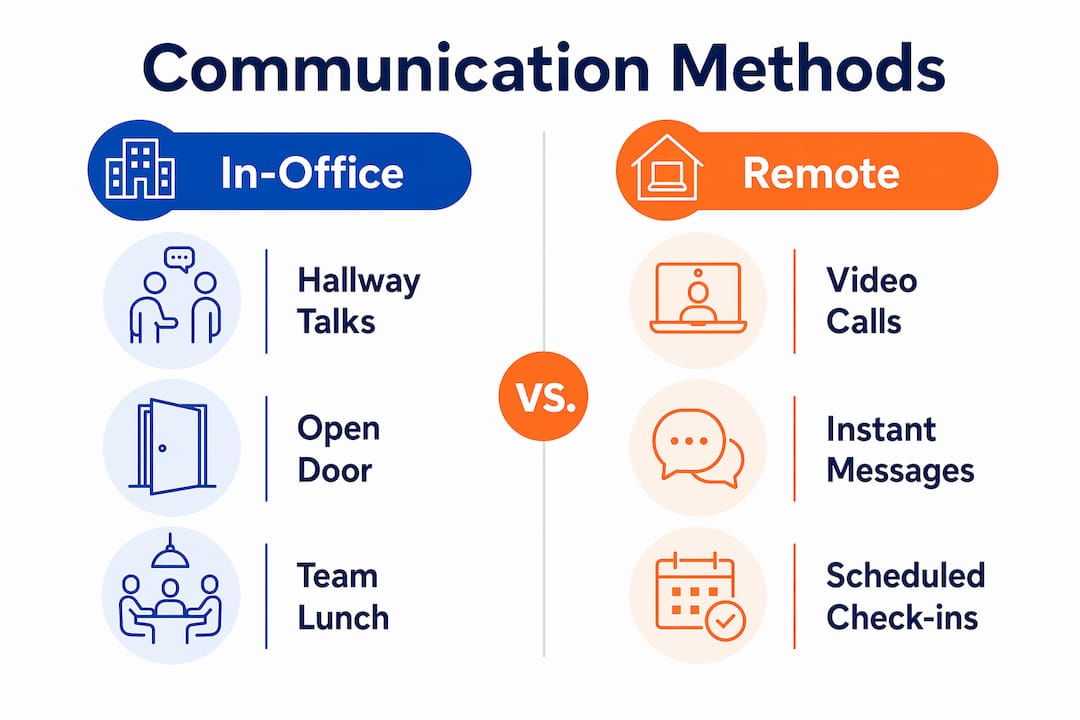
The “dual engine” skill that separates good remote leaders from great ones is the ability to run empathy and accountability in parallel. Empathy without accountability feels like abandonment; accountability without empathy erodes trust. Both engines must run simultaneously.
Pro Tip: At the start of each quarter, share your own OKRs with your team before asking for theirs. Modeling transparency first makes accountability feel collaborative rather than top-down.
Which communication practices optimize remote team performance?
Communication is the infrastructure of remote team management. Get it wrong and everything else breaks down. Get it right and your team can outperform co-located teams on nearly every metric. Remote teams with clear, transparent expectations achieve 25–30% higher productivity and engagement. Clarity is not a nice-to-have. It is a performance driver.
The practical structure that works looks like this:
- Weekly one-on-one meetings (30 minutes, synchronous). These are not status updates. They are relationship investments. Ask about blockers, energy levels, and what your team member needs from you that week.
- Daily async updates (written, Slack or Notion). Each team member posts a brief summary of what they completed, what they are working on, and any blockers. This replaces the need for a daily standup meeting and respects deep work time.
- Quarterly OKR reviews (synchronous, full team). Align on goals, celebrate wins, and reset priorities. Use tools like Lattice or Leapsome to track OKR progress between reviews.
- Documented decision rights. Use a RACI matrix or a simple decision log in Confluence or Notion to clarify who owns what. Ambiguity about ownership is the leading cause of dropped balls in distributed teams.
- A shared team handbook. Document your communication norms, meeting etiquette, response time expectations, and cultural values. Tools like Notion, Tettra, or Guru work well for this. Making implicit office rules explicit through documentation is one of the highest-leverage actions a remote leader can take.
The trap most remote leaders fall into is communication overload. More messages do not equal more clarity. Quality and intentionality of communication, rather than volume, builds trust and reduces virtual distance. Send fewer, better messages. Write with precision. Use tools like Grammarly or Hemingway Editor to tighten your written communication before it goes to the team.
How do you measure remote team engagement without micromanagement?
The answer is outcome-based performance management. Measuring hours logged, keystrokes, or screen time tells you nothing about whether your team is doing meaningful work. It tells you only whether they are performing the appearance of work. That distinction is critical.
OKRs (Objectives and Key Results) are the most widely adopted framework for outcome-based remote team management. Google, Intel, and Spotify have all used OKRs to align distributed teams around measurable outcomes rather than activity. The structure is simple: set a qualitative objective, then define two to four measurable key results that prove the objective was achieved.
Beyond OKRs, engagement in remote teams is built through intentional cultural rituals. These are the practices that replace the organic social glue of an office:
- Virtual recognition programs. Tools like Bonusly or Kudos let team members recognize each other publicly and frequently. Recognition from peers is often more motivating than recognition from managers.
- Non-work channels. A dedicated Slack channel for personal interests, wins, or humor creates the ambient social connection that distributed teams miss.
- Async celebration rituals. When a team member ships a major project, send a short video message rather than a text. The human face and voice carry emotional weight that text cannot.
- Quarterly in-person or virtual retreats. Even one intentional gathering per year dramatically strengthens affinity bonds. The remote team engagement ideas that work best combine structured work sessions with unstructured social time.
The data on structured remote management is clear. Teams that adopt outcome-based tracking alongside intentional engagement practices see measurable improvements in both retention and performance. Surveillance, by contrast, accelerates turnover and destroys the psychological safety that high performance requires.
How do remote leaders build authentic connection across distance?
Psychological safety is the condition under which people speak up, take risks, and do their best work. In a physical office, it builds gradually through shared experience. In a remote environment, it must be constructed deliberately. Continuous presence and trust-building amplified by deliberate virtual practices, rather than communication volume, is what creates it.
The practices that build authentic connection across distance share one quality: they are consistent. Consistency is the currency of trust in distributed teams. When your team knows exactly what to expect from you, when you show up the same way in every interaction, and when your words match your actions, trust accumulates over time.
- Start every one-on-one with a personal check-in. Two minutes of genuine human conversation before the agenda builds more connection than any team-building exercise.
- Be visible about your own challenges. Sharing a professional struggle or uncertainty models the psychological safety you want your team to feel.
- Follow through on every commitment, no matter how small. In a remote environment, small broken promises compound quickly into a culture of low trust.
- Acknowledge time zones and personal circumstances. Flexibility signals respect. Respect is the foundation of connection.
Pro Tip: Record a short personal video update at the end of each week and share it with your team. Two minutes of your face and voice does more for team connection than a dozen written messages. Tools like Loom make this effortless.
The essential leadership skills for distributed environments all trace back to one root: the willingness to be genuinely present, even through a screen.
Key takeaways
Effective remote leadership requires outcome-based management, intentional communication rhythms, and consistent trust-building practices to outperform traditional in-office oversight.
| Point | Details |
|---|---|
| Define outcomes, not activity | Replace hours-logged tracking with OKRs and weekly deliverables to build trust and performance. |
| Use the 70/30 communication ratio | Balance 70% async and 30% sync communication to protect deep work while maintaining human connection. |
| Make implicit norms explicit | Document decision rights, cultural values, and communication protocols so every team member operates from the same playbook. |
| Run empathy and accountability together | Neither care nor rigor alone sustains a remote team. Both must operate simultaneously as a dual engine. |
| Build connection through consistency | Predictable, authentic leadership behavior accumulates trust faster than any single team-building initiative. |
Remote leadership is practice, not performance
I have worked with enough distributed teams to say this plainly: the biggest mistake remote leaders make is treating leadership as something they perform for their team rather than something they practice with their team. The ACTS framework resonates with me precisely because it names this. Authenticity is not a communication style. It is a daily choice to show up as yourself, including on the days when you do not have all the answers.
The surveillance instinct is understandable. When you cannot see your team, the anxiety of not knowing what they are doing is real. But every time I have seen a manager install monitoring software or demand hourly check-ins, the result has been the same: the best people leave first. They always have options.
What I have found actually works is radical transparency about expectations combined with genuine curiosity about your team members as people. When someone knows exactly what success looks like and feels that their manager actually cares about their growth, they do not need to be watched. They want to perform.
The leaders who thrive in distributed environments are not the ones with the most sophisticated tech stack. They are the ones who have done the harder work of clarifying their own values, communicating them consistently, and holding themselves to the same standards they hold their teams to. That is the version of remote leadership worth building toward.
— Amichai
How Nomadexcel helps remote leaders grow faster
Remote leadership skills do not develop in isolation. They sharpen through structured practice, peer feedback, and exposure to leaders who have already solved the problems you are facing. Nomadexcel builds exactly that environment. The Online Entrepreneurship Bootcamp gives managers and founders the frameworks, accountability structures, and community they need to lead distributed teams with confidence. For teams that need to rebuild trust, alignment, and creative energy together, Nomadexcel’s company retreats are designed end-to-end to deliver both business impact and authentic human connection. If you are serious about leading remote employees well, the next step is finding the right environment to grow in.
FAQ
What is remote leadership in simple terms?
Remote leadership is the practice of managing and motivating a geographically distributed team through intentional communication, technology, and trust rather than physical presence. It replaces ambient office oversight with structured, outcome-based management.
What are the biggest challenges in remote management?
The two core challenges are operational distance (workflow coordination breakdowns) and affinity distance (social isolation). Both require deliberate leadership practices and digital tools to address effectively.
How do remote leaders build trust with their teams?
Trust in distributed teams is built through consistency, transparency, and follow-through on commitments. Research shows that quality and intentionality of communication, rather than volume, is the primary driver of trust across virtual distance.
What tools do effective remote leaders use?
Effective remote leaders use OKR platforms like Lattice or Leapsome for performance tracking, Slack or Microsoft Teams for async communication, Notion or Confluence for documentation, and Loom for personal video updates. The tools matter less than the discipline of using them consistently.
How does remote leadership affect team engagement?
Teams with structured remote management frameworks report 35% higher engagement and 28% lower turnover compared to teams managed without a clear system. Outcome-based tracking and intentional cultural rituals are the two practices most directly linked to those results.
Comments are closed.