
Business Retreats vs Bootcamps Explained for Teams
TL;DR:
- Business retreats are multi-day offsite programs aimed at strategic alignment and cultural strengthening within existing teams. Bootcamps are intensive short-term training programs designed to rapidly develop specific skills for individuals or small groups, often focusing on business launch or capability building. Choosing the appropriate format depends on the core problem, target audience, and desired outcomes, with effective planning and measurement ensuring maximum ROI.
A business retreat is a multi-day, offsite experience designed to align an existing team around strategy, culture, and shared goals. A bootcamp, by contrast, is an intensive training program built to develop specific skills or launch a business in a compressed timeframe. Understanding the difference between these two formats, what the industry calls “corporate learning interventions,” matters because choosing the wrong one wastes budget, time, and goodwill. This article on business retreats vs bootcamps explained covers structure, outcomes, risks, and how to pick the right format for your team’s actual needs.
What are business retreats vs bootcamps? Core definitions
Business retreats typically last 2–7 days and focus on existing teams working through strategy, alignment, and relationship repair. Bootcamps run 1–4 weeks and are built around rapid skill acquisition for individuals, founders, or small groups. The distinction matters more than most leaders realize. A team that needs better communication will not get it from a coding or marketing bootcamp. A founder who needs to learn how to validate a business idea will not get that from a three-day offsite with their current colleagues.
Both formats fall under the broader category of immersive corporate learning. Both remove participants from their daily environment to accelerate growth. But their audiences, objectives, and structures are fundamentally different, and confusing them leads to poor outcomes and wasted investment.
What is a business retreat: goals, structure, and activities?
A business retreat is a structured, offsite program for an existing team, typically lasting 2–7 days, with the primary goal of strategic alignment and cultural strengthening. The best retreats are not rewards or morale boosters. They are business initiatives with defined problems to solve and measurable outcomes to track.
Common retreat goals and outcomes
The most effective team building retreats focus on one or two concrete business problems rather than vague aspirations like “improving morale.” Effective retreats produce specific, documented outcomes such as decisions, commitments, and behavioral changes evaluated over a 60–90 day window after the event. That post-event measurement window is what separates a strategic retreat from an expensive group vacation.
Typical retreat activities include:
- Strategic planning sessions with facilitated workshops on priorities, roadblocks, and resource allocation
- Leadership alignment exercises where senior teams surface disagreements and build shared direction
- Informal shared experiences such as cooking together, hiking, or navigating unfamiliar terrain
- Retrospective reviews examining what worked, what failed, and what the team commits to changing
Authentic shared experiences like cooking a meal together or navigating an unfamiliar city drive genuine collaboration far better than scripted team-building games. That insight runs counter to the instinct many leaders have to fill every hour with structured programming. Unstructured time, when intentionally designed, is where real trust gets built.
Retreat risks you cannot ignore
28% of HR professionals reported post-retreat misconduct complaints in 2025, and 15% of those escalated to formal investigations. That number should stop any leader from treating a retreat as a casual offsite. Successful retreats require HR and legal oversight from the planning stage, including compliance with wage and hour laws, ADA accommodations, and clear conduct standards.
Pro Tip: Before booking any retreat venue, run the program agenda past your HR and legal teams. Identify which sessions are mandatory versus optional, and document attendance policies in writing to protect both the company and employees.
The business retreat benefits are real, including up to a 36% reduction in employee turnover in highly engaged organizations and returns averaging $4–$6 per $1 spent. But those returns depend entirely on how well the retreat is planned and facilitated.
What are business bootcamps: purpose, format, and outcomes?
A business bootcamp is an intensive, short-term training program designed to teach specific skills rapidly through immersive, focused experiences. Bootcamps combine lessons, mentorship, field work, and networking to accelerate learning in ways that traditional classroom or online courses cannot match. The format is built for speed and application, not reflection and alignment.

What bootcamps teach and who they serve
Business bootcamps focus on practical marketing, finance, leadership, and startup skills centered on job readiness or business launch. The participant profile is different from a retreat. Bootcamps serve aspiring entrepreneurs, early-stage founders, or employees who need to develop a specific capability quickly. They are not designed for intact teams working through strategic challenges together.
Key features of well-designed corporate bootcamps include:
- Daily accountability structures with structured sprints and progress check-ins
- Direct mentorship from experienced operators, marketers, and founders
- Peer cohorts that provide challenge, support, and long-term professional community
- Execution-focused frameworks for validating ideas, refining offers, and building repeatable systems
Nomadexcel’s entrepreneurship bootcamps, for example, bring together curated groups of driven founders for 1–4 weeks of hands-on learning. Participants leave with sharper strategy, new revenue-driving skills, and an active peer network. That community component is one of the most underrated bootcamp advantages. The relationships built during an intensive program often outlast the program itself and become a source of ongoing accountability and collaboration.
Pro Tip: When evaluating any bootcamp for your team or yourself, ask specifically about the mentor-to-participant ratio and the post-program community access. A bootcamp with no ongoing community is a course with better marketing.
How do retreats and bootcamps compare? A side-by-side breakdown
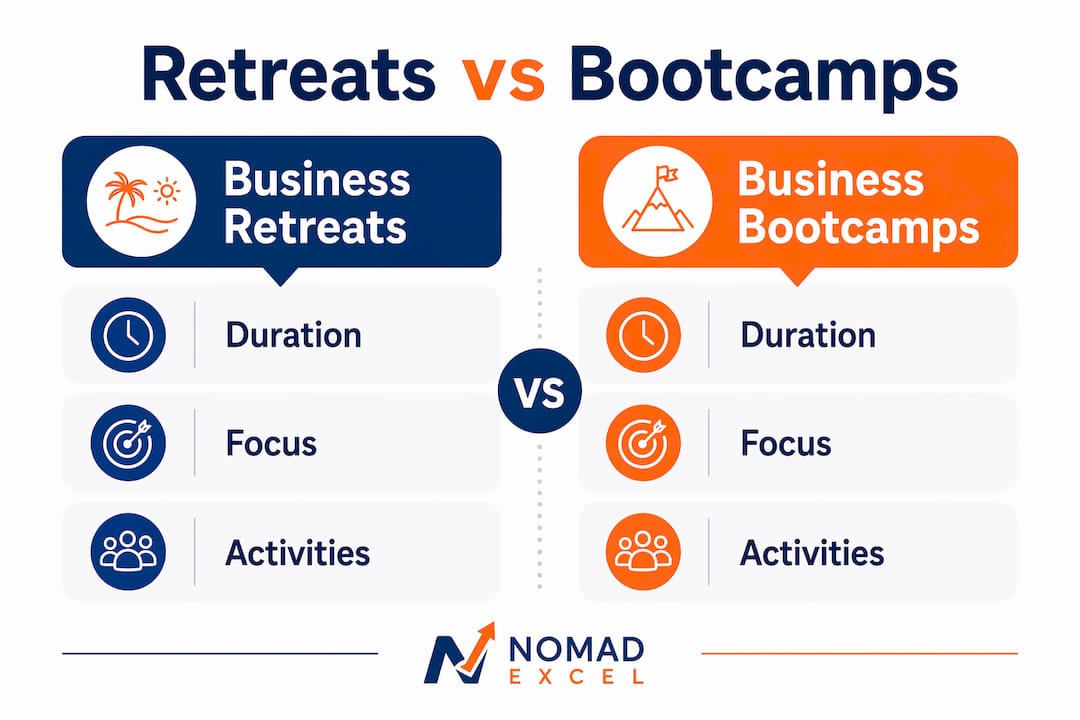
The clearest way to understand the retreat vs bootcamp distinction is to compare them across five dimensions: duration, intensity, audience, primary goal, and measurable output.
| Dimension | Business retreat | Business bootcamp |
|---|---|---|
| Duration | 2–7 days | 1–4 weeks |
| Intensity | Moderate, with recovery built in | High, sustained daily immersion |
| Primary audience | Existing teams and leadership groups | Individual founders, employees, or small cohorts |
| Core goal | Strategic alignment, trust, and culture | Skill acquisition, business launch, or scaling |
| Measurable output | Decisions, commitments, behavioral change | New skills, validated business models, revenue |
The strategic vs skill acquisition distinction is the most important one. Retreats work on the team. Bootcamps work on the individual. A company that sends its entire leadership team to a bootcamp will likely see individuals grow but the team dynamic remain unchanged. A company that sends one founder to a retreat designed for intact teams will find the format mismatched to their actual need.
Hybrid models that merge strategic alignment with skill development are gaining traction, and for good reason. Some organizations build leadership development components directly into their retreats, compounding the return on both time and investment. Nomadexcel designs custom programs that blend both formats for companies that need their teams to align and grow new capabilities simultaneously.
How to choose between a retreat and a bootcamp for your team
Choosing the right format starts with diagnosing the actual problem, not the symptom. Most leaders feel a vague sense that “the team needs something” without pinpointing whether that something is strategic clarity, skill gaps, or relationship repair.
Follow this decision framework:
- Define the specific business problem. Is your team misaligned on priorities? That is a retreat problem. Does your team lack the skills to execute on a growth strategy? That is a bootcamp problem.
- Assess your audience. Retreats serve existing teams. Bootcamps serve individuals or small cohorts who need to build capability fast.
- Evaluate time and budget. Retreats require 2–7 days of team-wide availability and significant logistical investment. Bootcamps require 1–4 weeks but typically involve fewer people.
- Consider culture and facilitation quality. A poorly facilitated retreat causes more damage than no retreat at all. The facilitator’s ability to surface real tension and guide productive conversation is the single biggest variable in retreat ROI.
- Plan for post-event measurement. Commit to evaluating outcomes at 60 and 90 days. Without this, neither format produces lasting change.
Neglecting recovery time in retreats triggers burnout and undermines the re-energizing goal that most leaders cite as a primary reason for running them. Build white space into the schedule deliberately. The same principle applies to bootcamps: sustained high intensity without recovery produces diminishing returns after the first week.
Pro Tip: If you are unsure whether your team needs a retreat or a bootcamp, run a 30-minute diagnostic session with your leadership group. Ask each person to write down the one thing that, if solved, would most accelerate the team’s performance. If the answers cluster around strategy and trust, plan a retreat. If they cluster around skills and execution, plan a bootcamp.
Inspiring retreat formats for remote teams often incorporate elements of both, using the first day for strategic alignment and subsequent days for skill-building workshops. That hybrid approach works particularly well for distributed teams that rarely share physical space and need both connection and capability development from a single investment.
Key takeaways
Business retreats and bootcamps serve distinct, non-interchangeable purposes: retreats align existing teams around strategy and culture, while bootcamps build individual skills and accelerate business execution.
| Point | Details |
|---|---|
| Retreats target team alignment | Use retreats when the core problem is strategic clarity, trust, or cultural cohesion within an existing team. |
| Bootcamps build individual capability | Choose bootcamps when the goal is rapid skill acquisition, business launch, or founder development. |
| HR and legal oversight is non-negotiable | 28% of retreats generate post-event complaints; involve HR and legal from the planning stage. |
| Measure outcomes at 60–90 days | Both formats require post-event evaluation to confirm behavioral change and business impact. |
| Hybrid models compound returns | Combining alignment work with skill development in one program produces stronger results than either format alone. |
My honest read on retreats and bootcamps after years in the field
Most organizations treat retreats as rewards and bootcamps as training line items. Both framings are wrong, and both lead to underwhelming results.
The retreats I have seen produce real, lasting change share one quality: the leadership team walked in willing to have uncomfortable conversations. The venue, the activities, and the catering are irrelevant if the people in the room are not prepared to surface real tension and make real commitments. I have watched beautifully designed retreats fail because the facilitator was too polite to push past surface-level agreement.
Bootcamps have the opposite problem. The best ones I have encountered are relentlessly execution-focused, but participants often leave without a clear plan for integrating new skills back into their existing work environment. The learning is real. The transfer is weak. That gap is where most of the ROI gets lost.
My recommendation: treat both formats as business investments with defined success criteria before you book anything. For retreats, write down the three decisions you need to make as a team. For bootcamps, identify the one skill gap that, if closed, would most directly impact revenue or growth. Then hold the program accountable to those criteria at 90 days.
The organizations that get the most from both formats are the ones that refuse to let either become a cultural ritual. A retreat that happens every year because “we always do a retreat” is a budget line, not a business tool. A bootcamp that employees attend because HR scheduled it is a compliance exercise, not a growth investment.
— Amichai
How Nomadexcel can accelerate your team’s growth
Nomadexcel runs both formats at a level of depth that most corporate programs do not reach. For entrepreneurs and early-stage founders, the online entrepreneurship bootcamp delivers 1–4 weeks of structured, mentor-led learning with a peer cohort that stays active long after the program ends. For companies and leadership teams, Nomadexcel designs custom company retreats built around your specific strategic challenges, from facilitated alignment sessions to immersive local experiences that build genuine trust. Every program is designed end-to-end, combining business impact with real human connection. If you are ready to move from vague goals to measurable growth, explore Nomadexcel’s full program offerings and find the format that fits your team’s actual needs.
FAQ
What is the main difference between a retreat and a bootcamp?
A retreat focuses on aligning an existing team around strategy, culture, and relationships over 2–7 days. A bootcamp is an intensive 1–4 week program designed to build specific skills or launch a business for individuals or small cohorts.
How long does a typical business retreat last?
Business retreats typically run 2–7 days, with the most effective programs balancing structured strategic sessions with unstructured recovery time to maintain energy and engagement.
Are business bootcamps only for startups?
No. While bootcamps are popular among founders and early-stage entrepreneurs, companies also use them to develop specific capabilities in employees, such as marketing, leadership, or financial management.
How do you measure the ROI of a business retreat?
The most reliable method is to document specific decisions, commitments, and behavioral changes at the end of the retreat, then evaluate progress at 60 and 90 days post-event. Organizations with high engagement report up to a 36% reduction in employee turnover following well-executed retreats.
Can a program combine both retreat and bootcamp elements?
Yes. Hybrid programs that merge strategic alignment with skill development are increasingly common and can produce compounded results, particularly for leadership teams that need both cohesion and new capabilities from a single investment.
Comments are closed.