
Entrepreneurship PPT guide 2026: boost startup success 60%
Effective entrepreneurship PPTs can make or break your startup journey. Presentations that blend storytelling with data achieve 60% higher funding success than those relying on one approach alone. For founders in bootcamps, your PPT is more than slides—it’s your roadmap for validation, mentorship engagement, and execution clarity. This guide gives you practical frameworks to structure presentations that unlock support, refine your business model, and accelerate growth through community feedback and actionable strategies.
Table of Contents
- Understanding The Role Of Entrepreneurship Ppts In Modern Bootcamps
- Core Components Of An Effective Entrepreneurship Ppt
- Common Misconceptions About Entrepreneurship Ppts
- Balancing Storytelling And Data: Frameworks For Persuasive Presentations
- From Ppt To Practical Execution: Applying What You Present
- Conclusion: Leveraging Entrepreneurship Ppts To Accelerate Startup Growth
- Explore Immersive Entrepreneurship Bootcamps To Level Up Your Startup Journey
Key takeaways
| Point | Details |
|---|---|
| PPTs organize ideas for validation | Structure transforms scattered concepts into testable business models that attract mentorship |
| Core components drive clarity | Problem, solution, market validation, business model, and execution plan form the foundation |
| Messaging beats flashy design | Clear articulation of your value proposition secures support more effectively than visual effects |
| Story plus data increases persuasion | Combining emotional narrative with validation evidence boosts funding likelihood significantly |
| PPTs guide practical execution | Translate presentation insights into measurable goals with mentorship and peer accountability |
Understanding the role of entrepreneurship PPTs in modern bootcamps
Entrepreneurship PPTs function as structured frameworks that systematically validate your startup ideas. Unlike traditional investor pitch decks focused primarily on securing capital, bootcamp presentations emphasize validation frameworks and collaborative learning. They help you test assumptions, gather feedback, and refine your business model before committing major resources.
These presentations serve multiple critical functions in bootcamp environments:
- They facilitate meaningful mentor engagement by clarifying your specific challenges and goals
- They enable peer collaboration through transparent sharing of business logic and assumptions
- They act as living documents that evolve as you gain insights and pivot strategies
- They accelerate validation by forcing you to articulate value propositions concisely
- They create accountability touchpoints for tracking progress throughout the program
When starting an entrepreneurship bootcamp journey, your PPT becomes the central tool for organizing thoughts and receiving targeted guidance. The process of building these presentations reveals gaps in your business model that might otherwise remain hidden until costly execution phases. This early detection saves time and resources while building confidence in your direction.
The collaborative nature of bootcamp environments amplifies PPT value. By joining entrepreneurship bootcamps with diverse founder cohorts, you gain perspectives that challenge assumptions and strengthen your positioning. Your presentation becomes a conversation starter rather than a one-way pitch, opening doors to unexpected partnerships and solutions.
Core components of an effective entrepreneurship PPT
Every successful entrepreneurship PPT contains five essential slide categories that tell your complete business story. These components work together to demonstrate viability while inviting constructive feedback.
The foundational slides include:
- Problem slide: Articulate the specific pain point your target customers experience daily
- Solution slide: Present your unique approach and why it solves the problem better than alternatives
- Market validation slide: Share evidence of customer interest, early traction, or demand signals
- Business model slide: Explain how you’ll generate revenue and achieve sustainable unit economics
- Execution plan slide: Outline your roadmap with milestones, timelines, and resource requirements
Structured frameworks like Lean Canvas and SWOT enhance clarity by providing proven templates for organizing business logic. These entrepreneurship frameworks prevent common oversights and ensure you address critical questions investors and mentors will ask.
| Framework | Primary Use | Key Benefit |
|---|---|---|
| Lean Canvas | Business model mapping | Identifies assumptions requiring validation |
| SWOT Analysis | Strategic positioning | Reveals competitive advantages and risks |
| Business Model Canvas | Revenue architecture | Clarifies value creation and capture mechanisms |
| Value Proposition Canvas | Customer alignment | Ensures product-market fit focus |
Include concrete market validation data to build credibility. Numbers from customer interviews, beta signups, or pilot programs demonstrate traction beyond hypothetical projections. Even small validation signals prove you’re testing assumptions rather than guessing.

Pro Tip: Limit each slide to one core message supported by 2 to 3 pieces of evidence. Dense slides confuse audiences and dilute your most important points. White space improves comprehension and keeps attention on your key claims.
Focus on evidence-based messaging rather than aspirational language. Replace vague statements like “huge market opportunity” with specific data showing addressable market size and growth rates. Quantify problems with statistics that make pain points tangible and urgent.
Common misconceptions about entrepreneurship PPTs
Many entrepreneurs mistakenly believe flashy design and polished animations win support. Research consistently shows that clear, concise messaging matters far more than visual effects when securing mentorship and investment. Mentors care about business substance, not your graphic design skills.
Another widespread myth treats bootcamp PPTs and investor pitch decks as interchangeable. Bootcamp presentations prioritize learning, validation, and collaboration over fundraising narratives. They invite questions and exploration rather than delivering rehearsed pitches designed to minimize objections. This fundamental difference shapes content depth and presentation style.
Some founders resist incorporating peer feedback, viewing it as diluting their vision. Actually, integrating community input improves presentation success rates by surfacing blind spots and unclear messaging. Your cohort provides the diverse perspectives needed to anticipate challenges and refine positioning before facing external stakeholders.
Common false assumptions to avoid:
- Believing longer presentations demonstrate thoroughness when brevity shows strategic thinking
- Assuming technical jargon establishes credibility when simple language proves comprehension
- Thinking perfection is required before sharing when iteration through feedback accelerates improvement
- Expecting one presentation version to serve all audiences when customization increases relevance
Active feedback integration transforms adequate presentations into compelling ones. Create structured opportunities to present works in progress and document suggested improvements. This iterative approach builds presentations that resonate because they’ve been stress-tested against real questions and concerns.
Pro Tip: Schedule informal presentation run-throughs with 2 to 3 peers before formal bootcamp sessions. Their fresh perspectives catch confusing transitions and weak arguments you’ve become blind to through over-familiarity.
The entrepreneurship bootcamp benefits extend far beyond initial presentations. Community feedback creates ongoing refinement cycles that compound over time, continuously improving your ability to articulate value and demonstrate traction.
Balancing storytelling and data: frameworks for persuasive presentations
Storytelling engages emotions and creates memorable narratives that resonate with human experiences. You paint pictures of customer struggles and transformative solutions that audiences can visualize and connect with personally. Stories make abstract business concepts concrete through relatable examples and scenarios.
Data-driven validation appeals to analytical thinking and reduces skepticism through objective evidence. Numbers provide the credibility needed to back up narrative claims and demonstrate you’ve moved beyond assumptions into testing. Metrics show momentum and market response in quantifiable terms.
The most effective entrepreneurship PPTs strategically combine both approaches. Presentations blending story and data achieve 60% higher funding success because they engage multiple cognitive pathways simultaneously. Emotional connection opens minds while evidence closes doubts.
| Approach | Strengths | Limitations | Best Use Cases |
|---|---|---|---|
| Storytelling | Emotional engagement, memorable, relatable | Can lack credibility, hard to measure | Problem illustration, vision casting |
| Data-driven | Objective, credible, quantifiable | Can feel cold, overwhelming | Market validation, traction proof |
| Combined | Engages emotions and logic, maximizes persuasion | Requires balance skill | Complete business presentations |
Real examples demonstrate this synergy. Start with a customer story illustrating the painful problem they face daily. Follow immediately with statistics showing how many people experience this same frustration and the economic impact. This one-two punch makes the problem both relatable and significant.
Your solution narrative should follow the same pattern. Describe how your approach transforms the customer’s situation, then support that transformation with pilot results, engagement metrics, or early revenue data. The story provides context while numbers prove viability.
“The best startup presentations make you feel the problem through story, then prove it exists at scale through data. This combination bypasses skepticism by engaging both heart and mind simultaneously.”
Structure your entrepreneurship program presentations to alternate between narrative and evidence. Open sections with scenarios or examples, then validate with supporting metrics. This rhythm maintains engagement while building cumulative credibility that individual slides cannot achieve alone.
Balance requires knowing your audience. Technical founders often over-index on data while creative entrepreneurs lean too heavily on story. Calibrate your mix based on who you’re presenting to, but always include both elements to maximize persuasive impact.
From PPT to practical execution: applying what you present
Your entrepreneurship PPT should translate directly into actionable execution goals with clear success metrics. Each major slide represents workstreams that need ownership, timelines, and measurable outcomes. This connection ensures presentations drive progress rather than gathering digital dust.
Follow these steps to convert presentations into momentum:
- Break each PPT component into specific tasks with defined completion criteria and deadlines
- Assign ownership for every action item to create accountability and prevent diffusion of responsibility
- Establish weekly check-ins with mentors or peers to review progress and adjust strategies
- Document learnings and pivots in updated presentation versions to maintain alignment
- Celebrate small wins publicly within your bootcamp community to build confidence and motivation
Mentorship and peer accountability transform presentations from static documents into dynamic execution roadmaps. Startup team building strategies emphasize regular touchpoints where you present progress against PPT commitments. These sessions surface obstacles early and generate solutions through collaborative problem-solving.
Structured work sprints maintain focus and prevent drift. Commit to 2-week cycles where you execute against specific PPT-derived goals, then present results and learnings. This cadence creates urgency while allowing enough time to generate meaningful traction on initiatives.
Pro Tip: Create a simple tracking dashboard linking each PPT slide to current status, next actions, and blockers. This visual connection between presentation and execution keeps your strategic narrative aligned with daily work priorities.
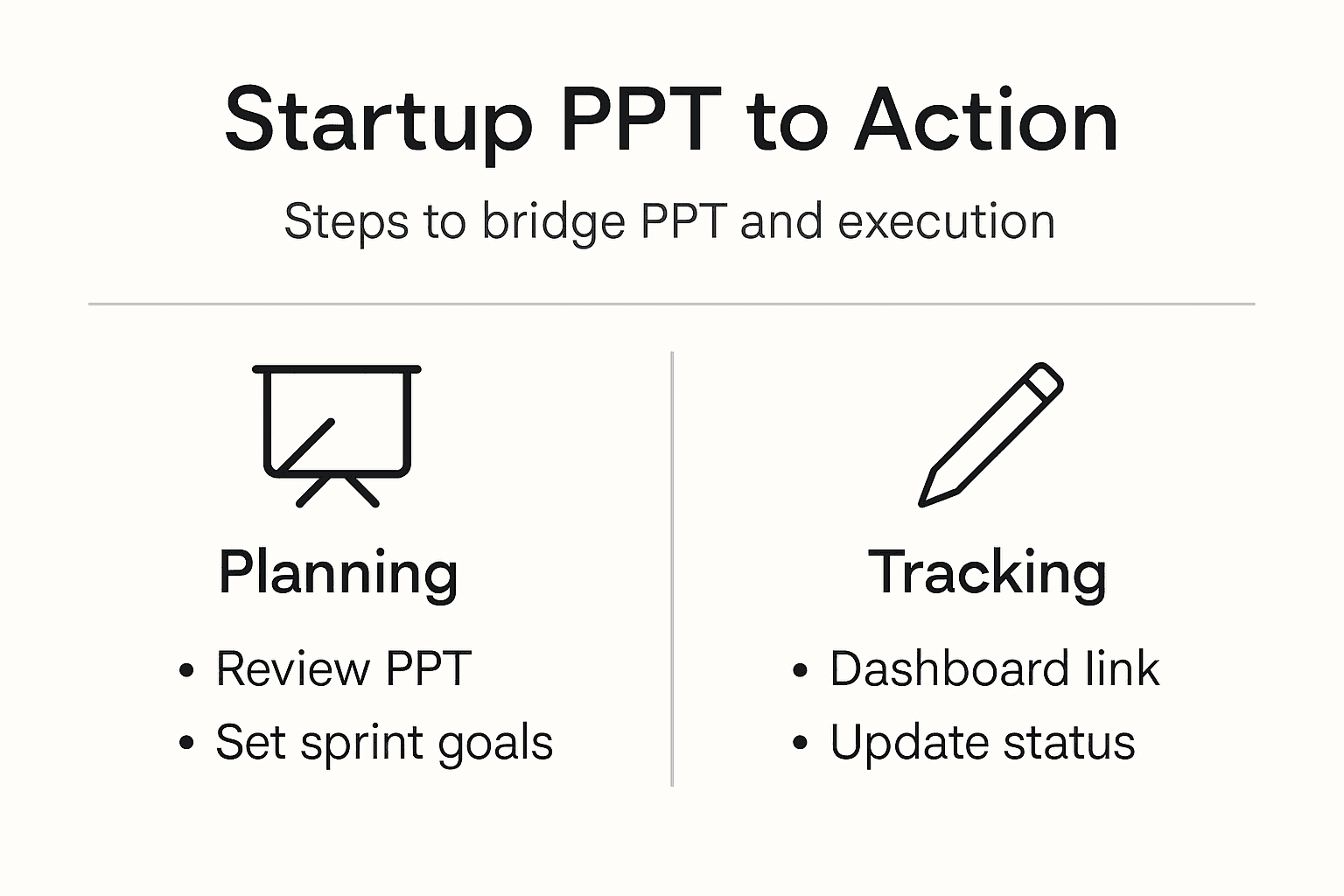
Regular progress tracking enables adaptive strategy. Using PPTs to set execution goals and tracking progress boosts startup growth by creating feedback loops between planning and reality. When execution reveals flawed assumptions, update your presentation and adjust course before investing more resources in wrong directions.
The execution phase proves whether your PPT logic holds under real-world conditions. Treat gaps between projected and actual outcomes as learning opportunities rather than failures. Document these insights to strengthen future strategic thinking and avoid repeating mistakes.
Conclusion: leveraging entrepreneurship PPTs to accelerate startup growth
Mastering entrepreneurship PPT creation gives you a powerful tool for clarifying vision, securing mentorship, and driving execution momentum. The frameworks and strategies in this guide help you structure presentations that generate actionable feedback and community support rather than polite nods.
Combining storytelling with data validation creates presentations that persuade through emotional connection and objective evidence. This balanced approach significantly increases your likelihood of gaining the resources and guidance needed to scale. Remember that your PPT is a living document that evolves as you learn and pivot.
Community and mentor feedback continuously refine your presentations and business model. The iterative process of presenting, gathering input, and incorporating insights accelerates validation cycles and uncovers opportunities you’d miss working in isolation. Effective PPTs catalyze faster growth by aligning your team, advisors, and supporters around a shared strategic vision.
Your PPT is the foundation for everything that follows. Invest time in getting it right, but don’t wait for perfection before sharing. The real value comes from using your presentation to spark conversations that unlock your startup’s full potential.
Explore immersive entrepreneurship bootcamps to level up your startup journey
Ready to transform your PPT insights into real business momentum? Nomad Excel’s online entrepreneurship bootcamp programs provide the mentorship, community, and structured accountability needed to validate and scale your startup. Our immersive experiences combine proven frameworks with hands-on execution sprints that turn presentations into traction.
Joining entrepreneurship bootcamps connects you with experienced mentors who provide targeted feedback on your business model and presentation. You’ll refine your PPT alongside a curated cohort of driven founders who challenge assumptions and celebrate wins. Our entrepreneurship bootcamp program delivers the tools and support system that accelerate your journey from idea to validated business.
FAQ
How long should my entrepreneurship PPT be for bootcamps?
Aim for 10 to 15 slides to cover essential components without overwhelming your audience. Each slide should focus on one core message supported by concise evidence. Longer presentations dilute impact and lose attention during collaborative feedback sessions.
What’s the difference between a bootcamp PPT and an investor pitch deck?
Bootcamp presentations emphasize validation, learning, and collaborative exploration of your business model. Investor pitch decks focus on compelling fundraising narratives with polished delivery designed to secure capital commitments. Bootcamp PPTs invite questions and iteration while pitch decks minimize objections to close deals.
How can I incorporate community feedback effectively into my PPT?
Solicit input early and often during bootcamp sessions before your presentation feels finished. Use version control or tracked changes to document all suggestions and your decisions about incorporating them. Prioritize feedback that clarifies your problem, solution, and validation slides since these form your strategic foundation.
Can a well-crafted PPT really speed up business validation?
Yes, clear and focused presentations help you communicate assumptions and gather actionable feedback much faster than informal conversations. Structured PPTs reduce validation time by 30% by forcing you to articulate testable hypotheses and creating frameworks for measuring results. The discipline of building presentations reveals gaps that would otherwise delay progress.
Should I customize my PPT for different bootcamp audiences?
Absolutely. Tailor emphasis based on whether you’re presenting to technical mentors, marketing experts, or fellow founders. Maintain your core business logic while adjusting detail level and examples to match audience expertise and interests. Customization shows respect for your audience’s time and increases relevance of feedback you receive.
Recommended
- 7 Top Entrepreneurship Tips 2025 for Startup Success
- 42% Startup Failures Cut by Mastering Entrepreneurship
- Entrepreneurship Frameworks 2025: Strategies for Rapid Growth
- Entrepreneurship Skills Guide for Launching Your Own Venture – Nomad Excel – Your Entrepreneurial Adventure Starts Here
- Mastering Digital Marketing for Startups in 2025 – Kadima
Comments are closed.